


Historical names: Alisandreston; Mara Mota
Location: Brecknockshire
Places / associated places: Brecknockshire
Location & Extent
GPS Location & Recorded Land Areas
Representative GPS point: 51.9613, -3.3501
Identity: confirmed — The registry manor is securely identified with the historical Alexanderstone and Mara Mota manorial complex in Brecknockshire. Mara Mota is recorded as an alternative historical name for Alexanderstone, and National Library of Wales material separately identifies the manors of Mara and Mota and Alexanderstone in the relevant Breconshire parishes. The 1687 Tredegar settlement also treats Alexanderstone and Mara Mota as manors associated with Brecon and the surrounding Brecknockshire properties.
Representative point: 51.9613, -3.3501
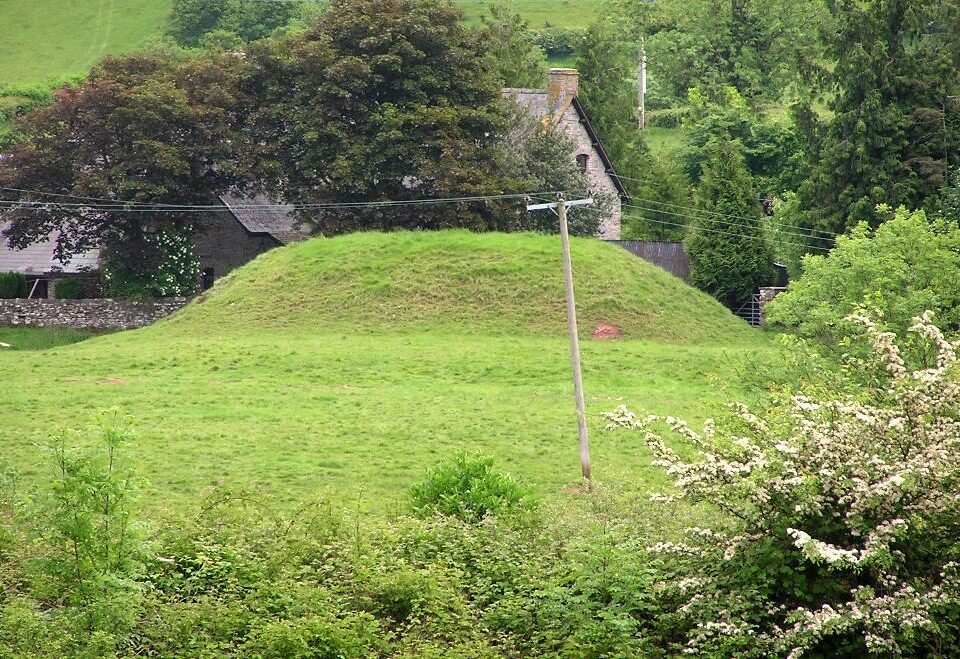
Basis: documented_manor_house — The listed building Alexanderstone is a substantial sixteenth- to seventeenth-century house, probably occupying the site of an earlier manor house, immediately adjacent to the Alexanderstone medieval motte and bailey. The house is located at OS grid reference SO073300.
Point confidence: high
Boundary status: representative_point_only
Boundary period: 1798 boundary description, with manorial extent also evidenced in seventeenth-century records
Boundary confidence: none
Boundary basis: The archive catalogue confirms a 1798 sworn description of the manor boundaries and earlier surveys, rentals and court records survive, but the actual boundary description, maps or parcel schedules are not available in a sufficiently geographic form through the consulted sources. Historical evidence indicates that the combined manorial interests extended beyond a single parish: Alexanderstone is associated with Llanddew, Llandyfaelog, Tre'r-craig and Llanfilo, while Mara and Mota are associated with Llangors and Llanfihangel Tal-y-llyn. These parish associations cannot safely be converted into a manor polygon because the manor consisted of selected lands or parcels rather than automatically encompassing the full modern or historical parishes.
Sources:
- Alexanderstone, Llanddew, Powys — Cadw listed-building record summary: https://britishlistedbuildings.co.uk/300083492-alexanderstone-llanddew — Provides the documented manor-house location, coordinates 51.9613, -3.3501, OS grid SO073300, and identifies the building as a substantial sixteenth- to seventeenth-century house connected with the adjacent medieval motte.
- Alexanderstone Motte, Llanddew — Gatehouse Gazetteer: https://gatehouse-gazetteer.info/Welshsites/16.html — Records Mara Mota as a historical name for Alexanderstone and places the site in Llanddew, Brecknockshire; gives the adjacent motte coordinates and confirms the medieval manorial/fortified centre context.
- National Library of Wales Archives — Tredegar Estate Records, AES 1/1: https://archifau.llyfrgell.cymru/index.php/informationobject/browse?collection=444654&levels=226&repos=436&sort=lastUpdated&sortDir=asc&topLod=0 — Describes a 1693 survey of Alexanderstone and Mara Mota among the Breconshire manorial surveys.
- National Library of Wales Archives — Tredegar Estate Records, Box 145 series: https://archifau.llyfrgell.cymru/index.php/informationobject/browse?collection=444654&levels=224&page=6&sf_culture=en&sort=startDate&sortDir=asc&topLod=0 — Identifies the archival series containing the Alexanderstone and Mara Mota manorial records, including surveys, court records, rentals and boundary material.
- National Library of Wales Archives — Duchy of Cornwall Welsh Records, RQ1: https://archifau.llyfrgell.cymru/index.php/informationobject/browse?collection=2768917&topLod=0 — A 1671-1672 account explicitly associates Mara and Mota with the parishes of Llangors and Llanfihangel Tal-y-llyn, and Alexanderstone with Llanddew, Llandyfaelog, Tre'r-craig and Llanfilo.
- National Library of Wales annual report / Tredegar estate catalogue summary: https://www.library.wales/fileadmin/docs_gwefan/adroddiadau_blynyddol/Ab1959.pdf — Confirms the existence of Alexanderstone and Mara Mota court papers, a 1798 description of boundaries taken on oath, an Act concerning commons within the manor, and a court book covering 1703-1833.
- Clwyd-Powys Archaeological Trust, Historic Landscapes: Middle Usk Valley: https://heneb.org.uk/archive/cpat/projects/longer/histland/usk/1173.htm — Places Alexanderstone within the historical landscape around Llanddew and identifies the farmhouse as probably occupying an earlier manor-house site associated with the medieval manorial centre.
Warnings / uncertainty:
- The historical manor was a composite territorial jurisdiction containing lands or parcels in several parishes; the listed parish associations must not be treated as the complete manor boundary.
- No reliable digitised map or parcel-level transcription of the 1798 sworn boundary description was found, so no historical polygon is returned.
- The representative point marks the documented Alexanderstone manor-house site, not the full territorial extent of Alexanderstone and Mara Mota Manor.
About the Manor
Alexanderstone and Mara Mota was a secular manor or group of associated manorial estates in the historic county of Brecknockshire, centred on Alexanderstone in the parish and community of Llanddew, approximately north-east of Brecon. Alexanderstone is associated with a medieval motte-and-bailey castle and a later gentry farmhouse, suggesting that the settlement developed around a post-Conquest manorial or estate centre. The name Alexanderstone is recorded in the later fourteenth century as Alisandreston. Mara Mota is recorded as an alternative name in archaeological and archival sources, and the two names occur together in seventeenth-century legal records as the manors of Alexanderstone and Mara Mota. The manorial jurisdiction is directly evidenced by court leet papers for 1703-1775, a sworn boundary description of 1798, an 1813 enclosure Act relating to commons within the manor, and a court leet book covering 1703-1833. The 1579 letters patent describe Alexanderstone as part of the lands and possessions formerly belonging to Edward, late Duke of Buckingham, while Mara Mota was being held by William Awbrey under an earlier Crown lease. The surviving public evidence does not yet establish a continuous descent of the freehold or lordship from the medieval period to the nineteenth century, and the leasehold, legal-settlement, and later testamentary evidence should not be treated as an uninterrupted ownership chain.
Ownership / Holder Account
The earliest securely identified ownership context is the Crown's administration of lands formerly belonging to Edward, late Duke of Buckingham. A 1579 letters patent records Alexanderstone as part of the former Buckingham possessions and records Mara Mota as leased to William Awbrey under letters patent of 16 November 1575 for twenty-one years beginning on 25 March 1576. This is direct evidence of Crown-controlled estate administration and of William Awbrey's leasehold interest, but it does not establish that he owned the manorial lordship. The descent is next securely visible in a 1687 settlement and associated 1697 final concord concerning the castle and site of Brecon and the manors of Brecon, Alexanderstone, and Mara Mota. Thomas Morgan of Tredegar is named as the deforciant in the final concord, while John Morgan and Charles Williams are named as plaintiffs. The documents establish a legal settlement involving these parties but do not make the precise beneficial effect of the fine fully clear from the catalogue abstracts. A 1706 letter addressed to John Morgan records W. Bellamy's claim that the manor of Alexanderstone was the property of the City of London; this is evidence of a disputed assertion of title, not proof of a completed conveyance. The Tredegar estate archive preserves manorial court and legal material for Alexanderstone and Mara Mota through the eighteenth and nineteenth centuries, but the public catalogue does not by itself identify every intervening lord. A 1841 abstract of the will of William Gwynne Vaughan lists the manor of Mara Mota among his property. The abstract identifies the will's date and beneficiaries but does not specify which beneficiary received Mara Mota, so no later devisee is entered. The descent therefore remains partial, with substantial documentary gaps between the 1570s, the 1687-1697 legal settlement, the 1706 disputed claim, and the 1841 testamentary evidence.
Manorial Rights & Privileges
Historic manorial rights / privileges (1)
Court leet jurisdiction
Provisional
Court leet papers and a court leet book provide direct evidence of manorial court-leet jurisdiction at Alexanderstone and Mara Mota from 1703 into the nineteenth century.
Records & References
Sources and references mentioning this manor/title which are not necessarily conveyances or transfers.
30 records found · showing 9–16.
1787: appointment of clerk/recorder, with other manors
Held by: National Library of Wales: Department of Collection Services
Further information: NRA 28351 Morgan
1765-1775: court papers incl presentments, lists of resiants, warrants and jury lists, etc
Held by: National Library of Wales: Department of Collection Services
Further information: NRA 28351 Morgan
1764: account, rent rolls, Tredegar estate, co. Brecknock on (made 1777) 1731-6, 1764
Held by: National Library of Wales: Department of Collection Services
Further information: NRA 28351 Morgan
1755: court papers incl presentments, list of resiants, warrant, etc
Held by: National Library of Wales: Department of Collection Services
Further information: NRA 28351 Morgan
1750- 1750: rental, Tredegar estate, co. Brecknock
Held by: National Library of Wales: Department of Collection Services
Further information: NRA 28351 Morgan
1744-1745: account book, rents and profits received, incl chief rents, with other manors
Held by: National Library of Wales: Department of Collection Services
Further information: NRA 28351 Morgan
1738-1782: accounts, chief rent etc, with other manors
Held by: National Library of Wales: Department of Collection Services
Further information: NRA 28351 Morgan
1738-1739: accounts, rents received and arrears, with other manors
Held by: National Library of Wales: Department of Collection Services
Further information: NRA 28351 Morgan
Conveyance & Descent
First holder to present holder: blood proximity & distance travelled
First recorded holder: William Awbrey, Doctor of Civil Law
Present holder:
Recorded title journey: 4 holder entries in this manor's saved Conveyance & Descent history.
No recorded holder currently has a usable saved direct-blood or collateral-blood relationship path from which to calculate proximity percentages.
First recorded holder → present holder
A usable saved blood relationship path between the first recorded holder and the present holder has not yet been recorded, so that first-to-present genealogical distance cannot be calculated.
William Awbrey, Doctor of Civil Law
Transfer: Lease under letters patent dated 16 November 1575, for twenty-one years beginning on 25 March 1576.
Holding arrangement: Other
Previous holder: The Crown, in the context of the Crown's administration of former Buckingham possessions
The 1579 letters patent states that the manor of Mara Mota had been let to William Awbrey by letters patent of 16 November 1575 for twenty-one years starting on the following 25 March. The same patent describes Alexanderstone as part of the lands and possessions of Edward, late Duke of Buckingham. This entry records William Awbrey's documented leasehold interest and does not treat him as proven lord of the manor. The catalogue description does not establish whether the Alexanderstone and Mara Mota leases were held together by the same instrument or whether the two manors had separate legal tenures at this date.
Source: National Library of Wales, Tredegar Estate Records, file 137/54, Letters Patent granting to William Awbrey, Doctor of the Civil Law, a lease for 21 years, 11 December 1579; the description recites the earlier letters patent of 16 November 1575 for Mara Mota. — source link
John Morgan and Charles Williams, Esquire
Transfer: Legal settlement by covenant to levy a fine, followed by an exemplification of a final concord in a fine levied in the Court of Great Sessions for Brecknockshire on 19 September 1687 and recorded by exemplification on 10 April 1697.
Holding arrangement: Joint
Shared holding: Joint plaintiffs in the fine; the precise beneficial uses are not stated in the catalogue abstract.
Previous holder: Thomas Morgan of Tredegar, Esquire
A settlement dated 12 September 1687 names Thomas Morgan of Tredegar as one party and describes a covenant to levy a fine of the castle and site of Brecon and the manors of Brecon, Alexanderstone, and Mara Mota, among other properties. A related final-concord record states that John Morgan and Charles Williams were plaintiffs and Thomas Morgan was deforciant. These records directly connect all three men with the manors, and support a legal transfer or settlement from Thomas Morgan's asserted possession into a settlement involving John Morgan and Charles Williams. Because the abstract does not state the precise uses declared under the settlement, the entry should not be read as proof that John Morgan and Charles Williams held equal absolute shares or that the manors were beneficially divided between them.
Source: National Library of Wales, Tredegar Estate Records, file 101/20, Further Settlement made after the marriage of Thomas Morgan and Martha, 12 September 1687; and file 101/22, Exemplification of a final concord in a fine levied in the Court of Great Sessions for Brecknockshire on 19 September 1687, dated 10 April 1697. — source link
Thomas Morgan of Tredegar, Esquire
Transfer: Documented as deforciant in the related fine and as the owner or possessor whose properties were placed under settlement; the exact legal effect of the settlement is not fully stated in the catalogue abstract.
The 12 September 1687 settlement identifies Thomas Morgan of Tredegar as the principal property holder whose castle, manors, lands, and appurtenances were to be subjected to a fine. The related final concord identifies him as deforciant. This is direct evidence that Thomas Morgan held or claimed the relevant manorial estate at the time, although the document's settlement structure means that the entry should be understood as a legal holding or estate position rather than an uncomplicated statement of unencumbered ownership.
Source: National Library of Wales, Tredegar Estate Records, file 101/20, Further Settlement made after the marriage of Thomas Morgan and Martha, 12 September 1687; and file 101/22, Exemplification of a final concord in a fine levied in the Court of Great Sessions for Brecknockshire on 19 September 1687, dated 10 April 1697. — source link
William Gwynne Vaughan of Penymaes, Llanvillo, Esquire, parish of Llanvillo
Transfer: Testamentary disposition: the abstract of his will lists the manor of Mara Mota among his property. The specific beneficiary or devisee of Mara Mota is not identified in the catalogue abstract.
The abstract of William Gwynne Vaughan's will lists the manor of Mara Mota among his property. This directly supports his historical ownership or estate interest in Mara Mota by the date of the will. The abstract names several beneficiaries but does not state which one received the manor, so no devisee is entered and no later conveyance is inferred. This evidence relates explicitly to Mara Mota; the consulted abstract does not state that Alexanderstone was included in the same devise.
Source: Powys County Archives, B/D/JGW/49/7, copy will of William Gwynne Vaughan of Penymaes, parish of Llanvillo, dated 13 March 1841, abstracted in the deposited J G Williams records catalogue. — source link
Corrections / Challenges
Sign in to challenge or submit evidence against a recorded assertion.
JSON API
Machine-readable published manor data, including public images, mapped land areas, notes, rights, conveyances, relationships, records, source/document-library entries and public file links.
https://manorialregistry.com/index.php?rest_route=/mhr/v1/manor/alexanderstone-and-mara-mota-manorPublic API access is currently disabled. Authorised API clients must use a private X-MHR-API-Key; currently only administrator keys are enabled.
Private source files, pending edits, moderation/admin information, user API keys and non-public import identifiers are not returned.