


England
Cecil of Salisbury — Robert Cecil’s differentiated Garter achievement
- Family / house
- Cecil
- Family / cadet branch
- Salisbury or Hatfield branch, founded by Robert Cecil, younger son of William Cecil, 1st Baron Burghley
- Armiger / bearer
- Robert Cecil, 1st Earl of Salisbury
- Entity type
- individual
- Social rank / class
- peer
- Heraldic authority
- Order of the Garter; English heraldic record tradition
- Record basis
- recording
- Issued / first recorded
- 1608
- Until / superseded
- 1612
- Historical period
- Late Elizabethan and early Jacobean period
- Grant / record reference
- Garter stall plate S21/11, recorded for Robert Cecil, elected Knight of the Garter in 1608; he had previously been created Baron Cecil of Essendon in 1603, Viscount Cranborne in 1604 and Earl of Salisbury in 1605.
- Blazon
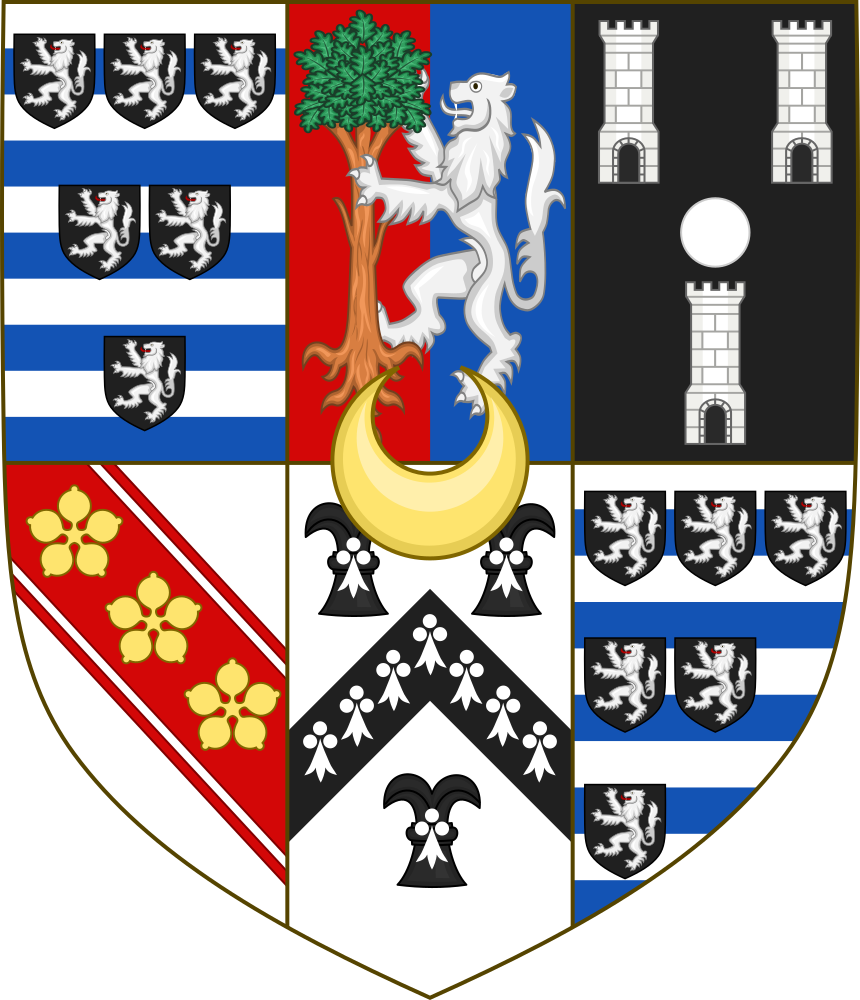
- Quarterly of six: 1st and 6th, Barry of ten Argent and Azure, over all six escutcheons Sable, three, two and one, each charged with a lion rampant Argent; 2nd, per pale Gules and Azure, a lion rampant Argent supporting a tree eradicated proper; 3rd, Sable, a plate between three towers triple-towered, ports open, Argent; 4th, Argent, on a bend cotised Gules three cinquefoils Or; 5th, Argent, a chevron between three chess-rooks Ermine; over all a crescent Or for difference. Crest: Six arrows in saltire Or, barbed and flighted Argent, tied together with a ribbon Gules, and surmounted by a morion cap proper. Motto: COR UNUM VIA UNA.
- Plain-English description
- The shield is principally the Cecil coat: ten horizontal white-and-blue stripes carrying six black escutcheons, each with a silver lion. Four additional quarters commemorate inherited maternal or ancestral arms associated with Winston, Caerleon, Heckington and Walcot. A gold crescent placed over the centre marks Robert as the younger son of William Cecil, Lord Burghley. His crest consists of six crossed arrows bound by a red strap beneath a morion helmet.
- Tinctures
- Argent; Azure; Sable; Gules; Or; Ermine; Proper
- Charges / ordinaries
- six escutcheons; lions rampant; lion supporting a tree; plate; three triple-towered towers; bend cotised; three cinquefoils; chevron; three chess-rooks; crescent; six arrows; morion cap
- Crest
- Six arrows in saltire Or, barbed and flighted Argent, tied together with a ribbon Gules, surmounted by a morion cap proper.
- Motto
- COR UNUM VIA UNA
- Exterior ornaments
- In the Garter achievement the shield is encircled by the Garter and associated with the insignia of a Knight of the Garter. Contemporary and near-contemporary representations also use the appropriate coronet of an earl, although the surviving stall plate is primarily an armorial record rather than a complete peerage achievement.
- Difference / variant
- This is the younger-son Salisbury form of the Burghley Cecil arms. The principal difference is the crescent Or over all. The inherited quarterings are retained, but the design is distinct from the undifferenced arms used by William Cecil, 1st Baron Burghley, and from the later simplified Cecil-Gascoyne arms of the Marquesses of Salisbury.
- Source reference
- Wikimedia Commons, Robert Cecil’s arms, based on Garter stall plate S21/11
- Linked historical person
- Robert Cecil, 1st Earl of Salisbury
- Source
- Open source
Genealogical context
- Father
- William Cecil, 1st Baron Burghley
- Mother
- Mildred Cooke, daughter of Sir Anthony Cooke of Gidea Hall and Anne Fitzwilliam
- Spouse(s)
- Elizabeth Brooke, daughter of William Brooke, 10th Baron Cobham, and Frances Newton
- Children / next generation
- William Cecil, 2nd Earl of Salisbury; Lady Frances Cecil, later Countess of Cumberland; Catherine Cecil, died in infancy
Documented depiction
Notes / sources
The exact nomenclature of the four ancestral quarters varies between sources: Winston/Wynstone/Winstone; Caerleon/Caerlion/Carlyon; Heckington/Dauney; and Walcot/Walcott. The Garter-based and stained-glass descriptions favour Winstone, Caerleon, Heckington and Walcot. The second quarter is described variously as supporting a tree eradicated proper or Vert; the stall-plate tradition represented in the Commons image uses proper. The crescent is gold in the 1608 Garter representation, whereas later Cecil-Gascoyne Salisbury arms use a red crescent for difference in a different heraldic context.