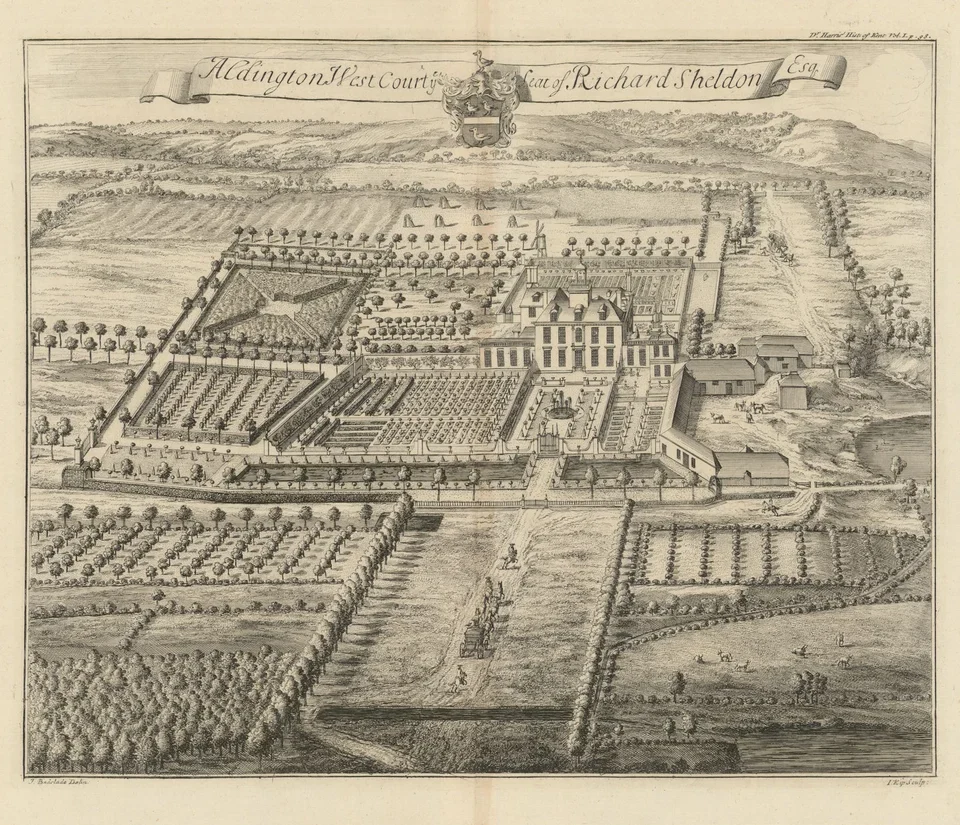



Historical names: Aldington Birton (Manor) | Aldington Gower (Manor) | Aldington Westcourt (Manor) | Byrtones Aldington (Manor)
Location: Thurnham, Kent
Places / associated places: Thurnham, Kent
Location & Extent
GPS Location & Recorded Land Areas
Representative GPS point: 51.2874, 0.5961
Identity: confirmed — The historical names Aldington Septvans, Aldington Westcourt, Aldington Gower and Byrtones Aldington all correspond to the Septvans/Gower moiety of Aldington in Thurnham, near Maidstone. Hasted's account identifies Westcourt alias Septvans as a moiety of the manor of Aldington, while the Kent Archaeological Society's study explicitly places Aldington-Septvans at Thurnham. The supplied registry location and archival court-roll references are consistent with this identification.
Representative point: 51.2874, 0.5961
Basis: documented_manor_site — The Kent Historic Environment Record identifies a medieval manor-house homestead-moat site at TQ 8110 5742, now associated with Aldington Place on Pilgrims Way, Thurnham. The site is the best surviving geographic match for Aldington Septvans/Westcourt, whose later residence is described by Hasted as Aldington Westcourt.
Point confidence: medium
Boundary status: representative_point_only
Boundary period: Medieval to early modern; exact surveyed period boundary not established
Boundary confidence: none
Boundary basis: The sources establish the manor's location and identify it as a moiety of Aldington, but no reliable manor-specific map, rental plan, survey or explicit perimeter has been located. The modern civil-parish boundary of Thurnham and the full extent of Aldington parish cannot be substituted for the historical manorial boundary.
Sources:
- The Family of Septvans, Kent Archaeological Society: https://www.kentarchaeology.org.uk/journal/40/family-septvans — Places Aldington-Septvans at Thurnham near Maidstone and distinguishes it from other Septvans manors.
- Hasted, History and Topographical Survey of Kent: Thurnham account: https://www.flickr.com/photos/jelltecks/25742315297/ — Describes Aldington Septvans alias Westcourt as the other moiety of Aldington, records the Gower and Brockhull succession, and states that later owners resided at Aldington Westcourt.
- Kent Historic Environment Record: TQ 85 NW 3, homestead moat site of medieval manor house: https://docs.planning.org.uk/20260217/28/TA911CTYJM200/51anqqh5dlswqjnt.pdf — Lists a medieval manor-house site at TQ 8110 5742 and identifies the associated place as Aldington Place, Thurnham.
- Kelly's Directory entry for Thurnham: https://leicester.contentdm.oclc.org/digital/api/collection/p16445coll4/id/327086/download — Identifies Aldington Place in Thurnham as an old building used as a farmhouse, supporting the surviving manorial-site association.
- The National Archives Discovery record F287543: https://discovery.nationalarchives.gov.uk/details/c/F287543 — Registry record supplied for the exact manor identification and archival association.
Warnings / uncertainty:
- Aldington Septvans/Westcourt was historically a moiety of Aldington, not necessarily the whole of the later civil parish or all land called Aldington.
- The representative coordinate is derived from the documented medieval manor-house site at Aldington Place and should not be treated as a surveyed modern property centroid.
- No historically defensible manor perimeter was found; a polygon would risk incorrectly substituting the parish boundary or another Aldington estate.
About the Manor
Aldington Septvans, also called Aldington Westcourt, West Court, Aldington Gower and Byrtones Aldington, was the Septvans moiety of the manor of Aldington in Thurnham, near Maidstone, Kent. The estate was distinguished from the other moiety, Aldington Eastcourt. It was historically held by the Septvans family, later acquired by John Gower, and subsequently passed to the Brockhull or Brockhill family. By the early eighteenth century the house and estate were associated with Richard Sheldon. The name Westcourt or West Court reflects the estate's position in relation to the other part of Aldington.
Ownership / Holder Account
The earliest securely documented descent begins with William Fitz Helte, whose estate was inherited through his co-heir Emma by Robert de Septvans. The senior Robert de Septvans was dead by about 1180, and his son Robert was in royal wardship in 1185. Robert de Septvans was recorded as holding manorial rights in Aldington in 1248-1249 and died possessed of Aldington Septvans in 1253. The estate subsequently descended in the Septvans family. William Septvans held the moiety, then called Westcourt or Septvans, in the twenty-fifth year of Edward III, approximately 1351-1352. His son William Septvans, while still a minor, was recorded in 1366 as holding the moiety. A conveyance to John Gower made about Christmas 1365 was treated as invalid while William was under age; after William attained full age, a royal licence enabled the estate to be re-granted to Gower in 1368. In 1373 Gower transferred the manor to trustees, including John de Cobham, to hold for Gower's benefit. It was later alienated to Sir John Brockhull, after which it remained with the Brockhull or Brockhill descendants. Nicholas Brockhill was lord of Aldington Westcourt in the second year of Edward IV, approximately 1462-1463. Henry Brockhill was lord of Aldington Westcourt by the late sixteenth century and in 1590 purchased the separate Aldington Eastcourt moiety, thereby bringing both moieties of Aldington into his possession. By 1719 Aldington West Court was associated with Richard Sheldon, whose family continued to hold the estate into the eighteenth century. The public sources consulted do not establish every intermediate conveyance between the medieval and early modern holders, so those gaps are retained rather than reconstructed by inference.
Manorial Rights & Privileges
Historic manorial rights / privileges (1)
Manorial rights in Aldington
Provisional
Robert de Septvans was recorded as holding manorial rights in Aldington in 1248-1249; this supports the existence of manorial rights associated with the estate but does not specify every component of those rights.
Records & References
Sources and references mentioning this manor/title which are not necessarily conveyances or transfers.
4 records found · showing 1–4.
1650-1700: particular
Held by: Kent History and Library Centre
Further information: NRA 5669
1407-1413: court roll
Held by: Kent History and Library Centre
Further information: NRA 5208
1399-1399: list of suitors (in court roll)
Held by: Kent History and Library Centre
Further information: NRA 5208
1399-1400: court roll
Held by: Kent History and Library Centre
Further information: NRA 5208
Conveyance & Descent
First holder to present holder: blood proximity & distance travelled
First recorded holder: Robert de Septvans
Present holder:
Recorded title journey: 11 holder entries in this manor's saved Conveyance & Descent history.
No recorded holder currently has a usable saved direct-blood or collateral-blood relationship path from which to calculate proximity percentages.
First recorded holder → present holder
A usable saved blood relationship path between the first recorded holder and the present holder has not yet been recorded, so that first-to-present genealogical distance cannot be calculated.
Robert de Septvans, Robert de Septvans of Aldington
Transfer: Inheritance through his wife Emma, co-heir of William Fitz Helte
Shared holding: Septvans family
Co-holders: Robert de Septvans, son of Robert de Septvans, William Septvans
Previous holder: William Fitz Helte
The first Kentish record of Robert de Septvans identifies him as of Aldington in Thurnham and as the husband of Emma, co-heir of William Fitz Helte. Fitz Helte died shortly before 26 Henry II, and the descent of the later Aldington-Septvans estate from Fitz Helte is supported by the published Septvans study. Robert de Septvans was dead by about 1180. The sources do not prove whether Fitz Helte held the whole of Aldington or only the moiety later known as Aldington Septvans.
Source: Reginald Tower, The Family of Septvans, Archaeologia Cantiana, volume 40, section Aldington-Septvans; the article cites the Pipe Roll of 26 Henry II and related royal records. — source link
Robert de Septvans, son of Robert de Septvans, Sir Robert de Septvans
Transfer: Inheritance from his father; the estate was held in royal wardship during his minority
Shared holding: Septvans family
Co-holders: Robert de Septvans, William Septvans
Previous holder: Robert de Septvans, Robert de Septvans of Aldington
The younger Robert de Septvans was twelve years old and in the King's wardship in 1185. The Inquisitiones Post Mortem index records manorial rights in Aldington as held by Robert de Septvans in capite in 1248-1249. The published Septvans account states that Sir Robert de Septvans died possessed of Aldington Septvans in 1253. The exact date and legal form of the transfer from his father are not stated in the sources.
Source: Kent History and Archaeology, Index to Inquisitiones Post Mortem, entry for Aldington; Reginald Tower, The Family of Septvans, Archaeologia Cantiana, volume 40. — source link
William Septvans, associated with the Kentish Septvans family
Transfer: Descent within the Septvans family
Shared holding: Septvans family
Co-holders: Robert de Septvans, Robert de Septvans, son of Robert de Septvans
Previous holder: Unspecified intervening Septvans holder
The published account of the Septvans family states that the Aldington property descended to William Septvans in the twenty-fifth year of Edward III and that he held the estate then called Westcourt or Septvans as the moiety of the manor of Aldington. The public evidence does not identify all intervening holders between Robert de Septvans in the thirteenth century and this William.
Source: Reginald Tower, The Family of Septvans, Archaeologia Cantiana, volume 40, section Aldington-Septvans, citing Hasted and the relevant medieval descent evidence. — source link
William Septvans, son of William Septvans
Transfer: Enfeoffment to John Gower while William was a minor; the arrangement was subsequently challenged and the estate was restored or re-granted
Shared holding: Septvans family; disputed alienation to Gower
Previous holder: William Septvans, father of William Septvans
A royal commission concerning the proof of William Septvans's age recorded that he held the moiety of Aldington worth £10 per year. The evidence states that, after the King removed his hand from the estate, William occupied it until Christmas 1364 or 1365, when he enfeoffed John Gower and his heirs. The transaction was made while William was a minor and was later treated as fraudulent or legally ineffective. This entry records the documented attempted conveyance rather than treating it as an uncontested permanent transfer.
Source: Probatio Aetatis of William de Septvans, Archaeologia Cantiana, volume 1, pp. 124-129; the text cites the royal inquisition and records the moiety of Aldington in Thurnham. — source link
John Gower, English poet and landholder
Transfer: Enfeoffment by William Septvans; the conveyance was annulled or treated as ineffective because William was under age
Shared holding: Gower, disputed temporary holding
Previous holder: William Septvans, son of William Septvans
John Gower acquired the Aldington-Septvans moiety from the minor William Septvans at or about Christmas 1365. The transaction was subsequently invalidated or removed from legal effect because William had not reached full age. Gower's temporary possession is nevertheless directly documented in the royal inquiry into the Septvans estate.
Source: Michael Bennett, Gower, Richard II and Henry IV, in Historians on John Gower, summarizing the royal proceedings and the 1365-1368 conveyances; corroborated by the Probatio Aetatis of William de Septvans. — source link
John Gower, English poet and landholder
Transfer: Re-grant or confirmation following William Septvans's attainment of full age and a royal licence
Shared holding: Gower family interest
Previous holder: William Septvans, son of William Septvans
After William Septvans reached full age, royal licences in February 1368 enabled the Aldington property to be re-granted to John Gower. This superseded the disputed 1365 transaction and provides the strongest evidence for Gower's legally recognized possession of the Aldington-Septvans moiety before his later settlement on trustees.
Source: Michael Bennett, Gower, Richard II and Henry IV, in Historians on John Gower; the chapter states that royal licences enabled Septvans to enfeoff Gower again in 1368. — source link
Trustees of John Gower, including John de Cobham, Lord Cobham
Transfer: Settlement by John Gower to trustees to hold for his benefit
Holding arrangement: Trust — The manor or moiety of Aldington known as Aldington-Septvans or Westcourt
Shared holding: Gower trust settlement
Previous holder: John Gower, English poet and landholder
In 1373 John Gower granted Aldington to Lord Cobham and other trustees to hold for Gower's use. This was a trust settlement and should not be interpreted as an outright beneficial alienation from Gower. The identity of all trustees is not supplied in the public source consulted.
Source: Michael Bennett, Gower, Richard II and Henry IV, in Historians on John Gower. — source link
Sir John Brockhull
Transfer: Later alienation from John Gower's trust or Gower's estate; the precise deed and date are not established in the public sources consulted
Shared holding: Brockhull family
Previous holder: John Gower or his trustees
Hasted's account, reproduced in later historical material, states that after John Gower's possession the Aldington-Septvans moiety was alienated to Sir John Brockhull and thereafter continued in his descendants. The exact date, instrument and legal route of this transfer are not stated, so the entry preserves a broad date and records the documentary gap.
Source: Edward Hasted, The History and Topographical Survey of the County of Kent, account of Thurnham and Aldington; later reproduction of the historical text identifying the transfer from Gower to Sir John Brockhull. — source link
Nicholas Brockhill, esquire, lord of Aldington Westcourt
Transfer: Descent within the Brockhull or Brockhill family
Shared holding: Brockhill family
Previous holder: Unspecified Brockhull descendant
A historical account of Thurnham states that Nicholas Brockhull or Brockhill, esquire, lord of Aldington Westcourt, was buried in the second year of Edward IV. This directly links him to the manor, but the source does not identify the precise predecessor or the date of his succession.
Source: Historical account of St Mary the Virgin, Thurnham, reproducing the manorial and ecclesiastical history of Aldington Westcourt and identifying Nicholas Brockhill as lord of the manor in 2 Edward IV. — source link
Henry Brockhill, esquire, of Aldington, lord of Aldington Westcourt
Transfer: Descent within the Brockhill family; in 1590 he also purchased the separate Aldington Eastcourt moiety from William, Lord Borough
Shared holding: Brockhill family; united Aldington moieties after 1590
Previous holder: Brockhill family predecessor
Hasted's account states that Henry Brockhill was already possessed of Aldington Westcourt, the former Septvans moiety, and that in the twelfth year of Elizabeth I, approximately 1590, he purchased the other moiety, Aldington Eastcourt, from William, Lord Borough. This purchase concerned Eastcourt and should not be mistaken for the original transfer of Westcourt. Henry Brockhill died in 1596.
Source: Edward Hasted, The History and Topographical Survey of the County of Kent, account of Thurnham and Aldington, as reproduced in the historical account of St Mary the Virgin, Thurnham. — source link
Transfer: Descent or acquisition within the Sheldon family; the precise conveyance is not established in the public sources consulted
Shared holding: Sheldon family
Previous holder: Unspecified Brockhill or intervening owner
John Harris's History of Kent, illustrated in 1719, identifies Aldington West Court as the seat of Richard Sheldon. A later historical account states that Richard Sheldon resided at Aldington, served as sheriff in 1717, and died in 1736, leaving the manors by his will to his widow. The sources consulted do not establish the exact conveyance by which the estate passed from the Brockhill line to Sheldon.
Source: John Harris, The History of Kent, 1719, illustration of Aldington West Court as the seat of Richard Sheldon; corroborated by the historical account of Thurnham. — source link
Corrections / Challenges
Sign in to challenge or submit evidence against a recorded assertion.
JSON API
Machine-readable published manor data, including public images, mapped land areas, notes, rights, conveyances, relationships, records, source/document-library entries and public file links.
https://manorialregistry.com/index.php?rest_route=/mhr/v1/manor/aldington-septvans-otherwise-westcourt-manorPublic API access is currently disabled. Authorised API clients must use a private X-MHR-API-Key; currently only administrator keys are enabled.
Private source files, pending edits, moderation/admin information, user API keys and non-public import identifiers are not returned.