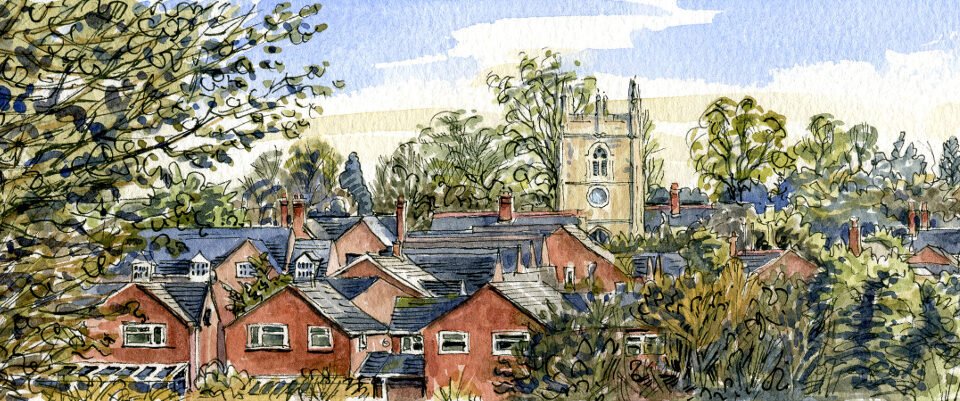



Historical names: Aldintone (Manor) | Aunton (Manor)
Location: Badsey with Aldington, Worcestershire
Places / associated places: Badsey with Aldington, Worcestershire
Listed in Domesday Book: Yes
Location & Extent
GPS Location & Recorded Land Areas
Representative GPS point: 52.0949, -1.9073
Identity: confirmed — The record is securely identified with the Worcestershire manor historically styled "Aldington alias Aunton" and earlier Aldintone/Aldington. The historical account places Aldington in the possessions of Evesham Abbey, records its connection with Badsey from 1291, and documents the manor's later descent under the names Aldington and Aunton. This matches the supplied Badsey with Aldington location and the TNA/MDR record F275580.
Representative point: 52.0949, -1.9073
Basis: documented_manor_house — The coordinates correspond to the listed Manor House and Aldington Court in Aldington, identified by Historic England's listing as the surviving manor-house complex. The local historical account describes Aldington Manor as being in the centre of Aldington; the earlier Manor Court/Aldington Court is attached to the manor house and is probably the original manor-house structure.
Point confidence: high
Boundary status: representative_point_only
Boundary period: Not established; the available evidence spans the medieval period to c.1806 but does not provide a recoverable perimeter.
Boundary confidence: none
Boundary basis: The sources establish the manor's association with Aldington and, at various periods, Badsey, but do not supply a documented polygon or enough explicit parcel-by-parcel boundary evidence to reconstruct one safely. A local historical account states that the Foley property in Aldington comprised about 250 acres when sold in 1806, but this area figure is not a boundary description. The 1807 Aldington enclosure map is reported as showing the manor house and estate features, yet the accessible evidence does not provide the map's manor-specific perimeter or parcel schedule. The manor must therefore not be substituted with the modern Aldington civil parish, the Badsey-with-Aldington ecclesiastical parish, or another administrative boundary.
Sources:
- Notes on the Manor of Aldington: https://www.badseysociety.uk/village-life/notes-the-manor-aldington — Local historical account identifies Aldington as an Evesham Abbey possession, records its connection with Badsey from 1291, documents the historical styles Aldington alias Aunton, and states that the manor property comprised about 250 acres when sold in 1806.
- The Manor House and Aldington Court, Aldington, Worcestershire: https://britishlistedbuildings.co.uk/101350006-the-manor-house-and-aldington-court-aldington — Historic England-derived listing identifies the surviving manor-house complex, gives the listing NGR SP0644744068, and describes Aldington Court as attached to the Manor House and apparently formerly its service wing.
- Aldington Conservation Area Appraisal: https://www.badseysociety.uk/sites/default/files/archive-files/Aldington%20Conservation%20Area%20Appraisal%20%281%29.pdf — States that Manor House/Manor Court is a surviving historic building associated with Aldington Manor, and that the manor and associated mill passed from Evesham Abbey after the Dissolution.
- Village Street, Aldington: https://www.badseysociety.uk/index.php/places/streets/village-street-aldington — Places Aldington Manor in the centre of Aldington and distinguishes the early-19th-century Aldington Manor extension from the earlier Manor Court/original manor-house structure.
- TNA/MDR record F275580: https://discovery.nationalarchives.gov.uk/details/c/F275580 — Registry authority record supplied for the exact manor identification: Aldington Manor, Badsey with Aldington, Worcestershire, authority/reference GB/NNAF/M293643.
- Cellarer's roll of Evesham Abbey, 1367-1369: https://discovery.nationalarchives.gov.uk/details/r/N16406794 — Supplied archival research lead for medieval Evesham Abbey manorial administration and leases, relevant to Aldington's monastic ownership context.
- Court book, 1543-1544: https://discovery.nationalarchives.gov.uk/details/r/N16408378 — Supplied archival research lead for the manor's sixteenth-century court administration under the Evesham Abbey/Crown transition period.
Warnings / uncertainty:
- The representative point is for the documented manor-house site, not the centroid of the historical manorial lands.
- No historically defensible manor boundary polygon was found in the accessible evidence.
- The 250-acre figure reported for c.1806 is an estate-area clue, not a perimeter and should not be converted into a guessed polygon.
- Do not substitute the modern Aldington civil-parish boundary, the Badsey with Aldington ecclesiastical-parish boundary, or the wider Badsey administrative area for the historical manor boundary.
About the Manor
Aldington Manor, also known historically as Aunton or Aldintone, was the principal manor of Aldington, a hamlet historically associated with Badsey in Worcestershire. In Domesday Book in 1086 Aldington appears as Aldintone, a berewick or outlying portion of the manor of Offenham, then associated with Evesham Abbey. By the later twelfth century Aldington had become connected with Bretforton, and by 1291 it had become joined to Badsey. The manor included the principal manor site and the associated Aunton Farm. The surviving manor-house complex includes seventeenth-century fabric and is associated with the historic manorial estate. The manor passed from Evesham Abbey at the Dissolution through a complicated sequence of Crown grants, conveyances, security arrangements and disputed claims before becoming part of the Foley estate in 1665. It remained in the Foley family for approximately 140 years, passed to George Day in the early nineteenth century, and was sold by Day to James Ashwin in 1808. The ecclesiastical advowson and tithes were separate interests and should not be confused with the lordship of the manor.
Ownership / Holder Account
Aldington was an Evesham Abbey possession by the time of Domesday Book and may have been associated with the monastery as early as 703, although the early charter evidence is described as doubtful. At the Dissolution the manor was granted to Richard Pygyon. In 1562 Elizabeth I granted Aldington together with Badsey to Sir Robert Throckmorton. The manor subsequently followed the descent of Badsey until its conveyance in 1598 by Richard and Margaret Griffin to Philip Bigge. Bigge and his wife Hester conveyed it in 1615 to William Courten and John Mounsey, apparently to the use of Courten. During the 1640s and 1650s the title became entangled in sales, security arrangements, debts, a jointure for Dame Katherine Courten, the interests of Sir Edward Littleton, George Carew, John Pettyward, Thomas Birkhead and the Commissioners dealing with Courten's creditors. The title of the Commissioners and Pettyward was expressly described as questionable. Despite that uncertainty, the manor was conveyed through William Bagott and Benjamin Lloyd, then Henry Scobell and William Baldwyn, and then John Whitfeild, before being sold in 1665 to Thomas Foley. Six successive generations of the Foley family held the manor or the Aldington estate until the estate was sold in the early nineteenth century. The manor was acquired by George Day around 1806 and was sold by him to James Ashwin in 1808. Later nineteenth-century directories identify members of the Ashwin family as lords of the manor, and James Ashwin was still identified as owner and lord of the manor in 1896. Publicly available sources consulted here establish Ashwin ownership into the early twentieth century, but do not provide a complete later legal descent of the manorial lordship.
Records & References
Sources and references mentioning this manor/title which are not necessarily conveyances or transfers.
2 records found · showing 1–2.
1543-1544: court book, with other manors
Held by: Worcestershire Archive and Archaeology Service
Further information: NRA 3524 Worcs RO misc
1367-1369: cellarer's roll of Evesham Abbey (lists of leases, entry fines and heriots), with other manors
Held by: Shakespeare Birthplace Trust
Further information: NRA 21856 Leigh
Conveyance & Descent
First holder to present holder: blood proximity & distance travelled
First recorded holder: Evesham Abbey
Present holder:
Recorded title journey: 24 holder entries in this manor's saved Conveyance & Descent history.
No recorded holder currently has a usable saved direct-blood or collateral-blood relationship path from which to calculate proximity percentages.
First recorded holder → present holder
A usable saved blood relationship path between the first recorded holder and the present holder has not yet been recorded, so that first-to-present genealogical distance cannot be calculated.
Evesham Abbey, Benedictine abbey
Transfer: Earlier monastic possession; Aldington is recorded in Domesday Book as a berewick of Offenham, and the manor remained associated with Evesham Abbey until the Dissolution.
Shared holding: Evesham Abbey
Previous holder: Unknown; an alleged grant by Offa in 703 is reported from the Evesham chronicle, but the early charter evidence is not wholly secure.
Domesday Book records Aldintone as a berewick or outlying portion of the manor of Offenham. The local historical account states that Aldington was an Evesham Abbey possession until the Dissolution. The reported 703 grant by Offa is retained only as background because the associated charter evidence is described as doubtful.
Source: E. A. B. Barnard, 'Notes on the Manor of Aldington', Badsey Society, citing Domesday Book and Evesham Abbey material. — source link
Richard Pygyon, Gentleman, member of the Badsey and Aldington Pygyon family
Transfer: Granted the Manor of Aldington by the Crown at the Dissolution of Evesham Abbey.
Previous holder: Evesham Abbey, Benedictine abbey
The local manor history states directly that at the Dissolution the Manor of Aldington was granted to Richard Pygyon. It also states that it is unclear when his lease or interest terminated; he may have continued to hold from the later grantee, Sir Robert Throckmorton, or may have died before that transition.
Source: E. A. B. Barnard, 'Notes on the Manor of Aldington', Badsey Society. — source link
Sir Robert Throckmorton, Knight
Transfer: Granted Aldington together with the Manor of Badsey by Queen Elizabeth I in 1562.
Previous holder: Richard Pygyon and/or the Crown
The 1562 grant expressly included the Manor of Aldington with the Manor of Badsey. The source says that the manor thereafter followed the descent of Badsey until 1598, but it does not provide every intervening holder, so no unrecorded intermediate conveyances are inserted.
Source: E. A. B. Barnard, 'Notes on the Manor of Aldington', Badsey Society. — source link
Philip Bigge, Gentleman, second son of Thomas Bigge of Lenchwick
Transfer: Conveyed by Richard and Margaret Griffin to Philip Bigge in 1598.
Previous holder: Richard and Margaret Griffin
The manor history identifies a 1598 conveyance by Richard and Margaret Griffin to Philip Bigge, second son of Thomas Bigge of Lenchwick. The source does not explain the precise descent from the Throckmortons or identify all holders between 1562 and 1598.
Source: E. A. B. Barnard, 'Notes on the Manor of Aldington', Badsey Society. — source link
William Courten and John Mounsey, Merchant, knighted 1622 in the case of Sir William Courten
Transfer: Philip Bigge and Hester Bigge jointly conveyed the manor to William Courten and John Mounsey on 13 July 1615, apparently for the use of William Courten.
Holding arrangement: Joint — Legal conveyance to both grantees; the source says it was apparently for the use of William Courten.
Previous holder: Philip Bigge and Hester Bigge
This is a documented joint conveyance, but the beneficial arrangement is not fully explained. The source states that William Courten afterwards held the manor. Hester Bigge is recorded as a conveying spouse rather than a continuing holder.
Source: E. A. B. Barnard, 'Notes on the Manor of Aldington', Badsey Society. — source link
William Courten, Esquire, merchant-trader
Transfer: Held after the 1615 conveyance; in April 1643 he reportedly sold the manor to Sir Edward Littleton, although the later title was contested.
Previous holder: William Courten and John Mounsey, Merchant, knighted 1622 in the case of Sir William Courten
The local account says William Courten afterwards held the manor. A later Commission found that Courten had made an earlier sale to Sir Edward Littleton in April 1643 before becoming bankrupt, while Courten's son and heir claimed under a former settlement. Because the title was disputed, the 1643 transaction is recorded as a reported conveyance rather than an uncontested descent.
Source: E. A. B. Barnard, 'Notes on the Manor of Aldington', Badsey Society. — source link
Sir Edward Littleton, of Pillerton Hall, Staffordshire
Transfer: William Courten reportedly sold or transferred the manor to Sir Edward Littleton in April 1643 as security for Courten's debts.
Holding arrangement: Trust
Shared holding: Security interest for William Courten's debts
Previous holder: William Courten, Esquire, merchant-trader
The 1 November 1649 indenture states that Sir Edward Littleton had received Aldington and Pirton in 1643 as security for substantial liabilities incurred for William Courten's debts. The arrangement was not necessarily an unencumbered beneficial ownership. Dame Katherine Courten's jointure and Thomas Coppin's interest also affected the title.
Source: E. A. B. Barnard, 'Notes on the Manor of Aldington', Badsey Society. — source link
George Carew, Gentleman of Gray's Inn, associated with Aldington during the mid seventeenth century
Transfer: Sir Edward Littleton released or left Aldington to George Carew for a 99-year term in consideration of Carew's payment and discharge of debt obligations.
Holding arrangement: Other — 99-year term
Shared holding: Lease or term arising from debt settlement
Previous holder: Sir Edward Littleton, of Pillerton Hall, Staffordshire
The 1 November 1649 indenture gave George Carew an interest in Aldington for 99 years after Carew paid £2,000 and discharged Littleton from specified obligations. This was a term interest arising from a complex debt settlement, not necessarily an absolute freehold transfer. Carew continued to appear in later conveyances.
Source: E. A. B. Barnard, 'Notes on the Manor of Aldington', Badsey Society. — source link
John Pettyward and Thomas Birkhead, Pettyward: creditor, Birkhead: citizen and armourer of London
Transfer: William Courten made over his interest in the manor to John Pettyward and Thomas Birkhead in connection with Courten's bankruptcy and debts.
Holding arrangement: Joint — Interest assigned jointly; after Birkhead's death the source says the whole estate came to Pettyward.
Shared holding: Creditors or assignees in bankruptcy
Previous holder: William Courten, Esquire, merchant-trader
A Commission found Courten bankrupt and indebted by more than £25,000. The account states that Courten made over his interest to Pettyward and Birkhead, but also records that Courten had already sold the manor to Littleton in 1643 and that claims under a former settlement existed. The title of Pettyward and the Commissioners was therefore expressly questionable.
Source: E. A. B. Barnard, 'Notes on the Manor of Aldington', Badsey Society. — source link
William Bagott and Benjamin Lloyd, Gentlemen, parties to the 1656 conveyance
Transfer: John Pettyward and the Commissioners dealing with Courten's creditors granted the manor to William Bagott and Benjamin Lloyd for ever by instruments dated 29 March 1656.
Holding arrangement: Joint
Previous holder: John Pettyward and the Commissioners for Courten's creditors
Pettyward received £2,000 paid to the Commissioners for the use of Courten's creditors, and the same consideration was stated in a bargain and sale by the Commissioners to Bagott and Lloyd. The transaction was part of a disputed and complicated title, but the source expressly identifies the manor as being granted to Bagott and Lloyd for ever.
Source: E. A. B. Barnard, 'Notes on the Manor of Aldington', Badsey Society. — source link
Henry Scobell and William Baldwyn, Scobell of Westminster, Baldwyn of the Inner Temple, London
Transfer: William Bagott, George Carew and related parties granted the manor to Henry Scobell and William Baldwyn by indenture dated 15 December 1657.
Holding arrangement: Joint
Previous holder: William Bagott and Benjamin Lloyd, with George Carew involved in the instrument
The 1657 indenture expressly granted the manor to Scobell and Baldwyn. A second instrument on the same day involved Carew and Joane Cole in connection with Carew's forthcoming marriage settlement, indicating that the conveyance formed part of wider settlement arrangements.
Source: E. A. B. Barnard, 'Notes on the Manor of Aldington', Badsey Society. — source link
John Whitfeild, Of Maidenhead, Berkshire, and the Middle Temple, London
Transfer: Henry Scobell, William Baldwyn and George Carew sold all that manor of Aunton or Aldington to John Whitfeild for £3,500 by indenture dated 15 March 1664.
Previous holder: Henry Scobell and William Baldwyn, with George Carew as a party to the sale
The source explicitly identifies the subject of the sale as 'all that manor of Aunton or Aldington'. Whitfeild's will later devised the manor to William Willoughby and William Cherry to be sold for the payment of a debt to Sir William Powell.
Source: E. A. B. Barnard, 'Notes on the Manor of Aldington', Badsey Society. — source link
William Willoughby and William Cherry, Willoughby of Hunsdon, Hertfordshire, Cherry of Maidenhead, Berkshire
Transfer: John Whitfeild devised the Manor of Aunton alias Aldington to William Willoughby and William Cherry, as devisees and intended sellers, for the payment of a debt to Sir William Powell.
Holding arrangement: Trust
Shared holding: Devise to sell and discharge debt
Previous holder: John Whitfeild, Of Maidenhead, Berkshire, and the Middle Temple, London
Whitfeild's will expressly named the Manor of Aunton alias Aldington and directed Willoughby and Cherry, or the survivor, to sell it for the payment of £1,000 to Sir William Powell. This is recorded as a testamentary trust or power of sale rather than an ordinary beneficial succession.
Source: E. A. B. Barnard, 'Notes on the Manor of Aldington', Badsey Society. — source link
Thomas Foley, Esquire, Member of Parliament
Transfer: Purchased the Manor of Aldington alias Aunton and Aunton Farm by indenture dated 6 June 1665 from William Courten, Samuel Baldwyn, George Carew, William Willoughby and William Cherry.
Previous holder: William Courten, Samuel Baldwyn, George Carew, William Willoughby and William Cherry
The 1665 deed expressly conveyed the manor and Aunton Farm to Thomas Foley. Foley continued the existing lease of Aunton Farm to William Jarrett. This was the beginning of approximately 140 years of Foley ownership.
Source: Maureen Spinks, 'FOLEY, Thomas (1617-1677) and descendants – Owners of Aldington Manor', Badsey Society; citing the 6 June 1665 indenture. — source link
Thomas Foley, Esquire, Member of Parliament
Transfer: Inherited the Aldington estate on the death of his father, Thomas Foley, in 1677.
Shared holding: Foley family succession
Co-holders: Thomas Foley, 1st Baron Foley, Thomas Foley, 2nd Baron Foley, Thomas Foley, 1st Baron Foley of the new creation, Thomas Foley, 2nd Baron Foley of the new creation
Previous holder: Thomas Foley (1617-1677)
The Foley family history states that the second Thomas Foley inherited the principal share of his father's landed property, including Aldington, on his father's death. The succession is described as inheritance rather than a separately dated conveyance.
Source: Maureen Spinks, 'FOLEY, Thomas (1617-1677) and descendants – Owners of Aldington Manor', Badsey Society. — source link
Thomas Foley, 1st Baron Foley, Member of Parliament
Transfer: Inherited Aldington with his father's estates on the death of Thomas Foley in 1701.
Shared holding: Foley family succession
Co-holders: Thomas Foley, Thomas Foley, 2nd Baron Foley, Thomas Foley, 1st Baron Foley of the new creation, Thomas Foley, 2nd Baron Foley of the new creation
Previous holder: Thomas Foley (c.1641-1701)
The Foley family history identifies this Thomas Foley as inheriting Aldington among his father's estates in 1701. He was raised to the peerage as Baron Foley in 1712, but the barony is not treated as an associated title of Aldington Manor.
Source: Maureen Spinks, 'FOLEY, Thomas (1617-1677) and descendants – Owners of Aldington Manor', Badsey Society. — source link
Thomas Foley, 2nd Baron Foley
Transfer: Inherited the Foley estates, including the Manor of Aldington, on the death of his father in 1732/33.
Shared holding: Foley family succession
Co-holders: Thomas Foley, Thomas Foley, 1st Baron Foley, Thomas Foley, 1st Baron Foley of the new creation, Thomas Foley, 2nd Baron Foley of the new creation
Previous holder: Thomas Foley, 1st Baron Foley, Member of Parliament
The Foley family history states that this Thomas Foley inherited the Manor of Aldington with the estates of his father. He died a bachelor in 1766 and the barony became extinct; his estates passed by will to his second cousin once removed, Thomas Foley of Stoke Edith.
Source: Maureen Spinks, 'FOLEY, Thomas (1617-1677) and descendants – Owners of Aldington Manor', Badsey Society. — source link
Thomas Foley, 1st Baron Foley of the new creation, Member of Parliament, 2nd Baron Foley, landowner
Transfer: Inherited the estates of his childless second cousin once removed, Thomas Foley, 2nd Baron Foley, including Aldington Manor, in 1766.
Shared holding: Foley family succession
Co-holders: Thomas Foley, Thomas Foley, 1st Baron Foley, Thomas Foley, 2nd Baron Foley, Thomas Foley, 2nd Baron Foley of the new creation
Previous holder: Thomas Foley, 2nd Baron Foley
Thomas Foley of Stoke Edith inherited the estates of the childless 2nd Baron Foley in 1766. The barony was revived in his favour in 1776. The source states that he died in November 1777, after which the estates passed to his son.
Source: Maureen Spinks, 'FOLEY, Thomas (1617-1677) and descendants – Owners of Aldington Manor', Badsey Society. — source link
Transfer: Succeeded to the Foley peerage and appears to have inherited or received the Aldington estate on the death of his father in 1777.
Shared holding: Foley family succession
Co-holders: Thomas Foley, Thomas Foley, 1st Baron Foley, Thomas Foley, 2nd Baron Foley, Thomas Foley, 1st Baron Foley of the new creation
Previous holder: Thomas Foley, 1st Baron Foley of the new creation, Member of Parliament, 2nd Baron Foley, landowner
The source states that this Thomas Foley succeeded his father in 1777 and that his share of the estates appears to have included Aldington. It also cautions that, because of debt arrangements, he was not immediately entitled to the full estates and initially received only an annuity while the balance of income was applied to debts. He died in 1793, and trustees continued to manage the settled estate.
Source: Maureen Spinks, 'FOLEY, Thomas (1617-1677) and descendants – Owners of Aldington Manor', Badsey Society. — source link
Thomas Foley, 3rd Baron Foley of the new creation, 4th Baron Foley, Privy Councillor, Lord Lieutenant of Worcestershire
Transfer: Succeeded to the Foley estates as a minor on the death of his father in 1793; trustees administered and sold parts of the settled estate.
Holding arrangement: Trust
Shared holding: Settled estate under trustees
Previous holder: Thomas Foley, 2nd Baron Foley of the new creation, Member of Parliament, 3rd Baron Foley, MP for Herefordshire and Droitwich, Postmaster General
The Foley family history states that Thomas Foley, aged twelve in 1793, succeeded to the estates and title, while the financial condition of the estate required sales and other dealings by trustees under private Acts of Parliament. Aldington was sold in the early nineteenth century; the local account places the sale of the Foley Aldington property in 1806, while another account suggests that a relevant 1803 indenture may indicate an earlier transaction. No exact conveyance date from Foley trustees to George Day is asserted here.
Source: Maureen Spinks, 'FOLEY, Thomas (1617-1677) and descendants – Owners of Aldington Manor', Badsey Society. — source link
George Day, Gentleman, merchant and banker of Evesham, Mayor of Evesham
Transfer: Acquired the Manor of Aldington from the Foley estate in the early nineteenth century, probably in or around 1806, and sold it to James Ashwin on 6 October 1808 for £12,000.
Previous holder: Thomas Foley and/or trustees of the settled Foley estate
The 1807 Aldington Inclosure Act identifies George Day as lord of the manor or reputed manor. The local biographical account states that he acquired the manor in 1806, leased it to William Preedy, and sold it two days after the 1808 enclosure award came into effect. William Preedy is recorded as a tenant or lessee, not as a manor holder.
Source: George Day, 'DAY, George (1764-1830) – The largest landowner in Aldington at the time of Enclosure', Badsey Society; see also the transcription of the 1807 Aldington Inclosure Act. — source link
James Ashwin, Of Bretforton, owner of Aldington Manor and associated estate
Transfer: Purchased the Manor of Aldington from George Day for £12,000 on 6 October 1808, according to the local account.
Previous holder: George Day, Gentleman, merchant and banker of Evesham, Mayor of Evesham
The sale from George Day to James Ashwin is directly stated in the local account and is also reflected in later descriptions of the Ashwin family ownership. The precise date of any later transfer within the Ashwin family is not established here; by 1880 the manor was being identified with Henry Ashwin as lord of the manor.
Source: George Day, 'DAY, George (1764-1830) – The largest landowner in Aldington at the time of Enclosure', Badsey Society; corroborated by 'Notes on the Manor of Aldington'. — source link
Transfer: Later Ashwin family holding; the exact conveyance or inheritance from James Ashwin is not established in the consulted sources.
Shared holding: Ashwin family ownership
Co-holder: James Ashwin
Previous holder: James Ashwin or another member of the Ashwin family
Kelly's Directory for 1880 identifies Henry Ashwin as lord of the manor of Aldington. Kelly's Directory for 1888 identifies William Henry Ashwin as a principal landowner and describes Henry Ashwin as lord of the manor. The sources do not make the precise identity relationship or date of transfer sufficiently explicit for a more exact conveyance to be asserted, so this entry preserves the uncertainty.
Source: Kelly's Directory of Worcestershire, 1880 and 1888, transcribed by the Badsey Society. — source link
James Ashwin, Of Bretforton, owner of Aldington Manor and associated estate
Transfer: Inherited or otherwise succeeded to Ashwin family holdings after the death of William Henry Ashwin in 1892; the exact manorial conveyance is not established.
Shared holding: Ashwin family ownership
Co-holder: Henry Ashwin, probably William Henry Ashwin
Previous holder: William Henry Ashwin
The Badsey Society's account of Ashwin ownership states that William Henry Ashwin died in 1892 and that his eldest son James Ashwin inherited the land. A 1910-1912 valuation record identifies James Ashwin as owner of Aldington Manor and associated Aldington property. This establishes continued Ashwin ownership into the early twentieth century, although the precise legal descent of the manorial lordship is not separately documented in the consulted sources.
Source: The Badsey Society, 'Land at Blackminster' and 'Valuation Survey - Aldington'; corroborated by Kelly's Directory of Worcestershire, 1896. — source link
Corrections / Challenges
Sign in to challenge or submit evidence against a recorded assertion.
JSON API
Machine-readable published manor data, including public images, mapped land areas, notes, rights, conveyances, relationships, records, source/document-library entries and public file links.
https://manorialregistry.com/index.php?rest_route=/mhr/v1/manor/aldington-manor-2Public API access is currently disabled. Authorised API clients must use a private X-MHR-API-Key; currently only administrator keys are enabled.
Private source files, pending edits, moderation/admin information, user API keys and non-public import identifiers are not returned.