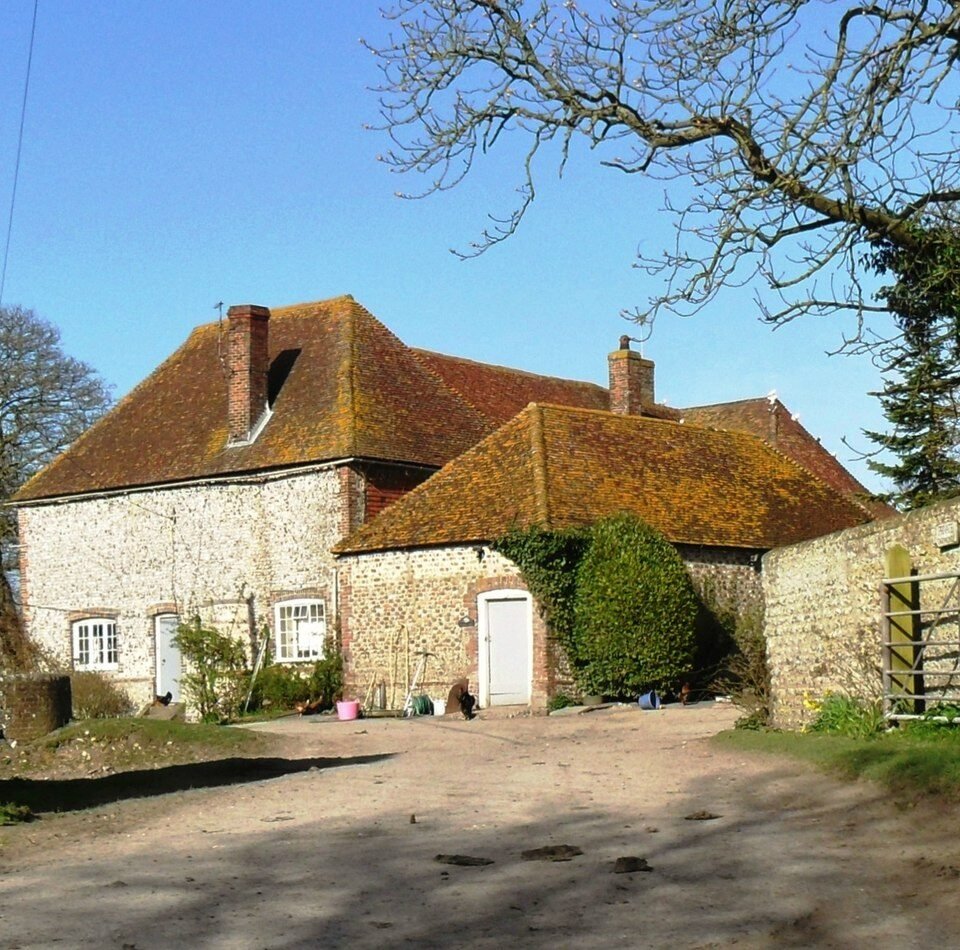



Location: Alciston, Sussex
Places / associated places: Alciston, Sussex
Listed in Domesday Book: Yes
Location & Extent
GPS Location & Recorded Land Areas
Representative GPS point: 50.82956, 0.13622
Identity: confirmed — The registry record, National Archives reference F254792, Alciston location, Gage archive references, and the scholarly study by Judith A. Brent all identify the Battle Abbey manor centred on Alciston, Sussex. The manor's medieval agricultural complex was at Alciston Court, including the surviving grange buildings, tithe barn, dovecote and associated water features.
Representative point: 50.82956, 0.13622
Basis: documented_manor_house — Alciston Court Farm occupies the medieval Battle Abbey grange/manorial complex. Historic England identifies the nearby tithe barn as part of the Alciston grange buildings, while local church and archival sources identify the grange as incorporated into the present Alciston Court farm complex. The coordinate is the geotagged position of Alciston Court Farm, corroborated by the Historic England grid reference for the adjacent tithe barn.
Point confidence: high
Boundary status: representative_point_only
Boundary period: Medieval manor, especially the late thirteenth to fifteenth centuries; extent varied over time
Boundary confidence: medium
Boundary basis: Reliable sources establish a large, fragmented manorial territory but do not provide a sufficiently georeferenced perimeter for a defensible polygon. Brent's study, based on medieval rentals, custumals, surveys and a reconstructed distribution map, places manor holdings in Alciston, Telton/Tilton, Alfriston, Lullington, Clopham, East Blatchington, Hellingly, Arlington, Hailsham, Selmeston/Sherington, Berwick, and more distant Sussex locations including Old Shoreham, Bramber and Wealden woodland. Victoria County History additionally records detached portions in or associated with the Lewes and Hastings rapes, including Ovingdean, Coding/Hooe, Batsford/Warbleton, Wivenham, Dallington, Shoyswell, Borzell and related places. These documented distributions demonstrate that the manor cannot safely be represented by the modern Alciston parish boundary, but the available public evidence does not supply precise parcel-by-parcel boundary coordinates.
Sources:
- The National Archives: Alciston Manor, F254792: https://discovery.nationalarchives.gov.uk/details/c/F254792 — Registry record for the exact manor, including its Alciston centre, Battle Abbey ownership, Gage succession and associated outlying places.
- Judith A. Brent, 'Alciston Manor in the Later Middle Ages', Sussex Archaeological Collections 106 (1968): https://archaeologydataservice.ac.uk/catalogue/adsdata/arch-285-1/dissemination/pdf/Vol_106_1968/SAC106_Brent.pdf — Scholarly study based on medieval rentals and surveys; describes the manor's dispersed holdings and provides a distribution map of parts among parishes.
- The Keep: Alciston parish and manor history: https://www.thekeep.info/places/eastsussex/parishesandsettlements/alciston/ — East Sussex archival summary confirming that the manor extended beyond the parish into Alfriston, Lullington, East Blatchington, Hellingly and Berwick, and identifying the surviving grange buildings at Alciston Court Farm.
- Historic England: The Tithe Barn south west of Court House Farm, Alciston, list entry 1191019: https://historicengland.org.uk/listing/the-list/list-entry/1191019 — Identifies the Grade I tithe barn at NGR TQ 50496 05527 and states that Alciston was a grange of Battle Abbey and that the barn formed part of its grange buildings.
- Victoria County History, Sussex volume 1, discussion of Battle Abbey's Alciston estate: https://en.wikisource.org/wiki/Page%3AVCH_Sussex_1.djvu/445 — Records the Domesday assessment of 50 hides, later reduction to approximately 44 and a half hides, and detached portions associated with the Lewes and Hastings rapes.
Warnings / uncertainty:
- No defensible historical manor polygon was found in the publicly accessible sources consulted.
- The manor's territorial extent was fragmented and changed over time; it must not be substituted with the modern Alciston civil or ecclesiastical parish boundary.
- The representative coordinate identifies the documented Alciston Court/grange centre, not the centre of the entire dispersed medieval estate.
About the Manor
Alciston Manor was a substantial Sussex manor centred on Alciston, with lands and dependent outliers extending into Alfriston, Lullington, East Blatchington, Hellingly, Berwick and other places. Domesday evidence records the estate at 50 hides in 1066, although later descriptions explain that outlying portions were detached into neighbouring rapes and that the manor was subsequently assessed at approximately 44 and a half hides. The manor became one of the principal agricultural estates of Battle Abbey and was operated as a demesne farm or grange, specialising particularly in sheep and cereal production. The surviving manorial evidence includes title deeds from about 1100, account rolls from 1336 to 1539, court rolls and later manor records. The medieval manorial complex included a curia or manor-house complex, a large tithe barn, dovecote and fishponds. At the Dissolution of Battle Abbey, the manor, excluding the portion lying in Alfriston, passed from the Crown to Sir John Gage of Firle and his wife Philippa. Later evidence shows the manor and much of the surrounding estate continuing in the Gage family or Gage Estate; the exact sequence of later legal conveyances has not been established from the publicly accessible sources consulted.
Ownership / Holder Account
In 1066 Alciston was held by Æthelnoth Cild, the pre-Conquest English landholder named in Domesday-related scholarship. Shortly after the Norman Conquest, William the Conqueror granted Alciston to the newly founded Benedictine Abbey of Battle. Battle Abbey retained the manor for the medieval period and administered it as one of its most important agricultural manors, with extensive outlying lands and a large body of surviving account and court records. The abbey remained lord until its dissolution in 1538. The Crown then granted the manor, shorn of the part situated in Alfriston, to Sir John Gage of Firle and his wife Philippa, in consideration of Gage's service. The accessible sources describe Alciston as having had only two principal ownership phases since the Conquest—Battle Abbey and the Gage family—but do not provide a complete sequence of individual Gage conveyances. A 1867 directory identifies Lord Gage as lord of the manor, and East Sussex archival and Firle Estate material records the continuing association of the manor with the Gage Estate. The precise legal descent between the original 1539 grant and the later Gage holders remains a documentary gap in this backfill.
Records & References
Sources and references mentioning this manor/title which are not necessarily conveyances or transfers.
78 records found · showing 73–78.
1336-1337: bailiffs' account roll
Held by: East Sussex and Brighton and Hove Record Office (ESBHRO)
Further information: NRA 9421 Gage
1335-1335: rental, incl tenements at Tilton in Selmeston, Michelham in Arlington, and East Blatchington
Held by: The National Archives
1324-1325: court rolls (2)
Held by: East Sussex and Brighton and Hove Record Office (ESBHRO)
Further information: NRA 9421 Gage
1288-1289: court rolls (2)
Held by: East Sussex and Brighton and Hove Record Office (ESBHRO)
Further information: NRA 9421 Gage
1275-1279: court rolls (2)
Held by: East Sussex and Brighton and Hove Record Office (ESBHRO)
Further information: NRA 9421 Gage
1272-1307: rental and custumal
Held by: The National Archives
Conveyance & Descent
First holder to present holder: blood proximity & distance travelled
First recorded holder: Æthelnoth Cild
Present holder:
Recorded title journey: 6 holder entries in this manor's saved Conveyance & Descent history.
No recorded holder currently has a usable saved direct-blood or collateral-blood relationship path from which to calculate proximity percentages.
First recorded holder → present holder
A usable saved blood relationship path between the first recorded holder and the present holder has not yet been recorded, so that first-to-present genealogical distance cannot be calculated.
Æthelnoth Cild, Pre-Conquest English landholder, Domesday holder of Alciston
Transfer: Domesday evidence records Æthelnoth Cild as holder of the 50-hide manor of Alciston in 1066. The subsequent transfer is described in later historical sources as a post-Conquest grant by William the Conqueror, but no precise date for the change of possession is established here.
This is the earliest securely identified holder of the exact Alciston estate. PASE identifies Æthelnoth Cild as the explicit 1066 holder of Alciston in Sussex. The source does not establish the circumstances by which he ceased to hold it.
Source: Prosopography of Anglo-Saxon England, entry for Æthelnoth Cild, discussion of the Domesday holding of Alciston in Sussex. — source link
Battle Abbey, Benedictine abbey, lord of Alciston Manor
Transfer: William the Conqueror granted Alciston to Battle Abbey after the Conquest. The exact date and surviving grant instrument were not established in the accessible sources consulted.
Shared holding: Battle Abbey
Previous holder: Æthelnoth Cild, Pre-Conquest English landholder, Domesday holder of Alciston
Battle Abbey held Alciston from the post-Conquest period until the Dissolution. The manor was one of the abbey's important estates and was operated as a home farm or grange. Medieval records include account rolls, court rolls, rentals and title deeds. VCH evidence also records that the manor was originally assessed at 50 hides and that outlying portions were detached into the rapes of Lewes and Hastings.
Source: Judith A. Brent, Alciston Manor in the Later Middle Ages, Sussex Archaeological Collections, volume 106, 1968, pages 89-102; Victoria County History, Sussex, volume 1, discussion of Battle Abbey and Alciston. — source link
Transfer: On the dissolution of Battle Abbey in 1538, Alciston passed into Crown hands before being granted to Sir John Gage and Philippa his wife. The accessible sources do not establish the precise date on which Crown title was perfected or the exact form of the grant.
Holding arrangement: Other — The dissolved abbey's manor of Alciston, subject to the later exclusion of the portion situated in Alfriston.
Shared holding: Crown custody after Dissolution
Previous holder: Battle Abbey, Benedictine abbey, lord of Alciston Manor
The Crown entry is included because the authoritative local-history source explicitly states that the Crown granted the manor after Battle Abbey was dissolved. This represents an intervening Crown ownership or custody phase, not a presumed private conveyance.
Source: The Keep, Alciston parish and settlement history, stating that when Battle Abbey was dissolved the Crown granted Alciston to Sir John Gage and Philippa his wife. — source link
Sir John Gage and Philippa Gage, née Guldeford, Knight of the Garter, Tudor courtier, grantee and lord of Alciston Manor, Knight, Vice-Chamberlain of the Household, Comptroller of the Household, Constable of the Tower of London
Transfer: Granted by the Crown after the dissolution of Battle Abbey, in consideration of Sir John Gage's service. The grant included Alciston Manor but excluded the part which lay in Alfriston.
Holding arrangement: Joint — Joint grant to Sir John Gage and Philippa his wife; the accessible summary does not specify separate fractional shares.
Shared holding: Gage family
Previous holder: The Crown, Crown owner or grantee after the dissolution of Battle Abbey
This is the first securely documented private ownership of the post-Dissolution manor. The East Sussex archival summary explicitly identifies the grantees as Sir John Gage of Firle and his wife Philippa and quotes the consideration as good, true and faithful service. Sir John died in 1556, but no source consulted establishes the date or legal mechanism by which the manor passed from the joint grantees to later members of the Gage family; therefore the end date is left open rather than being equated with Sir John's death.
Source: The Keep, Alciston parish and settlement history; Firle Place, The Collection, identifying Alciston as a reward granted to Sir John Gage KG by Henry VIII at the Dissolution. — source link
Transfer: The 1867 Kelly's directory identifies Lord Gage as principal landowner and lord of Alciston Manor. The intervening legal conveyances within the Gage family were not established from the accessible public sources and are therefore not inferred.
Holding arrangement: Other — The directory identifies Lord Gage as lord of the manor but does not specify the legal tenure, fractional share or instrument of succession.
Shared holding: Gage family / Gage Estate
Previous holder: Gage family, through an undocumented succession
This is a later dated confirmation of manorial lordship rather than a fully documented conveyance. It securely links a Gage title-holder to Alciston Manor in 1867, but the source does not identify which Lord Gage is meant or explain the exact succession from Sir John and Philippa. East Sussex archival material separately records that the Gage Estate continued to own most of the land in the parish and that Alciston manorial records continue into the twentieth century.
Source: Kelly's Post Office Directory for Sussex, 1867, entry for Alciston, identifying Lord Gage as principal landowner and lord of the manor. — source link
Gage Estate, Family estate associated with Alciston Manor and Firle
Transfer: The East Sussex archival summary describes the manor as remaining in the Gage family and records manor court books ending in 1925. It does not provide a discrete conveyance into or out of the Gage Estate, so this entry records continued family ownership rather than an inferred transfer.
Holding arrangement: Other — Continuing family estate ownership; the accessible sources do not specify whether the legal manor was held by an individual, trustees, settlement or corporate estate vehicle.
Shared holding: Gage Estate
Previous holder: Earlier Gage family holders
The Keep states that Alciston Manor and most of the parish had only two owners since 1066, Battle Abbey and the Gage family, and that the archive contains the last manor court book completed in 1925. It also states that most land in the parish was still owned by the Gage Estate. This supports continuity of the Gage ownership phase but not a precise individual-by-individual conveyance.
Source: The Keep, Alciston parish and settlement history, including the statement that the manor records end with the last manor court book completed in 1925 and that most parish land remained owned by the Gage Estate. — source link
Corrections / Challenges
Sign in to challenge or submit evidence against a recorded assertion.
JSON API
Machine-readable published manor data, including public images, mapped land areas, notes, rights, conveyances, relationships, records, source/document-library entries and public file links.
https://manorialregistry.com/index.php?rest_route=/mhr/v1/manor/alciston-manorPublic API access is currently disabled. Authorised API clients must use a private X-MHR-API-Key; currently only administrator keys are enabled.
Private source files, pending edits, moderation/admin information, user API keys and non-public import identifiers are not returned.