


Historical names: Albrighton; Elbretone
Location: Albright Hussey, Shropshire
Places / associated places: Albright Hussey, Shropshire
Location & Extent
GPS Location & Recorded Land Areas
Representative GPS point: 52.75358, -2.73907
Identity: confirmed — The record is securely identified with the surviving moated Albright Hussey manor house at Broad Oak, Albright Hussey, in the historic parish and hundred of Pimhill, Shropshire. The location, medieval Hussey lordship, associated chapel, and later Corbet ownership correspond to the supplied TNA/MDR record and to the historical account in Eyton's Antiquities of Shropshire.
Representative point: 52.75358, -2.73907
Basis: documented_manor_house — Documented location of the surviving moated Albright Hussey manor house, identified by OS grid reference SJ50201757 and matching the listed historic building and present Albright Hussey Manor hotel.
Point confidence: high
Boundary status: representative_point_only
Boundary period: Medieval to early modern manorial estate; extent varied over time
Boundary confidence: none
Boundary basis: The sources establish the manor-house site and identify a wider manorial connection extending beyond the immediate house. Eyton states that Walter Hussey's fee probably included Albright Hussey and its member Harlescott, with possible parts of Balderton and Sleap. Other evidence places Hateley Field and parts of the medieval common-field system within the manor of Albright Hussey. However, no accessible source located for this record supplies a sufficiently clear, georeferenced perimeter of the historical manorial land. The modern parish, battlefield, estate, hotel grounds, and administrative boundaries cannot safely be substituted for the manor boundary.
Sources:
- The National Archives Discovery: Albright Hussey Manor, F244507: https://discovery.nationalarchives.gov.uk/details/c/F244507 — Registry record and authority/reference for the exact manor identity.
- Eyton's Antiquities of Shropshire, volume 10, Albright Hussey: https://www.melocki.org.uk/eyton/Vol10.html — Historical account of the Hussey fee; states that it probably included Albright Hussey and its member Harlescott, with possible parts of Balderton and Sleap; also discusses the chapel and former ecclesiastical jurisdiction.
- Albright Hussey Manor, The Gatehouse Record: https://www.gatehouse-gazetteer.info/English%20sites/3046.html — Provides the manor-house identification, OS grid reference SJ50201757, coordinates 52.75358,-2.73907, moated-site description, and architectural chronology.
- Heritage Gateway, Albright Hussey manor and associated sites: https://www.heritagegateway.org.uk/Gateway/Results_Single.aspx?resourceID=1015&uid=MSA1252 — Confirms the historic manor-house location and records the associated medieval landscape and battle-field context, including fields historically connected with Albright Hussey.
- Historic England, Battle of Shrewsbury 1403, NHLE 1000033: https://historicengland.org.uk/listing/the-list/list-entry/1000033/ — States that ridge-and-furrow within the battlefield formed part of the common fields of the manor of Albright Hussey, confirming historical landholding beyond the house site.
- Shropshire Council, Shrewsbury Battlefield Heritage Assessment: https://www.shropshire.gov.uk/media/11322/shrewsbury-battlefield-heritage-assessment.pdf — Places the Albright Hussey manor house in relation to the historic battlefield and discusses surviving landscape features and historical estate context.
Warnings / uncertainty:
- The representative point is suitable for locating the manor house and documented manorial centre, not for defining the full medieval or early-modern estate.
- No reliable, sufficiently precise historical perimeter was found in the accessible sources; no polygon is returned.
- Eyton's statements about Harlescott and possible parts of Balderton and Sleap are cautious historical reconstruction, not a surveyed boundary.
- The present hotel grounds and modern parish or civil-parish boundaries must not be treated as the historical manor extent.
About the Manor
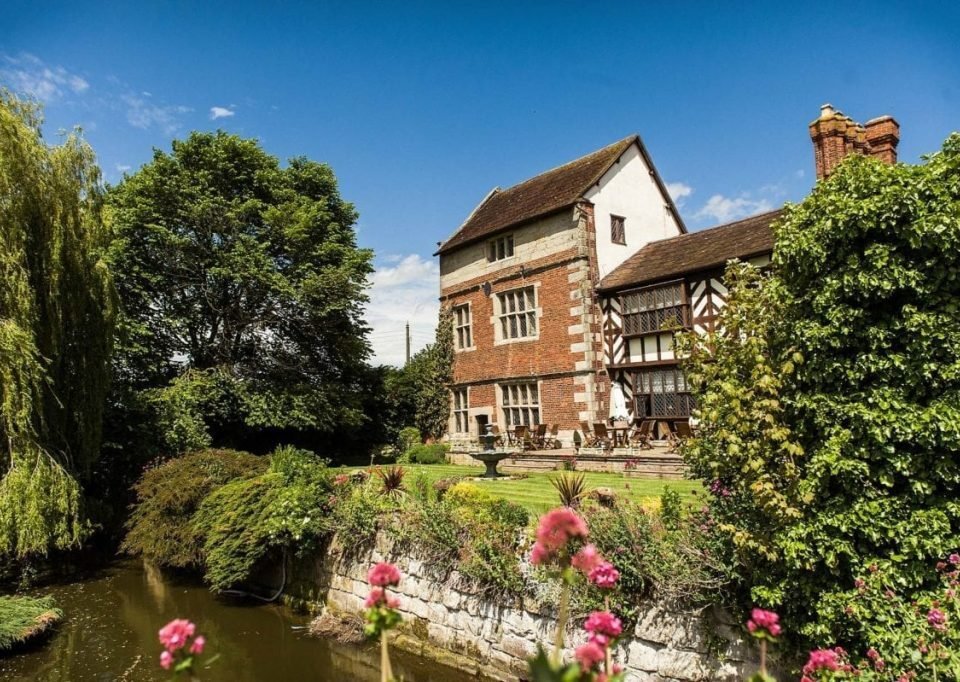
Albright Hussey was a medieval manor and estate in the historic parish and hundred of Pimhill, Shropshire, now within the Shrewsbury area. The estate is recorded in Domesday Book under forms of the name Albrighton or Elbretone. The later qualifying name Hussey was derived from the Hussey family, who held the estate from the twelfth century. The surviving moated manor house is principally a timber-framed building of the early sixteenth century, with a date of 1524 associated with the earlier range, later sixteenth-century enlargement, and a brick-built section dated 1601. A medieval chapel dedicated to St John the Baptist stood near the manor house, and the Husseys were associated with the foundation and patronage of Battlefield Church after the Battle of Shrewsbury. The estate later passed through the Hussey, Pelham and Corbet families. During the Civil War the house was occupied and used as a Royalist garrison. In the early eighteenth century the Corbet family moved its principal residence to Sundorne, after which Albright Hussey ceased to be their principal seat. The house was subsequently occupied by tenants and was eventually adapted for use as a hotel and restaurant.
Ownership / Holder Account
The earliest documentary evidence concerns two Domesday estates at Albrighton held in 1086 by Rainald the Sheriff; the precise identification of one or both Domesday entries with the later Albright Hussey manor is treated cautiously by Eyton. By 1165 Walter Hussey held a knight's fee of new enfeoffment in the barony of Fitz Alan, and the evidence indicates that his fee included Albright Hussey and associated lands at Harlescott. The manor descended through Walter's son Ralph Hussey, Walter Hussey II, Thomas Hussey, John Hussey, John Hussey II and Richard Hussey. Richard Hussey is directly recorded as lord of Albright Hussey in the early fifteenth century and as patron of its chapel. The estate remained with the Hussey family until an heiress married Sir William Pelham. Their daughter Anne married William Corbet of Leigh, and the property was eventually inherited by their son Pelham Corbet, born about 1601. The precise dates and legal instruments of the Hussey-Pelham-Corbet succession have not been established from the publicly accessible sources consulted, so the intervening transfers are recorded as documentary transitions rather than assigned exact dates. Sir Pelham Corbet was the owner at the outbreak of the Civil War, and his son Robert Corbet settled at Albright Hussey. Corbet occupation continued until the family succeeded to the Sundorne estate in 1760. The later history of legal ownership is not securely documented in the sources consulted. The present hotel's own history states that Franco Subbiani, his wife and their son Paul purchased Albright Hussey Manor in March 1988; this is evidence for a modern purchase of the property and not necessarily proof that the transaction conveyed the manorial lordship in the strict medieval sense.
Conveyance & Descent
First holder to present holder: blood proximity & distance travelled
First recorded holder: Rainald the Sheriff
Present holder:
Recorded title journey: 14 holder entries in this manor's saved Conveyance & Descent history.
No recorded holder currently has a usable saved direct-blood or collateral-blood relationship path from which to calculate proximity percentages.
First recorded holder → present holder
A usable saved blood relationship path between the first recorded holder and the present holder has not yet been recorded, so that first-to-present genealogical distance cannot be calculated.
Rainald the Sheriff, Sheriff of Shropshire or the relevant shire jurisdiction
Transfer: Recorded as holding one or possibly both of the Domesday estates later associated with Albright Hussey; exact identification is uncertain.
Shared holding: Domesday holding
Previous holder: Seward, before the Norman Conquest
Domesday Book records Rainald the Sheriff holding two estates named in forms of Albrighton in the relevant hundred. Eyton states that one must, and both may, have been represented by the later manor known as Albright Hussey. Because the identification is not certain, this is an early predecessor holding rather than an unqualified identification of the complete later manor.
Source: R. W. Eyton, Antiquities of Shropshire, volume 10, section Albright Hussey, citing Domesday Book, folio 255. — source link
Walter Hussey, Holder of a knight's fee under the barony of Fitz Alan
Transfer: New enfeoffment under the Fitz Alan barony; later succeeded by his elder son Ralph Hussey.
Shared holding: Hussey fee
Co-holders: Ralph Hussey, Walter Hussey II, Thomas Hussey, John Hussey, John Hussey II, Richard Hussey
Previous holder: Fitz Alan lordship or feoffor; the immediate transfer instrument is not identified
Eyton identifies Walter Hussey, living in 1165, as holding a knight's fee of new enfeoffment in the barony of Fitz Alan. Eyton considers it probable that the fee included Albright Hussey and its member Harlescott. Walter also granted land at Harlescott to Lilleshall Abbey, with his son Ralph present as heir, linking the family directly to the estate complex.
Source: R. W. Eyton, Antiquities of Shropshire, volume 10, section Albright Hussey, citing the Liber Niger and the Lilleshall Chartulary. — source link
Ralph Hussey, Lord of Albrighton Hussey, tenant in capite at Ightfield
Transfer: Succession from his father Walter Hussey.
Shared holding: Hussey fee
Co-holders: Walter Hussey, Walter Hussey II, Thomas Hussey, John Hussey, John Hussey II, Richard Hussey
Previous holder: Walter Hussey, Holder of a knight's fee under the barony of Fitz Alan
Eyton states that Ralph Hussey had succeeded his father by 1174. The Forest Roll of 1180 records the vill of Ebreton as Ralph's, and a 1173 or 1174 agreement describes Ralph as lord of Albrighton Hussey. These are direct links between Ralph and the manor.
Source: R. W. Eyton, Antiquities of Shropshire, volume 10, section Albright Hussey, citing the Forest Roll of 1180 and the 1173/1174 composition with St Mary's, Shrewsbury. — source link
Walter Hussey II, Holder of half a knight's fee in Albrighton under the Fitz Alan barony
Transfer: Succession from his father Ralph Hussey.
Shared holding: Hussey fee
Co-holders: Walter Hussey, Ralph Hussey, Thomas Hussey, John Hussey, John Hussey II, Richard Hussey
Previous holder: Ralph Hussey, Lord of Albrighton Hussey, tenant in capite at Ightfield
Eyton identifies Walter, son of Ralph Hussey, as succeeding his father. A Lilleshall charter describes him as confirming the abbey's stank on his land at Harlescott, and the 1240 Feodary records Walter Hozey holding half a knight's fee in Albrighton of the Fitz Alan barony.
Source: R. W. Eyton, Antiquities of Shropshire, volume 10, section Albright Hussey, citing a Lilleshall charter and Testa de Nevill. — source link
Transfer: Succession from Walter Hussey II.
Shared holding: Hussey fee
Co-holders: Walter Hussey, Ralph Hussey, Walter Hussey II, John Hussey, John Hussey II, Richard Hussey
Previous holder: Walter Hussey II, Holder of half a knight's fee in Albrighton under the Fitz Alan barony
Eyton states that Thomas Hussey had succeeded Walter Hussey II, probably by the time of Thomas's attestation of a Hardwick deed. Thomas was deceased by 1255, when his son and heir John was a minor.
Source: R. W. Eyton, Antiquities of Shropshire, volume 10, section Albright Hussey. — source link
John Hussey, Holder of two hides in Albrighton and Harlescott, lord of the estate complex
Transfer: Succession from his father Thomas Hussey while still in minority.
Shared holding: Hussey fee
Co-holders: Walter Hussey, Ralph Hussey, Walter Hussey II, Thomas Hussey, John Hussey II, Richard Hussey
Previous holder: Thomas Hussey, Holder of the Albright Hussey fee
Thomas Hussey's son John was in minority in 1255. The 1279 Pimhill Tenure-Roll records John Hussey holding two hides in Adbrigton and Harlescote of John Fitz Alan's fief, by military service at Oswestry. The record directly links him to the manor and its associated estate.
Source: R. W. Eyton, Antiquities of Shropshire, volume 10, section Albright Hussey, citing the 1279 Pimhill Tenure-Roll. — source link
Transfer: Likely succession from John Hussey; Eyton identifies him as John Hussey's successor around this period.
Shared holding: Hussey fee
Co-holders: Walter Hussey, Ralph Hussey, Walter Hussey II, Thomas Hussey, John Hussey, Richard Hussey
Previous holder: John Hussey, Holder of two hides in Albrighton and Harlescott, lord of the estate complex
Eyton states that John Hussey II seems to have succeeded his father about 1280-1290. In 1292-1293 he is described as Johannes filius Johannes Husey, Dominus de Adbritton, and in 1316 John Huse is entered as lord of the vill of Albrighton Hussey. An inquest of 1310 also records land in Albrighton Hussey and Harlescott held under John Husee.
Source: R. W. Eyton, Antiquities of Shropshire, volume 10, section Albright Hussey, citing a late thirteenth-century deed, the Inquestes ad quod damnum of 1310, and the 1316 Nomina Villarum. — source link
Transfer: Succession from John Hussey II; Eyton identifies Richard as his son and heir.
Shared holding: Hussey fee
Co-holders: Walter Hussey, Ralph Hussey, Walter Hussey II, Thomas Hussey, John Hussey, John Hussey II
Previous holder: John Hussey II, Lord of Albrighton Hussey
Eyton identifies Richard Hussey, occurring from 1333 to 1349, as son and heir of John Hussey. A later ecclesiastical record shows Richard, son of John Husee, presenting to the chapel in 1338, and further presentations identify Richard Husee as patron in 1349, 1389 and 1398. In January 1415 or 1416 Richard granted his lands, tenements, rents and services in Adbrighton Husee and Harlescott to named clerks as trustees, while retaining the manor connection as grantor. The trusteeship should not be confused with an outright alienation of the manor.
Source: R. W. Eyton, Antiquities of Shropshire, volume 10, section Albright Hussey; the 1406-1416 Battlefield foundation material also identifies Richard Hussey as lord of the manor. — source link
Sir John Hussey, member of the Hussey landed family, Baron Hussey of Sleaford, Sheriff of Lincolnshire, squire of Henry VIII's body
Transfer: Continuation of Hussey possession; no separate conveyance from Richard Hussey has been identified.
Shared holding: Hussey family
Previous holder: Richard Hussey or another member of the Hussey family; exact succession uncertain
A modern scholarly account states that Sir John Hussey fought at the Battle of Shrewsbury in 1403 on his estate's Hately Field. This directly associates him with the Albright Hussey estate, but the accessible source does not establish whether he held the complete manor in his own right, jointly, or as a member of the wider Hussey family. The entry is therefore retained with a cautious date and narrative.
Source: Gareth Williams, The Country Houses of Shropshire, chapter 8, Albright Hussey, Cambridge University Press, 2021/2023 online edition. — source link
Hussey family, through an heiress, Hussey heiress
Transfer: The Hussey estate passed through an heiress who married Sir William Pelham.
Shared holding: Hussey-Pelham succession
Previous holder: Hussey family
Gareth Williams states that the estate descended through the Husseys until an eventual heiress married Sir William Pelham. The source does not name the heiress or provide the marriage date, settlement, fine, or other instrument, so no exact conveyance date is assigned.
Source: Gareth Williams, The Country Houses of Shropshire, chapter 8, Albright Hussey, Cambridge University Press, 2021/2023 online edition. — source link
Sir William Pelham, knight
Transfer: Acquired the estate through marriage to the Hussey heiress; later succession passed through his daughter Anne.
Holding arrangement: Joint — Estate held through the marriage settlement or inheritance of his wife; exact legal share unknown
Shared holding: Pelham succession
Previous holder: Unnamed Hussey heiress
The surviving scholarly summary states that the Hussey estate passed to Sir William Pelham through his marriage with the eventual Hussey heiress. It further states that Pelham's daughter Anne married William Corbet of Leigh and that the property was eventually inherited by their son Pelham Corbet. The exact dates and legal instruments are not given in the accessible source.
Source: Gareth Williams, The Country Houses of Shropshire, chapter 8, Albright Hussey, Cambridge University Press, 2021/2023 online edition. — source link
Anne Pelham and William Corbet of Leigh, Pelham heiress and Corbet of Leigh
Transfer: The property passed through Anne Pelham's marriage to William Corbet of Leigh and was eventually inherited by their son.
Holding arrangement: Joint — Estate transmitted through the Pelham-Corbet marriage; exact legal shares unknown
Shared holding: Pelham-Corbet succession
Previous holder: Sir William Pelham and the Hussey heiress
The Cambridge account explicitly states that Sir William Pelham's daughter Anne married William Corbet of Leigh and that the property was eventually inherited by their son Pelham Corbet. No settlement, fine, or exact date has been identified, so the entry records the documented dynastic transition without inventing a precise conveyance.
Source: Gareth Williams, The Country Houses of Shropshire, chapter 8, Albright Hussey, Cambridge University Press, 2021/2023 online edition. — source link
Robert Corbet, Corbet of Leigh, son of Sir Pelham Corbet
Transfer: Settled at Albright Hussey as son of Sir Pelham Corbet; the precise legal conveyance is not identified.
Holding arrangement: Other — Resident Corbet holder or occupant; exact legal ownership not separately established
Shared holding: Corbet occupation and ownership
Previous holder: Sir Pelham Corbet
The antiquarian account states that Sir Pelham Corbet's son Robert Corbet settled at Albright Hussey and that his descendants continued to occupy it until the Corbets succeeded to the Sundorne estate in 1760. Because the source describes settlement and descent but does not provide a separate legal conveyance, Robert is recorded as an associated Corbet holder with the distinction between residence and title preserved.
Source: Henry W. Phillips, Castles and Old Mansions of Shropshire, section Albright Hussey. — source link
Franco Subbiani, Mrs Subbiani and Paul Subbiani, Modern proprietors of Albright Hussey Manor property
Transfer: Purchased Albright Hussey Manor from the previous owner or owners; the seller and legal nature of the transaction are not stated.
Holding arrangement: Joint — Joint family purchase; precise shares unknown
Shared holding: Modern property ownership
Previous holder: Not identified in the source
The Albright Hussey Manor hotel's own published history states that Mr and Mrs Franco Subbiani purchased Albright Hussey Manor in March 1988 with their son Paul. This is direct evidence of a modern purchase of the property identified as Albright Hussey Manor. The source does not establish whether the transaction included the historic manorial lordship, so the entry is classified as a modern joint property holding rather than an unqualified continuation of medieval manorial title.
Source: Albright Hussey Manor, History page, published by the property's operating business. — source link
Corrections / Challenges
Sign in to challenge or submit evidence against a recorded assertion.
JSON API
Machine-readable published manor data, including public images, mapped land areas, notes, rights, conveyances, relationships, records, source/document-library entries and public file links.
https://manorialregistry.com/index.php?rest_route=/mhr/v1/manor/albright-hussey-manorPublic API access is currently disabled. Authorised API clients must use a private X-MHR-API-Key; currently only administrator keys are enabled.
Private source files, pending edits, moderation/admin information, user API keys and non-public import identifiers are not returned.