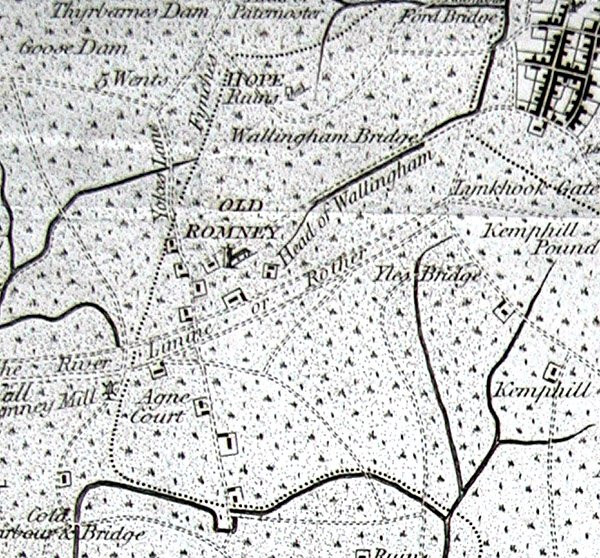



Historical names: Aghne Court; Agne Court; Agene; Hagene; Agnes Court; Agney Court; Agney Manor
Location: Old Romney, Kent
Places / associated places: Old Romney, Kent
Listed in Domesday Book: No
Location & Extent
GPS Location & Recorded Land Areas
Representative GPS point: 50.9883, 0.8913
Identity: confirmed — The supplied Old Romney identification matches the historically documented principal manor of Old Romney, also called Aghne Court, Agne Court, Agene, Hagene and Agney Court. The manor house, Agney Court or Court Lodge, stood about one mile south-west of St Clement's Church, and the estate extended into Midley. Scholarly and archival references distinguish it from other medieval manors in the Romney Marsh.
Representative point: 50.9883, 0.8913
Basis: documented_manor_house — The present Court Lodge, Wheelsgate Lane, Old Romney, is identified in scholarly discussion as Agney Court Lodge, the successor or surviving site of the historic manor house. A planning record gives the location as 50.9883, 0.8913.
Point confidence: medium
Boundary status: representative_point_only
Boundary period: Medieval to early modern; the estate's documented extent changed through reclamation and later subdivision or leasing
Boundary confidence: medium
Boundary basis: The evidence establishes that Agney was the principal manor of Old Romney, claiming over much of Old Romney and extending into Midley. Archaeological and landscape studies identify demesne lands around Agney Court Lodge and a long strip of Upper and Lower Agney in the adjoining Midley area. However, the consulted public sources do not reproduce the 1769 particular, 1782 estate maps, terriers, or a sufficiently explicit parcel schedule from which a defensible perimeter can be reconstructed. The manor therefore cannot safely be represented by a polygon without examining those archival maps and associated documentation.
Sources:
- TNA Discovery: Agney Manor record F287539: https://discovery.nationalarchives.gov.uk/details/c/F287539 — Registry authority and record for the manor of Agney in Old Romney, Kent.
- The Topography of the Walland Marsh area between the Eleventh and Thirteenth Centuries: https://www.kentarchaeology.org.uk/papers/the-topography-of-the-walland-marsh-area-between-the-eleventh-and-thirteenth-century — Identifies the demesne lands around Agney Court Lodge and the long strip of Upper and Lower Agney, entirely within the Canterbury Cathedral Priory manor, extending through the Midley area.
- New Romney and the 'river of Newenden' in the later Middle Ages: https://kentarchaeology.squarespace.com/s/papers-1988-01-01-new-romney-and-the-river-of-newenden-in-the-later-middle-ages.pdf — States that the present Court Lodge in Old Romney was Agney Court Lodge in 1649 and gives the historical identification as Aghne, represented by Court Lodge.
- Court Lodge, Wheelsgate Lane, Old Romney planning record: https://www.landcycle.com/planning-applications/local-authority/FolkestoneHythe/TN29 — Provides the modern Court Lodge address and coordinates 50.9883, 0.8913.
- Tithe Apportionment for Old Romney: https://www.kentarchaeology.org.uk/records/tithes/old-romney — Records Agney Court, House and Premises, Court Lodge field and associated estate parcels in the nineteenth-century landscape.
- Canterbury Cathedral Archives catalogue: Agney estate maps and particulars: https://discovery.nationalarchives.gov.uk/details/r/N17351412 — Catalogue record for the 1782 map attached to the Agney terrier, an important primary source for reconstructing the estate extent.
Warnings / uncertainty:
- The representative point is defensible for the manor-house site but should not be treated as the centre of the entire historical manor.
- The historic manor comprised dispersed demesne and marshland holdings, including Upper and Lower Agney in or adjoining Midley; it was not equivalent to the modern Old Romney parish boundary.
- The early eighth-century identification with King Offa's charter is uncertain and is not used as the basis for the location.
- No polygon is returned because the publicly accessible evidence consulted does not expose the perimeter of the 1782 estate map or an equivalent documented boundary.
About the Manor
Agney Manor was the principal manor of Old Romney and extended into the adjoining parish of Midley. Historical spellings and aliases include Aghne Court, Agne Court, Agene, Hagene, Agnes Court and Agney Court; the manor was also associated with its manor house, Agney Court or Court Lodge, situated about a mile south-west of Old Romney church. The estate comprised demesne land around the court lodge and extended marshland holdings. Its early medieval identification is not entirely certain: a charter of King Offa dated 785 grants land between the stream called Heorat Burnan and Hagana's tree to Ealdbeorht and Selethryth, and Christ Church later associated that estate with Agney, but modern scholarship cautions that the charter does not identify the place securely. The manor is not separately named in Domesday, although unnamed archiepiscopal properties in the Old Romney area are recorded. By the early thirteenth century Agney was an occupied and managed Christ Church estate; an account for 1225 records substantial livestock taken to Agney. The court lodge was rebuilt or repaired after the great storms and inundations of 1287-1288. The manor remained an ecclesiastical estate, first of Christ Church Priory, Canterbury, and after the Dissolution of the Monasteries of the Dean and Chapter of Canterbury Cathedral. The Dean and Chapter granted leases for lives to successive private lessees, including members of the Thornhurst, Jennings and Spencer-associated families. The freehold inheritance and the leasehold interests must therefore be distinguished: the Dean and Chapter remained the recorded institutional owners, while the named individuals generally held leasehold or life-interest rights rather than an outright freehold estate.
Ownership / Holder Account
The earliest ownership is traditionally traced to a late eighth-century royal grant later attributed by Christ Church to its estate at Agney, but the identification is expressly uncertain in modern scholarship. Hasted records that Aghne Court was given by King Offa to the Priory of Christ Church, Canterbury, and that Christ Church held it until the Dissolution in the thirty-first year of Henry VIII, 1539. The estate was then surrendered to the Crown and, under Henry VIII's endowment or dotation arrangements in the thirty-third year of Henry VIII, 1541, settled on the newly founded Dean and Chapter of Canterbury. The Dean and Chapter retained the inheritance thereafter. From the sixteenth century onward, the manor was commonly occupied under leases for lives. The most securely documented private interests include the Thornhurst leaseholding line, Frances Thornhurst and her descendants, a lease to Ralph Jenyns in 1663, a counterpart lease to Sarah, Duchess of Marlborough, in 1728, and a lease or counterpart to the Earl Spencer in 1783. These instruments demonstrate successive leasehold interests but do not establish every intervening transfer or prove that each named lessee held the entirety of the manor at the same time. The public evidence therefore supports a continuous institutional freehold in the Dean and Chapter, with a partially recoverable sequence of leasehold occupants and beneficiaries.
Records & References
Sources and references mentioning this manor/title which are not necessarily conveyances or transfers.
21 records found · showing 9–16.
1693-1693: valuation (3 docs)
Held by: Canterbury Cathedral Archives and Library
Further information: NRA 39557
1635-1635: terrier, with other manors (1 vol)
Held by: Canterbury Cathedral Archives and Library
Further information: NRA 39557
1380-1384: serjeants' accounts (1 unfit for production) (4 rolls)
Held by: Canterbury Cathedral Archives and Library
1290-1320: summary of customs, with other manors (in volume with other items)
Held by: British Library, Manuscript Collections
1290-1320: summary of rents of assize, with other manors (in volume with other items)
Held by: British Library, Manuscript Collections
1290-1320: allowances of rents, with other manors (in volume with other items)
Held by: British Library, Manuscript Collections
1290-1320: summary of rents of assize and customs, with other manors (in volume with other items)
Held by: British Library, Manuscript Collections
1288-1288: ordinances rel to maintenance and repair of sea defences and drainage of marshes, with other manors (copy undated, late 14th cent)
Held by: Canterbury Cathedral Archives and Library
Conveyance & Descent
First holder to present holder: blood proximity & distance travelled
First recorded holder: Priory of Christ Church, Canterbury, represented by the prior and convent
Present holder:
Recorded title journey: 11 holder entries in this manor's saved Conveyance & Descent history.
No recorded holder currently has a usable saved direct-blood or collateral-blood relationship path from which to calculate proximity percentages.
First recorded holder → present holder
A usable saved blood relationship path between the first recorded holder and the present holder has not yet been recorded, so that first-to-present genealogical distance cannot be calculated.
Priory of Christ Church, Canterbury, represented by the prior and convent, Prior and convent of Christ Church
Transfer: Traditional attribution of the Agney estate to a grant by King Offa; the identification of the charter estate with Agney remains uncertain in modern scholarship.
Shared holding: Christ Church Priory ownership
Previous holder: King Offa or the Crown, if the charter identification is accepted
Hasted states that Aghne Court, alias Old Romney Court, was given by King Offa to the Priory of Christ Church. Nicholas Brooks and later Romney Marsh scholarship treat the connection between Offa's 785 charter and Agney as possible rather than certain. Hasted records Christ Church as holding the manor until its dissolution in 1539. The entry is therefore secure for the medieval Christ Church ownership attested by Hasted, but the exact beginning date and the direct continuity from the eighth-century charter should not be treated as certain.
Source: Edward Hasted, The History and Topographical Survey of the County of Kent, vol. 8, 1799, Old Romney, p. 441; Nicholas Brooks, 'Romney Marsh in the early Middle Ages', Archaeologia Cantiana, discussion of the 785 charter and Agney. — source link
Transfer: Christ Church Priory surrendered Agney with its other possessions at the Dissolution; the manor passed into the king's hands pending settlement on the Dean and Chapter of Canterbury.
Holding arrangement: Other — Whole manor during Crown custody and redistribution
Shared holding: Dissolution and Crown custody
Previous holder: Priory of Christ Church, Canterbury, represented by the prior and convent, Prior and convent of Christ Church
Hasted says that Agney continued with Christ Church until the priory's dissolution in the thirty-first year of Henry VIII, when it was surrendered into the king's hands with the rest of the priory's possessions. This entry records Crown custody or possession during the transfer process rather than a long-term private conveyance.
Source: Edward Hasted, The History and Topographical Survey of the County of Kent, vol. 8, 1799, Old Romney, p. 441. — source link
Dean and Chapter of Canterbury Cathedral
Transfer: By Henry VIII's dotation or endowment charter in the thirty-third year of Henry VIII, Agney was settled on the newly founded Dean and Chapter of Canterbury.
Shared holding: Canterbury Cathedral Dean and Chapter ownership
Previous holder: The Crown, King Henry VIII and the Crown
Hasted states that after the Dissolution Agney was settled by Henry VIII's dotation charter on the new Dean and Chapter of Canterbury, with whom the inheritance continued. This is the strongest evidence for the manor's institutional freehold ownership. Later private persons named in the sources should generally be understood as lessees or holders of life interests under the Dean and Chapter, not as outright owners of the inheritance.
Source: Edward Hasted, The History and Topographical Survey of the County of Kent, vol. 8, 1799, Old Romney, p. 441; Hasted's index identifies Aghne-court Manor in Old Romney among the possessions of the Dean and Chapter of Canterbury. — source link
Sir Stephen Thornhurst, member of the Thornhurst family
Transfer: Lease for lives or related leasehold grant from the Dean and Chapter of Canterbury; exact instrument and date not located in the sources reviewed.
Holding arrangement: Other — Leasehold or life interest; extent not specified
Shared holding: Thornhurst leaseholding line
Co-holders: Sir William Thornhurst, Sir Giffard Thornhurst
Previous holder: Dean and Chapter of Canterbury Cathedral
Secondary historical accounts state that Agney was leased in the middle of the sixteenth century to Sir Stephen Thornhurst. This was a private leasehold interest under the Dean and Chapter, not a transfer of the institutional inheritance. The precise commencement date, term and documentary instrument remain unidentified in the public sources reviewed.
Source: Edward Hasted, The History and Topographical Survey of the County of Kent, vol. 8, 1799, Old Romney, p. 441, for the Dean and Chapter's inheritance; modern summary of the Agney leaseholding sequence corroborated by later scholarship on the Thornhurst family. — source link
Sir William Thornhurst, member of the Thornhurst family
Transfer: Succession to the Agney leasehold interest within the Thornhurst family; the exact legal instrument and date are not established.
Holding arrangement: Other — Leasehold or life interest; extent not specified
Shared holding: Thornhurst leaseholding line
Co-holders: Sir Stephen Thornhurst, Sir Giffard Thornhurst
Previous holder: Sir Stephen Thornhurst, member of the Thornhurst family
The available account states that the Agney lease passed from Sir Stephen Thornhurst to his son Sir William Thornhurst and then to Sir William's son Sir Giffard Thornhurst. The manor's inheritance nevertheless remained with the Dean and Chapter of Canterbury. Because the underlying lease or renewal has not been located, the transition is recorded as a documented succession of the leasehold interest with uncertain dates rather than as a freehold conveyance.
Source: Modern historical summary of the Manor of Agney, citing the Agney leaseholding tradition and Hasted's account of the Dean and Chapter inheritance. — source link
Sir Giffard Thornhurst, first and only Thornhurst Baronet of Agnes Court
Transfer: Succession to the Thornhurst leasehold interest in Agney; the exact date of the lease transfer is unknown.
Holding arrangement: Other — Leasehold or life interest; extent not specified
Shared holding: Thornhurst leaseholding line
Co-holders: Sir Stephen Thornhurst, Sir William Thornhurst
Previous holder: Sir William Thornhurst, member of the Thornhurst family
Sir Giffard Thornhurst is explicitly associated with Agney Court and held the Thornhurst leasehold interest until his death in 1627. He was knighted in 1622 and became the first and only baronet of Agnes Court, but the baronetcy was a personal title and did not convert the Dean and Chapter's freehold into a territorial barony. On his death the leasehold interest passed to his infant daughter Frances, while his widow Susan held it during Frances's minority according to the available account.
Source: Modern account of the Manor of Agney, Kent; Hasted's index records Giffard Thornhurst of Agnes Court; Cambridge University Press, The Jacobite Duchess, chapter on Frances Thornhurst and Agney. — source link
Susan Temple, later Susan Lister
Transfer: Temporary possession or management of the Agney leasehold after the death of Sir Giffard Thornhurst, pending the minority of their daughter Frances.
Holding arrangement: Trust — Life or custodial interest pending Frances Thornhurst's majority
Shared holding: Thornhurst family minority holding
Previous holder: Sir Giffard Thornhurst, first and only Thornhurst Baronet of Agnes Court
After Sir Giffard Thornhurst died in 1627, the Agney interest belonged beneficially to his daughter Frances, but the available account states that her mother Susan held the property until Frances came of age and a new lease was prepared for Frances. This is recorded as a temporary custodial or trust-like holding rather than an outright conveyance or freehold ownership.
Source: Modern historical summary of the Manor of Agney, Kent; Cambridge University Press, The Jacobite Duchess, chapter on Frances Thornhurst's inheritance of a lease of lives in Agney. — source link
Frances Thornhurst, later Frances Jennings, later Mrs Richard Jennings
Transfer: A new lease was prepared for Frances Thornhurst after she came of age, following her father's death and her mother's interim possession.
Holding arrangement: Other — Leasehold for lives; extent not specified
Shared holding: Jennings-associated Agney leasehold
Previous holder: Susan Temple, later Susan Lister
Frances Thornhurst inherited the Agney leasehold interest from her father Sir Giffard Thornhurst. The account states that a new lease was prepared for her when she came of age. She later married Richard Jennings, after which the interest became associated with the Jennings family. The source does not establish the exact date of Frances's majority, the terms of the renewal or the precise date on which her interest ended.
Source: Modern historical summary of the Manor of Agney, Kent; Cambridge University Press, The Jacobite Duchess, chapter identifying Frances Thornhurst as inheriting a lease of lives on Agney. — source link
Transfer: Lease and counterpart from the Dean and Chapter of Canterbury Cathedral, recorded in Canterbury Cathedral Archives as U63/64651.
Holding arrangement: Other — Leasehold interest; extent and term require consultation of the original instrument
Shared holding: Documented Dean and Chapter lease
Previous holder: Dean and Chapter of Canterbury Cathedral; any immediate prior private lessee is not established
Canterbury Cathedral Archives records a 1663 lease and counterpart to Ralph Jenyns for Agney. This is direct evidence of a leasehold interest connected to the manor, but it does not by itself prove that Ralph Jenyns was the successor to Frances Thornhurst or that he held the whole manor. The intervening conveyance and exact lease terms remain unestablished.
Source: Canterbury Cathedral Archives, U63/64651, Lease and counterpart to Ralph Jenyns, 1663, as cited in the published study of the Thornhurst and Temple families. — source link
Sarah Churchill, Duchess of Marlborough, wife of John Churchill, 1st Duke of Marlborough, courtier and landowner
Transfer: Counterpart lease from the Dean and Chapter of Canterbury Cathedral, recorded in Canterbury Cathedral Archives as U63/64614.
Holding arrangement: Other — Leasehold interest; extent and term require consultation of the original instrument
Shared holding: Marlborough-associated Agney lease
Previous holder: Earlier leaseholder not securely established; the Jennings and Thornhurst connection is reported in secondary sources
Canterbury Cathedral Archives records a 1728 counterpart lease to the Duchess of Marlborough for Agney. This directly documents Sarah Churchill's leasehold interest in the manor. The source does not establish that she acquired the freehold, nor does the archival citation alone specify whether she held the whole manor or a defined part. Secondary accounts connect her interest with the earlier Jennings and Thornhurst leaseholding line.
Source: Canterbury Cathedral Archives, U63/64614, Counterpart lease to the Duchess of Marlborough, 1728, as cited in the published study of the Thornhurst and Temple families. — source link
John Spencer, 1st Earl Spencer, Member of Parliament
Transfer: Lease and counterpart to the Earl Spencer, recorded in Canterbury Cathedral Archives as U63/69865.
Holding arrangement: Other — Leasehold interest; extent and term require consultation of the original instrument
Shared holding: Spencer family Agney lease
Previous holder: Earlier leaseholder not securely established from the cited archival reference
Canterbury Cathedral Archives records a 1783 lease and counterpart to the Earl Spencer for Agney. The archival reference provides direct evidence of a Spencer leasehold interest. It does not establish the exact relationship between this lease and Sarah Churchill's 1728 lease, nor whether the Earl Spencer held the entire manor. The Dean and Chapter's inheritance remained the institutional freehold according to Hasted.
Source: Canterbury Cathedral Archives, U63/69865, Lease and counterpart to Earl Spencer, 1783, as cited in the published study of the Thornhurst and Temple families. — source link
Corrections / Challenges
Sign in to challenge or submit evidence against a recorded assertion.
JSON API
Machine-readable published manor data, including public images, mapped land areas, notes, rights, conveyances, relationships, records, source/document-library entries and public file links.
https://manorialregistry.com/index.php?rest_route=/mhr/v1/manor/agney-manorPublic API access is currently disabled. Authorised API clients must use a private X-MHR-API-Key; currently only administrator keys are enabled.
Private source files, pending edits, moderation/admin information, user API keys and non-public import identifiers are not returned.