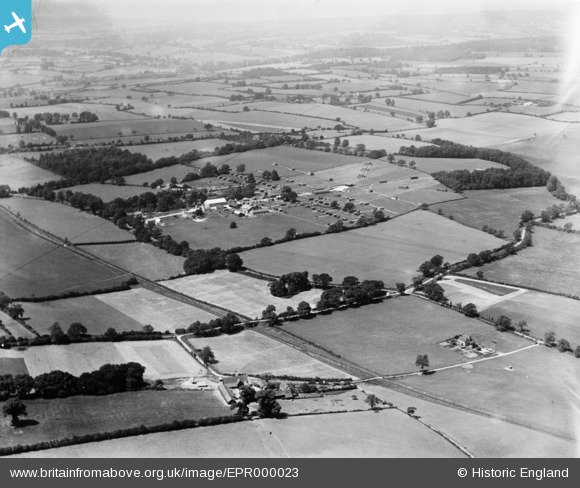



Historical names: Aynells (Manor) | Aignells (Manor) | Agnews (Manor) | Agnalls (Manor)
Location: Hemel Hempstead, Hertfordshire
Places / associated places: Hemel Hempstead, Hertfordshire
Location & Extent
GPS Location & Recorded Land Areas
Representative GPS point: 51.778835, -0.447814
Identity: confirmed — The supplied F246005 record, variant names, Hemel Hempstead location, associated St Agnells locality, and cited Agnells Manor records consistently identify the Hemel Hempstead manor, distinct from the separately recorded Agnells/Aynells manor in Redbourn.
Representative point: 51.778835, -0.447814
Basis: documented_manor_site — St Agnell's Farmhouse in Cupid Green Lane is the surviving named Agnell's/Aynells farmstead in the historical Agnells locality. Heritage evidence describes the site as a post-medieval farmstead with medieval origins, and the 1645 copy plan of Agnells Manor confirms the manor as an identifiable estate. The coordinate is the listed-building point for St Agnell's Farmhouse, corroborated by a geotagged survey photograph at approximately TL 0718 1004.
Point confidence: medium
Boundary status: representative_point_only
Boundary period:
Boundary confidence: none
Boundary basis: The research confirms the manor's location around St Agnell's Farm/Cupid Green and the northern Hemel Hempstead area, but no accessible source provides a sufficiently legible or explicitly transcribed perimeter from the 1645 plan, the 1366 extent, rentals, or court material. The modern settlement, parish, ward, or development boundaries cannot safely substitute for the historical manorial extent.
Sources:
- The National Archives, Manorial Documents Register: Agnells Manor, F246005: https://discovery.nationalarchives.gov.uk/details/c/F246005 — Registry record identifying Agnells Manor as the Hemel Hempstead manor and recording its historical variants and subordinate status.
- Hertfordshire Archives and Local Studies, copy plan of Agnells Manor, 1645, ref. 79703: https://discovery.nationalarchives.gov.uk/details/r/N14307817 — Archive catalogue record confirming the existence of a plan specifically depicting Agnells Manor in Hemel Hempstead in 1645; the accessible catalogue entry does not expose the plan's perimeter.
- Hemel Garden Communities Heritage Impact Assessment, Appendix 1: https://www.stalbans.gov.uk/sites/default/files/attachments/Planning%20Policy/R19/Appendix_1_Hemel_Garden_Communities.pdf — Identifies St Agnell's Farm, Cupid Green Lane, as a post-medieval farmstead with medieval origins, known as Agnell's or Aynells until the twentieth century.
- Planning Data, St Agnell's Farmhouse, listed building 1078122: https://www.planning.data.gov.uk/entity/31535626 — Provides the official listed-building coordinate POINT (-0.447814 51.778835) for St Agnell's Farmhouse in the Hemel Hempstead/Grovehill locality.
- Geograph, Hemel Hempstead: St Agnell's Farmhouse: https://www.geograph.org.uk/photo/6710387 — Locates the surviving farmhouse in Cupid Green Lane and gives a geotagged position of approximately 51.77877, -0.44781; it also records the historic map name Agnell's Farm from 1878 to 1938.
- London Metropolitan Archives, transcript of the Agnells Manor court material: https://adrianfinchblog.wordpress.com/wp-content/uploads/2020/07/london-metropolitan-archives-12-mar-2008.pdf — Transcribes the 23 September Philip and Mary 4&5 court heading for the Manor of Agnells in Hemel Hempstead, held by Sir William Dods and Elizabeth his wife, formerly wife of John Coningsby, deceased lord of the manor.
- Hertfordshire: A Landscape History: https://dokumen.pub/hertfordshire-a-landscape-history-9781909291003.html — References the 1645 copy plan of Agnells Manor, Hemel Hempstead, archive ref. 79703, within modern scholarly landscape research.
Warnings / uncertainty:
- The representative point is a defensible manorial-site proxy centred on St Agnell's Farmhouse, not proof that the surviving farmhouse is the exact medieval manor house.
- No reliable historical perimeter polygon was established. Do not inject a polygon based on the modern parish, Grovehill ward, St Agnells Lane, Cupid Green, or present-day estate boundaries.
- The Hemel Hempstead manor must not be conflated with St Agnells Farmhouse and the separate Agnells/Aynells manor in Redbourn.
About the Manor
Agnells Manor was a subordinate manor of the principal manor of Hemel Hempstead in Hertfordshire. The manor is recorded under variant forms including Aynells, Aignells, Agnews and Agnalls, and gave its name to the historic Agnells or St Agnells locality and farm in the northern part of Hemel Hempstead, around the modern St Agnells Lane and Cupid Green area. The surviving evidence indicates medieval origins: John de Aygnel held courts there during the reigns of Edward II and Edward III. A surviving court transcript for 23 September in the fourth and fifth regnal years of Philip and Mary, equivalent to 1556–1557, identifies Sir William Dods and Elizabeth his wife as holding the court baron; Elizabeth is described as the former wife of the deceased John Coningsby, knight, who had been lord of the manor. A copy plan of Agnells Manor dated 1645 is cited in modern county landscape research, confirming the continuing existence of the manor as an identifiable estate at that date. The manor should not be conflated with the separate Agnells or Aynells manor in Redbourn, Hertfordshire.
Ownership / Holder Account
The earliest securely located evidence is a court held by John de Aygnel in the nineteenth year of Edward II, followed by further courts from the second to the twenty-fourth years of Edward III. The source does not provide a documented conveyance into or out of the Aygnel family, so no intervening succession is asserted. By 23 September in the fourth and fifth years of Philip and Mary, the manor was in the hands of Sir William Dods and Elizabeth his wife; the court heading describes Elizabeth as formerly the wife of John Coningsby, knight, deceased lord of the manor. The precise conveyance from John Coningsby or his estate to Elizabeth and William Dods is not stated in the surviving evidence located. A 1645 plan demonstrates that Agnells Manor remained an identifiable estate, but the present research has not securely established its holder after the Dods and Elizabeth evidence. The descent is therefore partial, with a substantial documentary gap between the mid-sixteenth-century court and later estate evidence.
Manorial Rights & Privileges
Historic manorial rights / privileges (1)
Court baron
Provisional
The manor is expressly recorded as having a court baron, including the court held by Sir William Dods and Elizabeth his wife in 1556–1557.
Records & References
Sources and references mentioning this manor/title which are not necessarily conveyances or transfers.
11 records found · showing 1–8.
1862-1862: details of customs, with other manors (in steward's memoranda book)
Held by: Hertfordshire Archives and Local Studies
Further information: NRA 18363 Grover
1808-1838: minutes (2 vols)
Held by: Hertfordshire Archives and Local Studies
Further information: NRA 18363 Grover
1805-1923: steward's memoranda books, with other manors (3 vols)
Held by: Hertfordshire Archives and Local Studies
Further information: NRA 18363 Grover
1800-1900: steward's memoranda book, with other manors
Held by: Hertfordshire Archives and Local Studies
Further information: NRA 18363 Grover
1736-1736: rental
Held by: Hertfordshire Archives and Local Studies
Further information: NRA 18363 Grover
1645-1645: map (copy made in 18th century)
Held by: Hertfordshire Archives and Local Studies
1627-1669: court book, with other manors
Held by: Hertfordshire Archives and Local Studies
Further information: NRA 7246 Grimston
1564-1564: court book, with other manors
Held by: The London Archives: City of London
Further information: NRA 8596 See Acc/1085;Acc/1085/M/23
Conveyance & Descent
First holder to present holder: blood proximity & distance travelled
First recorded holder: John de Aygnel
Present holder:
Recorded title journey: 4 holder entries in this manor's saved Conveyance & Descent history.
No recorded holder currently has a usable saved direct-blood or collateral-blood relationship path from which to calculate proximity percentages.
First recorded holder → present holder
A usable saved blood relationship path between the first recorded holder and the present holder has not yet been recorded, so that first-to-present genealogical distance cannot be calculated.
John de Aygnel, Recorded as John de Aygnel, also appears in antiquarian material as John de Aignel or Aygnel
Transfer: Earliest securely evidenced holder located. Henry Chauncy's county history, as reported in a later antiquarian source, states that John de Aygnel held a court in this manor in the nineteenth year of Edward II and several other courts from the second through the twenty-fourth years of Edward III. No earlier holder or conveyance into John de Aygnel has been located.
The evidence is a direct manorial-court reference linking John de Aygnel to this Agnells Manor in Hemel Hempstead, not merely a family or place-name association. The source describes him as holding a court, which is strong evidence of lordship or manorial control, although the precise legal tenure and the date on which he first acquired the manor are not stated.
Source: Henry Chauncy, The Historical Antiquities of Hertfordshire (London, 1700), folio/page reference reported as f. 594; corroborated by the later antiquarian discussion identifying John de Aygnel as holding courts in the Hemel Hempstead manor of Agnells. — source link
John Coningsby, Knight, described in the Agnells court heading as deceased lord of the manor
Transfer: The 1556–1557 court heading describes John Coningsby, knight, as deceased lord of the manor and identifies Elizabeth, his former wife, and her current husband Sir William Dods as holding the court. The source does not state how or when the manor passed from John Coningsby or his estate to Elizabeth and William Dods.
Previous holder: Unknown
John Coningsby is entered because the contemporary court record explicitly identifies him as the deceased lord of this Agnells Manor. His starting date and the precise date and mechanism of his acquisition are unknown. The record establishes that he held the lordship before the court of 23 September in the fourth and fifth regnal years of Philip and Mary, but it does not by itself prove that Elizabeth inherited the manor or that William Dods acquired it through marriage.
Source: London Metropolitan Archives transcript of a sixteenth-century manorial court volume, folio 82 verso: 'Manor of Agnells in Hemel Hempstead'; court baron of Sir William Dods and Elizabeth his wife, 'once the wife of John Coningsby kt deceased lord of the said manor', dated 23 September Philip and Mary 4 and 5. — source link
Sir William Dods and Elizabeth Dods, Knight, holder of the Agnells Manor court jointly with Elizabeth his wife
Transfer: At the court held on 23 September in the fourth and fifth regnal years of Philip and Mary, Sir William Dods and Elizabeth his wife held the court baron of Agnells Manor. Elizabeth is described as having previously been the wife of the deceased John Coningsby, knight, who had been lord of the manor. The precise conveyance or succession from Coningsby is not recorded in the source located.
Holding arrangement: Joint
Shared holding: Sir William Dods and Elizabeth his wife
Previous holder: John Coningsby, Knight, described in the Agnells court heading as deceased lord of the manor
This is direct evidence that the Dods and Elizabeth couple exercised the manorial court at Agnells Manor in 1556–1557. The wording establishes joint court-holding by the married couple but does not specify whether Elizabeth held an inherited or dower interest, whether Sir William held a separate legal estate, or whether the couple held the whole manor jointly. No end date has been securely established.
Source: London Metropolitan Archives transcript, folio 82 verso, headed 'Manor of Agnells in Hemel Hempstead': 'Court Baron of Sir William Dods kt and Elizabeth his wife once the wife of John Coningsby kt deceased lord of the said manor', dated 23 September Philip and Mary 4 and 5. — source link
Elizabeth Dods, Wife of Sir William Dods, formerly wife of John Coningsby, knight
Transfer: Elizabeth appears jointly with her husband Sir William Dods as holder of the court baron. The court identifies her as the former wife of John Coningsby, deceased lord of the manor, but does not state whether her interest arose by inheritance, dower, settlement, purchase, or another legal mechanism.
Holding arrangement: Joint
Shared holding: Elizabeth Dods and Sir William Dods
Previous holder: John Coningsby, Knight, described in the Agnells court heading as deceased lord of the manor
Elizabeth is included separately because the court record expressly names her as one of the persons holding the court and connects her to the previous lord through her former marriage. That marital relationship is not treated as proof of a conveyance; the legal transfer remains unknown.
Source: London Metropolitan Archives transcript, folio 82 verso, headed 'Manor of Agnells in Hemel Hempstead': court baron of Sir William Dods and Elizabeth his wife, once the wife of John Coningsby, deceased lord of the manor, dated 23 September Philip and Mary 4 and 5. — source link
Corrections / Challenges
Sign in to challenge or submit evidence against a recorded assertion.
JSON API
Machine-readable published manor data, including public images, mapped land areas, notes, rights, conveyances, relationships, records, source/document-library entries and public file links.
https://manorialregistry.com/index.php?rest_route=/mhr/v1/manor/agnells-manorPublic API access is currently disabled. Authorised API clients must use a private X-MHR-API-Key; currently only administrator keys are enabled.
Private source files, pending edits, moderation/admin information, user API keys and non-public import identifiers are not returned.