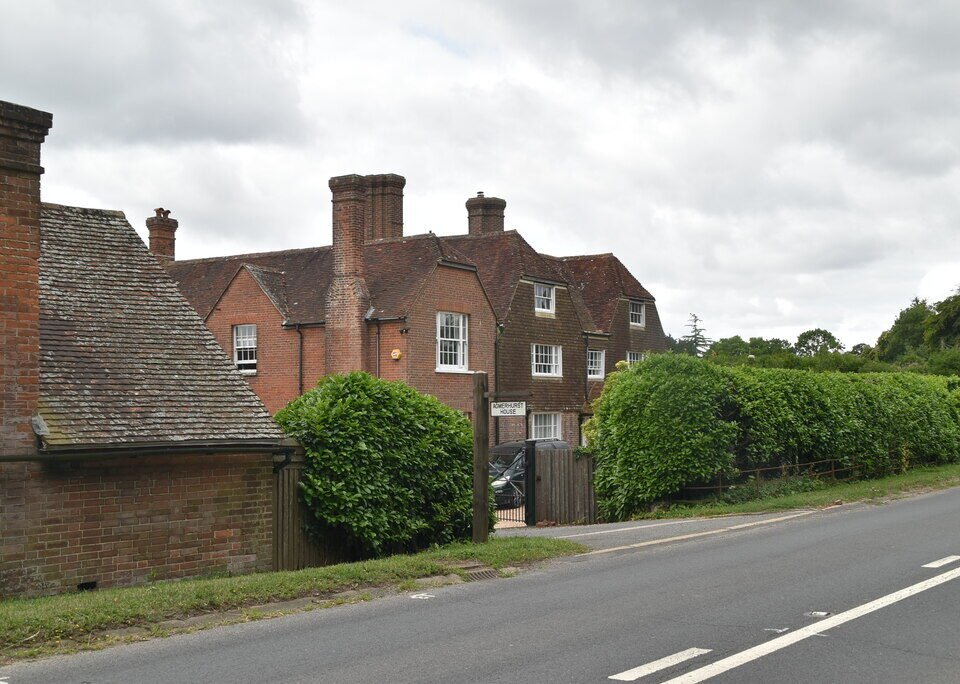



Historical names: Agmondhurst (Manor) | Ashmereshurst (Manor)
Location: Ashburnham, Sussex
Places / associated places: Ashburnham, Sussex
Location & Extent
GPS Location & Recorded Land Areas
Representative GPS point: 50.903415, 0.419135
Identity: confirmed — The exact TNA/MDR record is for Agmerhurst Manor in Ashburnham, Sussex. The Keep independently lists Agmerhurst among the manors that controlled land in Ashburnham, while the supplied historical variants Agmondhurst and Ashmereshurst are consistent with the record identity.
Representative point: 50.903415, 0.419135
Basis: supported_manorial_centre — Best available geographic proxy is the documented Agmerhurst House/Agmerhurst Farm cluster on Kitchenham Road, centred on Agmerhurst House at NGR TQ7019314336. This is not asserted to be the surviving manor house; it is a name-preserving locality and the most defensible surviving indicator of the manor's historical core.
Point confidence: medium
Boundary status: representative_point_only
Boundary period: Undetermined; no manor-specific perimeter could be established from the public evidence located.
Boundary confidence: none
Boundary basis: The Keep confirms that Agmerhurst controlled land in Ashburnham and identifies the Ashburnham tithe map and award (1839-1840, PAR 233/21/2 and TDE 68/2), but the publicly accessible material located does not identify which tithe plots belonged specifically to Agmerhurst Manor or provide a mapped manor boundary. The Battle Abbey rentals, courts and surveys are evidence of manorial administration and landholding but were not available in a form permitting reconstruction of a complete perimeter. The parish, civil parish, estate and modern property boundaries therefore cannot safely be substituted.
Sources:
- The National Archives, Manorial Documents Register: Agmerhurst Manor, F254790: https://discovery.nationalarchives.gov.uk/details/c/F254790 — Registry record identifying Agmerhurst Manor in Ashburnham, Sussex, with the relevant authority/reference and historical record context.
- The Keep: Ashburnham — introduction to the parish and documents held at The Keep: https://www.thekeep.info/places/eastsussex/parishesandsettlements/ashburnham/ — Lists Agmerhurst among the manors that controlled land in Ashburnham and identifies the Ashburnham tithe map and award holdings.
- Historic England: Agmerhurst House, Ashburnham, list entry 1278842: https://historicengland.org.uk/listing/the-list/list-entry/1278842 — Documents the surviving Agmerhurst House in Ashburnham at National Grid Reference TQ7019314336, used to derive the representative coordinate.
- East Sussex Record Office: Guide to Rating and Taxation Records: https://www.thekeep.info/wp-content/uploads/2014/07/Guide-to-Rating-and-Taxation-Records.pdf — Confirms the Ashburnham tithe map and award references PAR 233/21/2 and TDE 68/2 for 1839-1840.
- Calendar of the Battle Abbey Archives: https://cdn.calisphere.org/data/13030/7j/c8rn3f7j/files/battle_abbey_calendar.pdf — Confirms the existence of dedicated Agmerhurst post-Dissolution court-book material and related Battle Abbey manorial records, supporting the historical identity but not supplying a usable boundary.
Warnings / uncertainty:
- Agmerhurst House and Agmerhurst Farm are later name-preserving places and are not treated as proof that either surviving property is the medieval manor house.
- No reliable manor-specific polygon was found; the representative point should not be interpreted as the territorial boundary.
- The Ashburnham parish boundary, modern estate boundary, or current property boundaries must not be substituted for the historical manorial extent.
- The point is suitable as a cautious location proxy, but its identification as the exact medieval manorial centre remains unproven.
About the Manor
Agmerhurst Manor was a manor in the parish of Ashburnham, Sussex, also recorded as Agmondhurst and Ashmereshurst. The manor should be distinguished from the later Agmerhurst House and Agmerhurst Farm, although those places preserve the manor's historical name. Agmerhurst is listed by The Keep, East Sussex's principal archive service, among the manors that controlled land in Ashburnham. From the sixteenth century it formed part of the wider Battle Abbey estate, which after the Dissolution was held by the Browne family, Viscounts Montagu, and subsequently by the Webster family. The surviving public evidence located for this backfill does not provide a complete medieval descent or prove that every later parcel bearing the Agmerhurst name remained within the manorial estate.
Ownership / Holder Account
The earliest documentary material located is medieval Battle Abbey evidence referring to rents and tenements in Agmerhurst in Ashburnham, but the surviving reference does not by itself establish that Battle Abbey held the manor as a whole. The secure manorial descent begins with the post-Dissolution Battle Abbey estate. Battle Abbey and substantial associated lands were granted or sold to Sir Anthony Browne in 1538, and the post-Dissolution estate descended in the Browne family, who became Viscounts Montagu. A later account of the 1721 transaction expressly identifies the Manor of Agmerhurst as one of the manors included in the Battle Abbey estate acquired from Viscount Montagu by Sir Thomas Webster. The Battle Abbey estate remained with the Webster family until its sale in 1857 to Lord Harry Vane, later 4th Duke of Cleveland. The estate was reacquired by Sir Augustus Webster in 1901 and remained in the Webster family until the estate's sale to the state in 1976. These estate-level successions are evidence for the manor only insofar as Agmerhurst is explicitly identified as part of the Battle Abbey estate in the 1721 evidence; the public sources located do not establish whether Agmerhurst Manor was retained intact through every later sale or whether parts were separately disposed of. The post-1976 ownership of the specific manor, as distinct from Battle Abbey itself and from Agmerhurst House or Farm, was not established.
Records & References
Sources and references mentioning this manor/title which are not necessarily conveyances or transfers.
43 records found · showing 1–8.
1916-1916: steward's papers
Held by: East Sussex and Brighton and Hove Record Office (ESBHRO)
Further information: NRA 5228 Sheppard
1870-1870: rental
Held by: East Sussex and Brighton and Hove Record Office (ESBHRO)
Further information: NRA 1211 Battle manor
1860-1860: rental, with other manors
Held by: East Sussex and Brighton and Hove Record Office (ESBHRO)
Further information: NRA 5228 Sheppard
1852-1852: rental
Held by: East Sussex and Brighton and Hove Record Office (ESBHRO)
Further information: NRA 1211 Battle manor
1835-1835: court fees
Held by: East Sussex and Brighton and Hove Record Office (ESBHRO)
Further information: NRA 1000 Ashburnham
1831-1839: steward's fee book, with other manors
Held by: East Sussex and Brighton and Hove Record Office (ESBHRO)
Further information: NRA 1000 Ashburnham
1822-1888: notebook of fees, with other manors (1822-1831, 1888)
Held by: East Sussex and Brighton and Hove Record Office (ESBHRO)
1820-1844: quit rents, with other manors (8)
Held by: East Sussex and Brighton and Hove Record Office (ESBHRO)
Further information: NRA 1211 Battle manor
Conveyance & Descent
First holder to present holder: blood proximity & distance travelled
First recorded holder: Sir Anthony Browne and the Browne family, later Viscounts Montagu
Present holder:
Recorded title journey: 5 holder entries in this manor's saved Conveyance & Descent history.
No recorded holder currently has a usable saved direct-blood or collateral-blood relationship path from which to calculate proximity percentages.
First recorded holder → present holder
A usable saved blood relationship path between the first recorded holder and the present holder has not yet been recorded, so that first-to-present genealogical distance cannot be calculated.
Sir Anthony Browne and the Browne family, later Viscounts Montagu, Sir Anthony Browne was a Tudor courtier and Master of the Horse, his son Anthony Browne became 1st Viscount Montagu in 1554
Transfer: Post-Dissolution grant or acquisition of Battle Abbey and its associated estate from the Crown, followed by descent in the Browne family and Viscounts Montagu
Shared holding: Browne family and Viscounts Montagu
Previous holder: Battle Abbey, the Benedictine monastery of St Martin at Battle, and ultimately the Crown after the Dissolution
Battle Abbey was dissolved in 1538, and the abbey together with a substantial area of associated land was granted or sold to Sir Anthony Browne. The Battle Abbey archive subsequently consisted of Browne family and Viscounts Montagu estate papers. The evidence does not provide a separate 1538 deed naming Agmerhurst Manor, but a later account of the Battle Abbey estate explicitly includes Agmerhurst among the manors held by that estate. This entry therefore records the post-Dissolution estate holding with medium rather than high evidence for the specific manor link.
Source: Historic England, Battle Abbey, Battle, National Heritage List for England entry 1000309; The Huntington Library, Battle Abbey Archives, 1077-circa 1830, collection description; Rose Fuller Whistler, The Annals of an English Family, Sussex Archaeological Collections, volume 35 (1887), as summarized in the Battle estate history. — source link
Sir Thomas Webster, 1st Baronet, and the Webster family, Member of Parliament, owner of the Battle Abbey estate from 1721
Transfer: Purchase of the Battle Abbey estate from Viscount Montagu; the purchased estate expressly included the Manor of Agmerhurst
Shared holding: Webster family, first ownership period
Previous holder: Anthony Browne, 6th Viscount Montagu
In 1721 Sir Thomas Webster purchased the Battle Abbey estate from Viscount Montagu. The contemporary or near-contemporary estate account cited in the research specifically lists the Manors of Battle, Barnhorne, Agmerhurst and Swineham among the assets acquired. This is the clearest direct evidence located linking the specific manor to a named owner. The date is given as 1721 because that is the date stated by the principal modern and archival summaries, although some secondary accounts describe the disposal as occurring between 1715 and 1721.
Source: Henry Whistler, ‘Whistler, Henry’, Epsom and Ewell History Explorer, citing Rose Fuller Whistler, The Annals of an English Family, Sussex Archaeological Collections, volume 35 (1887); The Huntington Library, Battle Abbey Archives, 1077-circa 1830; English Heritage, History of Battle Abbey and Battlefield. — source link
Webster family, including the successive Webster baronets, Baronets of the Webster family of Battle Abbey
Transfer: Descent within the Webster family after the death of Sir Thomas Webster; no separate manor-specific conveyance located
Shared holding: Webster family, inherited Battle Abbey estate
Previous holder: Sir Thomas Webster, 1st Baronet
The Battle Abbey estate remained in the Webster family after Sir Thomas Webster's death. Public summaries identify successive Webster baronets as owners of the estate and state that the estate was sold out of the family in 1857. Because the sources located describe the Battle Abbey estate as a whole and do not provide separate Agmerhurst deeds for each succession, this entry records the family holding rather than asserting an individual manor conveyance at every generational change.
Source: The Huntington Library, Battle Abbey Archives, 1077-circa 1830, collection description; English Heritage, History of Battle Abbey and Battlefield; Google Arts & Culture, The Webster Family and Battle Abbey; Friends of the National Libraries, Title deeds from Raper and Fovargue of Battle, solicitors. — source link
Harry Vane, later 4th Duke of Cleveland, and the Cleveland estate, Harry Vane later became 4th Duke of Cleveland, the Duchess of Cleveland held the estate until 1901
Transfer: Purchase of the Battle Abbey estate from the Webster family
Shared holding: Cleveland estate
Previous holder: Webster family
The Battle Abbey estate was sold in 1857 to Lord Harry Vane, later 4th Duke of Cleveland. The Duchess of Cleveland held the estate until her death in 1901. The sources located describe this as ownership of the Battle Abbey estate, but do not reproduce the conveyance or separately name Agmerhurst Manor in the 1857 transaction; the manor connection is therefore recorded as medium-strength estate evidence rather than as a direct manor deed.
Source: Historic England, Battle Abbey, National Heritage List for England entry 1000309; English Heritage, History of Battle Abbey and Battlefield; Battle History Society, Cleveland, the Duke and Duchess. — source link
Sir Augustus Webster and the Webster family, Webster baronets of Battle Abbey
Transfer: Reacquisition of the Battle Abbey estate after the death of the Duchess of Cleveland
Shared holding: Webster family, reacquired estate
Previous holder: Duchess of Cleveland and the Cleveland estate
After the death of the Duchess of Cleveland in 1901, Sir Augustus Webster bought the Battle Abbey estate back into the Webster family. The estate remained associated with the Webster family until its sale to the state in 1976. Agmerhurst is documented in the nineteenth- and twentieth-century Ashburnham landscape, including Agmerhurst House and Farm, but the sources located do not prove whether the entire manor remained intact within the Battle Abbey estate throughout this period. This entry therefore records the estate-level succession with a stated qualification.
Source: English Heritage, History of Battle Abbey and Battlefield; Historic England, Battle Abbey, National Heritage List for England entry 1000309; The Keep, Ashburnham parish and manorial records; Historic England, Agmerhurst House, National Heritage List for England entry 1278842. — source link
Corrections / Challenges
Sign in to challenge or submit evidence against a recorded assertion.
JSON API
Machine-readable published manor data, including public images, mapped land areas, notes, rights, conveyances, relationships, records, source/document-library entries and public file links.
https://manorialregistry.com/index.php?rest_route=/mhr/v1/manor/agmerhurst-manorPublic API access is currently disabled. Authorised API clients must use a private X-MHR-API-Key; currently only administrator keys are enabled.
Private source files, pending edits, moderation/admin information, user API keys and non-public import identifiers are not returned.