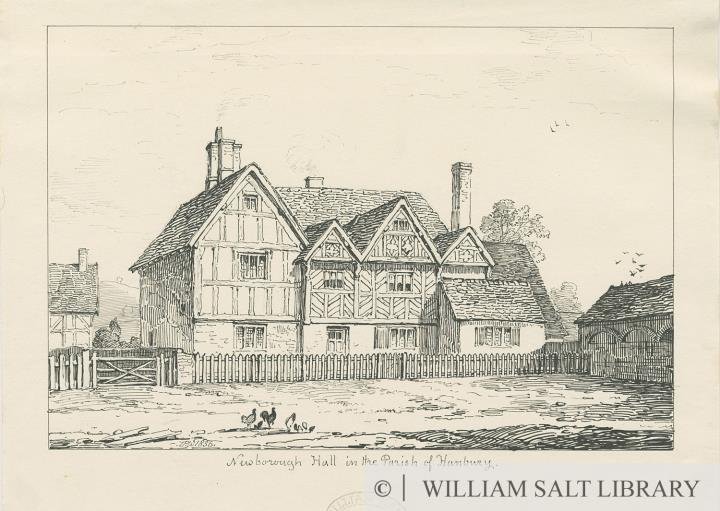



Historical names: Edgareslege; Newborough
Location: Hanbury, Staffordshire
Places / associated places: Hanbury, Staffordshire
Listed in Domesday Book: Yes
Location & Extent
GPS Location & Recorded Land Areas
Representative GPS point: 52.8307, -1.8026
Identity: confirmed — The record is securely identified as the medieval Agardsley lordship in Hanbury parish, Staffordshire, later associated with the borough and settlement of Newborough. The Staffordshire County Council Newborough Extensive Urban Survey links Agardsley, Newborough, the de Ferrers and Lancastrian lordship, and the medieval manor-house site at Newborough Hall. The associated National Archives manorial records also identify Agardsley as a Duchy of Lancaster manor administered with the Honour of Tutbury.
Representative point: 52.8307, -1.8026
Basis: documented_manor_site — Newborough Hall moated site, millpond and fishpond complex, centred approximately at OS grid reference SK 133259 / Historic England NGR SK 13392 25914. The Staffordshire Newborough EUS states that this site appears to have originated as the location of Agardsley/Newborough manor house, which existed by the late thirteenth century.
Point confidence: high
Boundary status: representative_point_only
Boundary period: Medieval to early modern manor, with surviving administrative records from the fourteenth to nineteenth centuries
Boundary confidence: none
Boundary basis: The available evidence establishes the manor's location and historical associations but does not provide a sufficiently clear, publicly accessible polygon for the manorial landholding. Domesday records describe Agardsley with arable, meadow and woodland pasture, including woodland pasture dimensions associated with the wider Marchington/Agardsley landscape, but these descriptions cannot safely be converted into a perimeter. The Newborough EUS provides conjectural maps of the medieval settlement and landscape, not a documented boundary of the entire manor. The later Newborough Hall estate must not be treated as equivalent to the whole Agardsley lordship. A 1610 manor-boundary record is catalogued in the Staffordshire archive material, but its boundary geometry was not available in the consulted online evidence.
Sources:
- Newborough Hall moated site, millpond, two fishponds and connecting channels, Historic England NHLE 1010124: https://historicengland.org.uk/listing/the-list/list-entry/1010124 — Identifies the scheduled medieval moated site at Newborough, gives the precise National Grid References SK 13392 25914 and SK 13440 25978, and records the surviving archaeological remains of Newborough Hall.
- Newborough Extensive Urban Survey Report, Staffordshire County Council: https://www.staffordshire.gov.uk/environment/Environment-and-countryside/HistoricEnvironment/Documents/Newborough-EUS-Report-Final.pdf — States that Agardsley was the Domesday settlement and manor later associated with Newborough; the earlier settlement location is uncertain but believed to lie in the present settlement area; and Newborough Hall moated site appears to have originated as the manor-house location by the late thirteenth century. It also distinguishes the manor-house site from later freehold and tenanted estates and provides only conjectural medieval landscape maps.
- Newborough Hall moated site, Ancient Monuments UK: https://ancientmonuments.uk/108339-newborough-hall-moated-site-millpond-two-fishponds-and-connecting-channels-newborough — Publishes the approximate WGS84 coordinates 52.8307, -1.8026 and OS grid reference SK133259 for the Historic England scheduled monument.
- Staffordshire and Stoke-on-Trent Archive Service, Guide to Manorial Records: https://staffordshirehistorycentre.blog/wp-content/uploads/2023/05/guide-to-sources-no.7-manorial-records-2021.pdf — Confirms Agardsley manorial court rolls for 1404-1618 in Duchy of Lancaster custody and notes the wider Agardsley grouping including Thornyhill, Hoar Cross and Newborough; it also directs Agardsley Park material to Needwood.
- The National Archives, Agardsley Manor record F256004: https://discovery.nationalarchives.gov.uk/details/c/F256004 — Primary registry record for the exact Agardsley Manor identity and the authority/reference GB/NNAF/M274045.
Warnings / uncertainty:
- The representative point marks the documented or strongly supported medieval manor-house site at Newborough Hall, not the centre of the entire historical lordship.
- No historical manorial polygon is returned because the consulted evidence does not expose a defensible perimeter. Do not substitute Newborough civil parish, the modern settlement boundary, the Newborough Hall estate, or the Needwood estate boundary.
- The location of the earlier Domesday settlement of Agardsley remains uncertain, although it is believed to have been in or near present-day Newborough.
- The Domesday woodland-pasture dimensions and the later association with Needwood Forest indicate a potentially extensive and changing territorial context, but they do not define a safe polygon for Agardsley Manor.
About the Manor
Agardsley Manor was the medieval manor associated with the Domesday settlement of Edgareslege in Hanbury parish, Staffordshire. The name Agardsley was later replaced or supplemented by Newborough, the borough founded within the manor in 1263 by Robert de Ferrers, earl of Derby. The location of the earlier settlement is uncertain, but it is believed to have been in the area of present-day Newborough. Agardsley formed part of the de Ferrers and later Lancastrian estates and was associated with Needwood Forest. A manor house existed by the late thirteenth century at the site now represented by Newborough Hall moat. The Newborough Hall estate should not automatically be equated with the entire lordship: it was leased to tenants from 1310 and later followed a separate estate history. The surviving Agardsley manorial court records include Duchy of Lancaster material from 1404 to 1618 and Staffordshire record-office court books and papers from the seventeenth to nineteenth centuries.
Ownership / Holder Account
The Domesday estate of Agardsley, recorded as Edgareslege, was held in 1086 by Henry de Ferrers, after having been held in 1066 by Wulfric. The de Ferrers family retained the lordship and were created earls of Derby in 1138. The manor was temporarily granted to Tutbury Priory in the early thirteenth century, but had returned to the de Ferrers by 1263, when Robert de Ferrers issued a borough charter to his burgesses of Agardsley and founded Newborough. Following the forfeiture of the estates of Robert de Ferrers, earl of Derby, after the Barons' War, Agardsley passed in 1265 or 1266 to Edmund, younger son of Henry III and earl of Lancaster. The manor thereafter formed part of the Lancastrian estate. The Lancastrian connection was absorbed into the Crown when Henry of Bolingbroke became Henry IV in 1399; Duchy of Lancaster records attest continuing administration of Agardsley from 1404 onward. In the later seventeenth century, the manor was acquired by the Egerton interest: Staffordshire historical research states that the Egerton family received Agardsley Manor, including Newborough, in 1668. A later antiquarian account records that Sir Symon Degge purchased the manors of Marchington and Agardsley from Charles Egerton and the earl of Bridgewater, probably in the later seventeenth century, although the precise date and legal form of that transaction require verification from the underlying deeds. By 1851, William White described the manor of Agardsley as belonging to H. C. M. Ingram. The complete descent from the late seventeenth-century Degge holding to H. C. M. Ingram has not been securely established from the publicly accessible sources consulted.
Records & References
Sources and references mentioning this manor/title which are not necessarily conveyances or transfers.
81 records found · showing 9–16.
1826-1837: letters rel to enfranchisement of copyholds, with Marchington (in bundle with other items)
Held by: Staffordshire and Stoke-on-Trent Archive Service: Staffordshire County Record Office
Further information: NRA 8481 Chetwynd-Talbot
1820-1820: list of copyholders
Held by: Staffordshire and Stoke-on-Trent Archive Service: Staffordshire County Record Office
Further information: NRA 28038 Meynell
1819-1819: presentment re manor boundary
Held by: Staffordshire and Stoke-on-Trent Archive Service: Staffordshire County Record Office
Further information: NRA 8481 Chetwynd-Talbot
1819-1843: perambulations 1819, 1843
Held by: Staffordshire and Stoke-on-Trent Archive Service: Staffordshire County Record Office
Further information: NRA 28038 Meynell
1818-1819: perambulation
Held by: The National Archives
1815-1815: papers rel to fishing rights
Held by: Staffordshire and Stoke-on-Trent Archive Service: Staffordshire County Record Office
Further information: NRA 40756 Challinor
1811-1817: extracts from court rolls, with Marchington
Held by: Staffordshire and Stoke-on-Trent Archive Service: Staffordshire County Record Office
Further information: NRA 8481 Chetwynd-Talbot
1810-1825: accounts, with Marchington
Held by: Staffordshire and Stoke-on-Trent Archive Service: Staffordshire County Record Office
Further information: NRA 8481 Chetwynd-Talbot
Conveyance & Descent
First holder to present holder: blood proximity & distance travelled
First recorded holder: Wulfric
Present holder:
Recorded title journey: 11 holder entries in this manor's saved Conveyance & Descent history.
No recorded holder currently has a usable saved direct-blood or collateral-blood relationship path from which to calculate proximity percentages.
First recorded holder → present holder
A usable saved blood relationship path between the first recorded holder and the present holder has not yet been recorded, so that first-to-present genealogical distance cannot be calculated.
Wulfric, Lord of the Agardsley estate in 1066
Transfer: Held before the Domesday tenure of Henry de Ferrers; the Domesday evidence identifies Wulfric as the pre-Conquest lord of the Agardsley estate.
The Domesday material identifies Wulfric as the lord in 1066 of the estate recorded as Agardsley or Edgareslege. This is evidence for the predecessor estate or settlement, not necessarily for a fully developed later medieval manor.
Source: Open Domesday, Agardsley, Staffordshire; based on the Domesday Book entry for Edgareslege. — source link
Transfer: Norman Crown grant or post-Conquest succession; the Domesday entry records Henry de Ferrers as tenant-in-chief and lord in 1086.
Shared holding: de Ferrers family
Co-holders: de Ferrers family, including Robert de Ferrers II, earl of Derby, Robert de Ferrers III, earl of Derby
Previous holder: Wulfric, Lord of the Agardsley estate in 1066
Agardsley was recorded in Domesday Book as Edgareslege under the land of Henry de Ferrers. Staffordshire historical research states that by 1086 the estate was held by the de Ferrers family, who later became earls of Derby.
Source: Staffordshire County Council, Newborough Extensive Urban Survey, section 2.4.1.1, citing the Domesday Book; Open Domesday, Agardsley. — source link
de Ferrers family, including Robert de Ferrers II, earl of Derby
Transfer: Dynastic succession within the de Ferrers family; no single conveyance date has been established.
Shared holding: de Ferrers family
Co-holders: Henry de Ferrers, Robert de Ferrers III, earl of Derby
A record of Robert de Ferrers II, earl of Derby, confirming grants to Tutbury Priory in 1150x1159 mentions his market at Newborough. The evidence links the de Ferrers earl directly with the Agardsley/Newborough estate before the temporary grant to Tutbury Priory.
Source: Gazetteer of Markets and Fairs to 1516, Staffordshire, entry for Newborough, citing A. Saltman, The Cartulary of Tutbury, no. 52. — source link
Transfer: Temporary grant from the de Ferrers; the precise grant and restoration dates are not stated in the accessible source.
Holding arrangement: Other
Shared holding: Tutbury Priory
Previous holder: de Ferrers family
Staffordshire historical research states that the de Ferrers briefly granted Agardsley Manor to Tutbury Priory in the early thirteenth century and that the manor had returned to the de Ferrers by 1263. This was a temporary institutional holding, not merely a tenancy.
Source: Staffordshire County Council, Newborough Extensive Urban Survey, section 2.4.1.2. — source link
Robert de Ferrers III, earl of Derby
Transfer: Restoration or recovery from Tutbury Priory before 1263; Robert de Ferrers issued the 1263 borough charter to the burgesses of Agardsley, establishing Newborough within the manor.
Shared holding: de Ferrers family
Co-holders: Henry de Ferrers, de Ferrers family, including Robert de Ferrers II, earl of Derby
Previous holder: Tutbury Priory, Priory of St Mary
The 1263 charter issued by Robert de Ferrers, earl of Derby, to the burgesses of Agardsley demonstrates direct lordship over the manor at that date. The estate was then forfeited or transferred to the Lancastrian interest following the earl's involvement in the Barons' War.
Source: Gazetteer of Markets and Fairs to 1516, Staffordshire, entry for Newborough; Staffordshire County Council, Newborough Extensive Urban Survey, sections 2.4.1.2 and 2.4.1.3. — source link
Transfer: The manor passed to Edmund, younger son of King Henry III, after the forfeiture of the de Ferrers estates following the Barons' War.
Shared holding: House of Lancaster
Co-holder: Thomas, earl of Lancaster
Previous holder: Robert de Ferrers III, earl of Derby
The Staffordshire County Council historical survey states that Agardsley Manor passed to Edmund, earl of Lancaster, in 1265 or 1266 after the involvement of the earl of Derby in the Barons' War. The manor consequently became part of the Lancastrian estate.
Source: Staffordshire County Council, Newborough Extensive Urban Survey, section 2.4.1.2; corroborated by research on the Honour of Tutbury. — source link
Transfer: Succession to the Lancastrian estate after the death of Edmund, earl of Lancaster; the 1300 charter for Newborough identifies Thomas, earl of Lancaster, as the lord for whom the market and fair were to be held at the manor.
Shared holding: House of Lancaster
Co-holder: Edmund, earl of Lancaster
Thomas inherited the Lancastrian estates from Edmund. A charter dated 1 April 1300 granted a market and fair to Thomas, earl of Lancaster, to be held at the manor of Newborough, the borough situated within Agardsley Manor. This provides direct contemporary evidence of Lancastrian lordship over the Agardsley/Newborough manor complex.
Source: Gazetteer of Markets and Fairs to 1516, Staffordshire, entry for Newborough, citing the Charter Rolls, 1257-1300, page 482. — source link
Crown, through the Lancastrian estate and later the Duchy of Lancaster, Royal and ducal estate administration
Transfer: The Lancastrian estate was taken into Crown custody or ownership after the forfeiture of Thomas, earl of Lancaster, in 1322. The precise date at which Agardsley ceased to be administered as a forfeited estate and its later legal descent is not established. From 1399 the former Lancastrian estate was associated with the Crown through Henry IV and the Duchy of Lancaster.
Holding arrangement: Other
Shared holding: Crown and Duchy of Lancaster
Previous holder: Thomas, earl of Lancaster, Earl of Lancaster and Leicester
The accessible sources establish the broader Crown and Duchy of Lancaster continuity but do not provide a single direct conveyance deed for Agardsley covering the whole period. Agardsley court rolls are recorded among Duchy of Lancaster records for 1404-1618, confirming continuing manorial administration by the Duchy. The Newborough Extensive Urban Survey also states that Needwood became a de facto royal forest when the duchy of Lancaster passed to the Crown on the accession of Henry IV in 1399.
Source: Staffordshire and Stoke-on-Trent Archive Service, Guide to Sources No. 7: Manorial Records, entries for Agardsley and Marchington & Agardsley; Staffordshire County Council, Newborough Extensive Urban Survey, section 2.4.2.1. — source link
Charles Egerton and the Egerton family, Esquire, member of the Egerton family
Transfer: The Egerton family received Agardsley Manor, including Newborough, in 1668; the exact grant or purchase instrument is not identified in the accessible source.
Holding arrangement: Other
Shared holding: Egerton family
Previous holder: Crown and Duchy of Lancaster
The Staffordshire County Council survey states that the Egerton family received what was known as Agardsley Manor, including Newborough, in 1668. A later antiquarian account states that the manor of Marchington and Agardsley was purchased from Charles Egerton and the earl of Bridgewater, indicating that Charles Egerton and the Bridgewater interest held the manor immediately before the Degge acquisition. The precise relationship between the 1668 Egerton receipt and the earl of Bridgewater's interest remains to be established from the deeds.
Source: Staffordshire County Council, Newborough Extensive Urban Survey, section 2.5.1.1; W. H. Harland, notes on Sir Symon Degge and the Degge family, reporting the purchase of Marchington and Agardsley from Charles Egerton and the earl of Bridgewater. — source link
Sir Symon Degge, Knight, recorder of Derby, judge of west Wales
Transfer: Purchased the manors of Marchington and Agardsley from Charles Egerton and the earl of Bridgewater; the precise purchase date is not stated in the accessible source.
Shared holding: Degge family
Previous holder: Charles Egerton and the earl of Bridgewater
A published account of the Degge family states that Sir Symon Degge was the purchaser of the manor of Marchington and Agardsley from Charles Egerton and the earl of Bridgewater. This is direct evidence for the manor connection, but the account does not supply the date or the original deed reference. It should therefore be treated as medium-strength evidence pending examination of Staffordshire conveyances or the relevant Egerton, Bridgewater, and Degge papers.
Source: William H. Harland, genealogical and antiquarian notes on Sir Symon Degge, reproduced in the PDF account of the Degge family. — source link
Transfer: The descent from the late seventeenth-century Degge holding to H. C. M. Ingram is not established in the accessible sources. William White's 1851 Staffordshire directory identifies H. C. M. Ingram as the owner of Agardsley Manor.
Shared holding: Ingram family
By 1851, Agardsley Manor was in the possession of H. C. M. Ingram. The same directory distinguishes the manor from Agardsley Park Farm, which belonged to the Crown and was leased to H. K. Hall; this distinction is important because Crown ownership of Agardsley Park Farm does not prove Crown ownership of Agardsley Manor. The intervening conveyances have not been established.
Source: William White, History, Gazetteer and Directory of Staffordshire, 1851, entry for Newborough, reproduced with the quoted description of Agardsley Manor. — source link
Corrections / Challenges
Sign in to challenge or submit evidence against a recorded assertion.
JSON API
Machine-readable published manor data, including public images, mapped land areas, notes, rights, conveyances, relationships, records, source/document-library entries and public file links.
https://manorialregistry.com/index.php?rest_route=/mhr/v1/manor/agardsley-manorPublic API access is currently disabled. Authorised API clients must use a private X-MHR-API-Key; currently only administrator keys are enabled.
Private source files, pending edits, moderation/admin information, user API keys and non-public import identifiers are not returned.