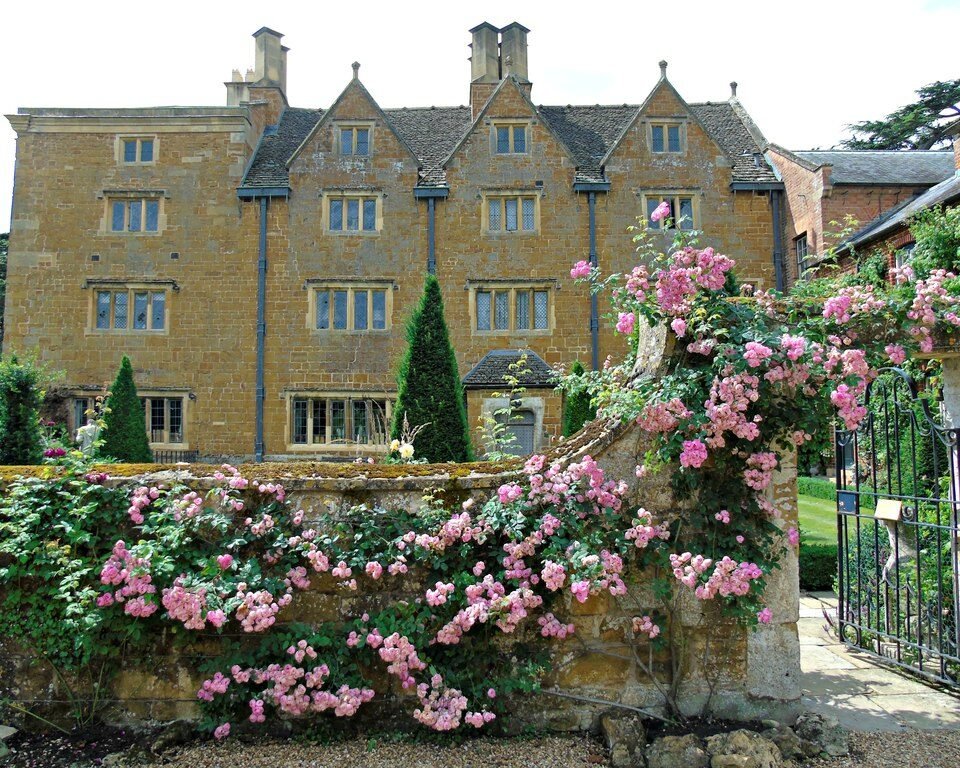



Historical names: Adderminton (Manor) | Adelminton (Manor) | Adminton (Manor) | Edelminton (Manor)
Location: Quinton, Gloucestershire
Places / associated places: Quinton, Gloucestershire
Listed in Domesday Book: Yes
Location & Extent
GPS Location & Recorded Land Areas
Representative GPS point: 52.10939, -1.71232
Identity: confirmed — The record is the historic manor of Adminton/Admington in the former Gloucestershire hamlet of Admington, associated with Quinton parish and now within Warwickshire. The documentary aliases Edelminton, Adelminton and Adminton match the Domesday and medieval forms of the same place. Admington Hall and its associated medieval moated manorial complex provide a site-specific identification, distinguishing it from other similarly named manors.
Representative point: 52.10939, -1.71232
Basis: documented_manor_house — Admington Hall is the post-Dissolution manor house associated with the Burston family and stands at the southern end of the historic Admington settlement. A medieval moated manorial complex survives immediately by the Hall, and the Admington court rolls describe the medieval manor house and its service buildings.
Point confidence: medium
Boundary status: representative_point_only
Boundary period: Medieval to post-Dissolution manor; territorial extent not securely mapped from the sources located
Boundary confidence: none
Boundary basis: The evidence establishes the manor at Admington and indicates an associated territorial relationship with Hidcote Bartrim, described in historical material as a township of Admington Manor. The Crown grant of 1554 also refers to the manor and chapel of Adminton together with lands called Wind-Cerney and other former Winchcombe Abbey lands. However, no reliable digitised manor map, survey, rental map, enclosure plan, or explicit perimeter description was located that would justify reconstructing the historical manorial boundary. The modern civil-parish boundary and the wider former Quinton parish have therefore not been substituted for the manor boundary.
Sources:
- The National Archives: Admington Manor, F246175: https://discovery.nationalarchives.gov.uk/details/c/F246175 — Registry identity and archival context for the manor record.
- Admington Hall, Warwickshire Historic Environment Record / Our Warwickshire: https://www.ourwarwickshire.org.uk/content/catalogue_her/admington-hall-4 — Identifies Admington Hall as the post-medieval country house at Admington and describes its architectural character.
- Medieval moated site at Admington Hall, Warwickshire Historic Environment Record / Our Warwickshire: https://www.ourwarwickshire.org.uk/content/catalogue_her/moated-site-at-admington-hall — Records the medieval moat, associated earthworks and pottery, and states that Admington court rolls describe the medieval manor house and its service buildings.
- Admington Hall, Warwickshire Museum Historic Environment Record MWA8632: https://timetrail.warwickshire.gov.uk/detail.aspx?monuid=WA8632 — Provides the historic-environment identification of Admington Hall and its location in Admington.
- Admington Hall archive record, Historic England Archive, BF097683: https://historicengland.org.uk/images-books/photos/job/95/01624 — Confirms the identity and location of Admington Hall in Admington, Stratford-on-Avon, Warwickshire.
- Gloucestershire Military Survey 1522: https://www.bgas.org.uk/wp-content/uploads/2021/01/GRS-6-Military-Survey-of-Glos-1522-pt2.pdf — States that the abbot of Winchcombe was lord at Adminton and that the lands there were valued at £31 in 1522.
- Virginia Magazine of History and Biography, volume 14, digitised extract: https://wvancestry.com/Files/The_Virginia_Magazine_of_History_and_Biography_-_Vol_14.pdf — Contains the historical account of Winchcombe Abbey's lordship, the temporary assignment to St Evroult, the 1554 grant of the manor and chapel of Adminton with associated lands to William Brent alias Burston, and the later reference to Earl Brooke.
- Hidcote Bartrim historical account: https://en.wikipedia.org/wiki/Hidcote_Bartrim — Reports the historical territorial association of Hidcote Bartrim with Admington Manor; used only as a lead for the extent question, not as sufficient evidence for a boundary polygon.
Warnings / uncertainty:
- A defensible manor-house point has been established at Admington Hall, but the exact perimeter of the historical manorial land has not been established.
- Hidcote Bartrim appears to have been territorially associated with Admington Manor in historical accounts, but its inclusion and the precise boundary cannot be converted into a reliable polygon from the sources located.
- The former Quinton parish, the modern Admington civil parish, and present administrative boundaries are not treated as the manor boundary.
- The representative coordinates are suitable for locating the manor site but should not be interpreted as the centroid or full territorial extent of the medieval manor.
About the Manor
Adminton Manor was the manor of Adminton, a hamlet historically in Quinton parish, Gloucestershire, now within the modern Warwickshire administrative area. The place appears in Domesday Book as Edelmintone, held by Winchcombe Abbey. Medieval evidence records the estate in the hands of Winchcombe Abbey, a temporary assignment to the Abbey of Saint-Evroult in Normandy in the reign of Edward II, and a subsequent reversion to Winchcombe. After the Dissolution, the manor and chapel of Adminton, formerly belonging to Winchcombe Abbey, were granted by the Crown to William Brent, alias Burston, in the seventh year of Edward VI. Admington Hall, a late-sixteenth- or early-seventeenth-century house, was constructed for the Burston family, described in architectural literature as the post-Dissolution owners. A later historical account states that the Earl Brooke was lord of the manor by the early twentieth century. The precise descent between the Crown grant to William Brent alias Burston and the later lordship of Earl Brooke remains incompletely documented in the sources located.
Ownership / Holder Account
The earliest securely identified institutional holder is Winchcombe Abbey, which held Edelmintone in Domesday Book and is again recorded as holding Adminton in the early thirteenth century. In the twelfth year of Edward II, the abbot of Winchcombe assigned the manor to the Abbey of Saint-Evroult in Normandy; the estate later reverted to the monks of Winchcombe, who remained proprietors until the dissolution of their house. The manor and chapel of Adminton were granted by the Crown to William Brent, alias Burston, in the seventh year of Edward VI. The Burston family were the post-Dissolution owners associated with the construction of Admington Hall. The subsequent descent is not fully established by the sources reviewed. By the early twentieth century, a published account described the Earl Brooke as lord of the manor. Corbett Holland Corbett is documented as owner or resident of Admington Hall in the nineteenth century, but the available evidence does not by itself establish that he held the manor lordship, so he has not been entered as a manor holder.
Records & References
Sources and references mentioning this manor/title which are not necessarily conveyances or transfers.
12 records found · showing 9–12.
1389-1391: court rolls, with other manors (2)
Held by: Gloucestershire Archives
1377-1379: court rolls, with other manors (2)
Held by: Gloucestershire Archives
1357-1367: court rolls, with other manors (3)
Held by: Gloucestershire Archives
1341-1342: court rolls, with other manors (2)
Held by: Gloucestershire Archives
Conveyance & Descent
First holder to present holder: blood proximity & distance travelled
First recorded holder: Winchcombe Abbey
Present holder:
Recorded title journey: 5 holder entries in this manor's saved Conveyance & Descent history.
No recorded holder currently has a usable saved direct-blood or collateral-blood relationship path from which to calculate proximity percentages.
First recorded holder → present holder
A usable saved blood relationship path between the first recorded holder and the present holder has not yet been recorded, so that first-to-present genealogical distance cannot be calculated.
Winchcombe Abbey, Benedictine abbey at Winchcombe, Gloucestershire
Transfer: The Domesday Book records Edelmintone as held by Winchcombe Abbey. Later historical accounts identify the same Adminton estate as belonging to Winchcombe Abbey in the fifth year of Henry III and state that the monks remained proprietors until the later temporary assignment recorded under Edward II.
Shared holding: Ecclesiastical lordship
Previous holder: Unknown pre-Conquest holder; Domesday records the estate in Winchcombe Abbey's possession
This is the earliest securely evidenced holder for the imported Adminton/Adelminton/Edelmintone manor. The Domesday entry is for Edelmintone in the relevant locality and is identified by later sources with Admington. The date 1086 is documentary rather than an inferred acquisition date.
Source: Domesday Book, Gloucestershire/Warwickshire entry for Edelmintone, held by Winchcombe Abbey; corroborated by the historical account of Adminton in Shakespeare's Homeland, quoting Samuel Rudder's New History of Gloucestershire. — source link
Abbey of Saint-Evroult in Normandy
Transfer: The abbot of Winchcombe assigned Adminton Manor to the Abbey of Saint-Evroult in Normandy in the twelfth year of Edward II. The later account states that the manor reverted to the monks of Winchcombe; the precise date and instrument of reversion were not established.
Shared holding: Temporary ecclesiastical assignment
Previous holder: Winchcombe Abbey, Benedictine abbey at Winchcombe, Gloucestershire
This was a documented assignment from Winchcombe to Saint-Evroult, not an inferred family or succession transfer. Because the reversion date is not given in the source, the end date is left uncertain.
Source: Historical account of Adminton in Shakespeare's Homeland, stating that the abbot of Winchcombe assigned the manor to the Abbey of Saint-Evroult in 12 Edward II and that it later reverted to Winchcombe. — source link
Winchcombe Abbey, Benedictine abbey at Winchcombe, Gloucestershire
Transfer: The manor reverted to Winchcombe Abbey after the temporary assignment to Saint-Evroult. Winchcombe Abbey remained proprietor until its dissolution.
Shared holding: Restored ecclesiastical lordship
Previous holder: Abbey of Saint-Evroult in Normandy
The source explicitly states reversion to the monks of Winchcombe and continued proprietorship until the dissolution of the abbey. The exact date of reversion is not supplied and is therefore not fabricated.
Source: Historical account of Adminton in Shakespeare's Homeland, stating that the manor reverted to the monks of Winchcombe and remained with them until their house was dissolved. — source link
William Brent, alias Burston, Grantee of Adminton Manor and chapel in 7 Edward VI
Transfer: The manor and chapel of Adminton, together with lands called Wind-Cerney and other lands formerly belonging to Winchcombe Abbey, were granted by the Crown to William Brent, alias Burston, in the seventh year of Edward VI.
Shared holding: Post-Dissolution lay ownership
Previous holder: The Crown, following the dissolution of Winchcombe Abbey
This is the first securely documented post-Dissolution lay grant located. The source identifies the grantee as William Brent, alias Burston. Later architectural evidence describes the Burston family as the post-Dissolution owners and identifies Admington Hall as a house constructed for them, but the intervening descent from William Brent alias Burston is not established here.
Source: Historical account of Adminton in Shakespeare's Homeland, stating that the manor and chapel of Adminton, formerly belonging to Winchcombe Abbey, were granted to William Brent alias Burston in 7 Edward VI; corroborated by British Brick Society Information 109, which describes the Burston family as the post-Dissolution owners. — source link
Earl Brooke, lord of Adminton Manor according to the cited account
Transfer: Later source states that Earl Brooke was the lord of the manor. The transfer from the Burston family or any intermediate holder has not been identified.
Shared holding: Later titled lay lordship
Previous holder: Unknown; the available evidence does not prove the intervening descent
The source describes Earl Brooke as the then lord of the manor and as having a large house at Adminton. This establishes a later manor-holder link but does not establish when or how the lordship passed from the Burston family or any intervening owner. Corbett Holland Corbett's documented association with Admington Hall has not been treated as proof of manor lordship.
Source: Historical account of Adminton in Shakespeare's Homeland, stating that Earl Brooke was the present lord of the manor and had a large house there. — source link
Corrections / Challenges
Sign in to challenge or submit evidence against a recorded assertion.
JSON API
Machine-readable published manor data, including public images, mapped land areas, notes, rights, conveyances, relationships, records, source/document-library entries and public file links.
https://manorialregistry.com/index.php?rest_route=/mhr/v1/manor/admington-manorPublic API access is currently disabled. Authorised API clients must use a private X-MHR-API-Key; currently only administrator keys are enabled.
Private source files, pending edits, moderation/admin information, user API keys and non-public import identifiers are not returned.