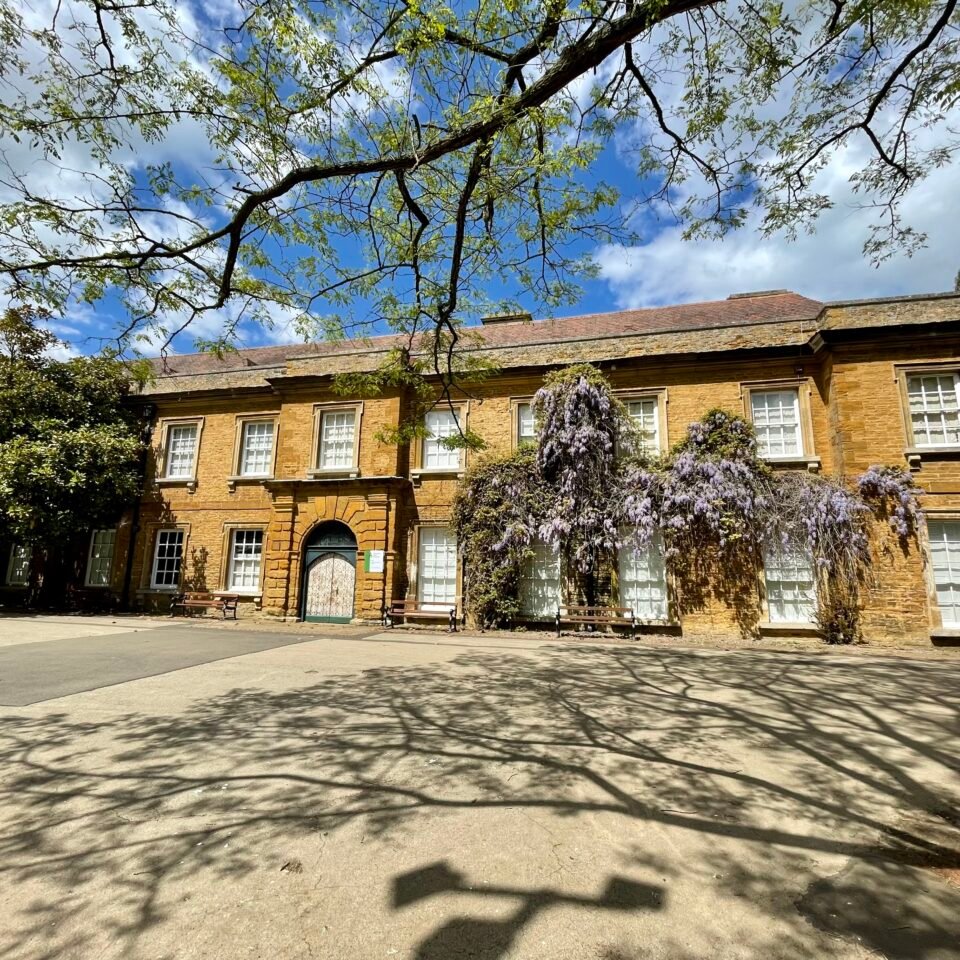



Historical names: Abington; Abington Manor
Location: Abington, Northamptonshire
Places / associated places: Abington, Northamptonshire
Listed in Domesday Book: Yes
Location & Extent
GPS Location & Recorded Land Areas
Representative GPS point: 52.2462, -0.8666
Identity: confirmed — The registry record, Northamptonshire location, associated place, and description consistently identify the principal manor of Abington, Northamptonshire, whose surviving manor house is Abington Abbey/Abington Manor House, now Abington Museum. The documented Bernard, Thursby, Loyd and Wantage ownership sequence matches the Abington manor and estate identified in Northamptonshire historic-environment records.
Representative point: 52.2462, -0.8666
Basis: documented_manor_house — Abington Abbey/Abington Manor House, the surviving historic manor house and present museum, is documented at OS grid reference SP7747861497. The manor house is the strongest surviving geographic anchor for this manor.
Point confidence: high
Boundary status: representative_point_only
Boundary period:
Boundary confidence: none
Boundary basis: The sources establish the manor house, medieval village, open fields, and successive post-medieval private park and estate, but do not provide an accessible, complete polygon for the historical manorial landholding. The 1742 Abington Estate Map and 1671 Abington map are important boundary evidence leads, but the available catalogue and HER entries do not reproduce sufficient mapped perimeter coordinates. The later Abington Park and the approximately 20 acres gifted to Northampton Corporation in 1892 are explicitly only partial later estate transfers and cannot safely be substituted for the full historical manor extent.
Sources:
- The National Archives: ABINGTON MANOR, TNA/MDR record F278601: https://discovery.nationalarchives.gov.uk/details/c/F278601 — Registry record identifying Abington Manor as the principal manor of Abington, Northamptonshire, associated with Abington Abbey/Abington Manor House.
- Northamptonshire Historic Environment Record: Abington Abbey: https://her.northamptonshire.gov.uk/Monument/MNN32311/ — Documents the manor house, its location and architectural history, the Bernard and Thursby ownership, the later Loyd ownership, and the gift of the house and part of the estate to Northampton Corporation.
- Northamptonshire Historic Environment Record: Abington Estate Map, 1742: https://her.northamptonshire.gov.uk/Source/SNN41652/ — Catalogues the 1742 Abington Estate Map held by Northamptonshire Record Office and links it to Abington Abbey, the deserted medieval village, open fields, Abington Park and the landscape-park boundary.
- Northamptonshire Historic Environment Record: Post-medieval gardens, Abington Abbey: https://her.northamptonshire.gov.uk/Monument/MNN31941 — Records that the 1671 and 1742 maps show boundaries and the development of the manor-house grounds, including a southern manor boundary along the Northampton road, while identifying the relevant archival maps.
- Northamptonshire Historic Environment Record: Abington Park: https://www.heritagegateway.org.uk/Gateway/Results_Single.aspx?resourceID=1044&uid=MNN762 — Summarizes the enlargement of the private park after 1669, the removal of much of the medieval village by 1742, and the distinction between the historic estate park and later public-park ownership.
- Abington Park, Northampton - Northamptonshire Gardens Trust history: https://www.parksandgardens.org/places/abington-park — Provides corroborating historical context for the manor house, mapped 1671 and 1742 estate development, later park extensions, and the partial 1892 transfer to Northampton Corporation.
Warnings / uncertainty:
- The representative point is safe for locating the manor house and historical manorial centre, but it is not a proxy for the full extent of the medieval or early-modern manor.
- Do not substitute the modern Abington Park, Abington Park Conservation Area, civil parish, or Northampton administrative boundaries for the historical manorial boundary.
- The 1892 gift to Northampton Corporation covered the manor house and approximately 20 acres, with additional land acquired later; it was not evidence that the corporation acquired the entire historical manor.
- The 1742 estate-map record is strong evidence that a mapped estate existed, but a defensible polygon cannot be generated from the accessible catalogue metadata alone.
About the Manor
Abington Manor was the principal manor of Abington, Northamptonshire, associated with the manor house now known as Abington Abbey or Abington Manor House and now occupied by Abington Museum. The settlement and its estate are recorded in Domesday Book in 1086, when Abington was held by Richard, with Alwin the hunter recorded as lord in 1066. The manor later passed through the Bassingburne, Colville, Gernon, Lyllyng and Bernard families. The Bernards held it from the early fifteenth century for more than two centuries and developed the surviving manor house, whose late-medieval hall dates from approximately the turn of the sixteenth century. Sir John Bernard sold the manor and estate to William Thursby in 1669. The Thursbys enlarged and remodelled the house and created an extensive private park, with much of the medieval village subsequently removed. The estate was sold in 1841 to the banker Lewis Loyd and was later inherited by his son Samuel Jones Loyd, 1st Baron Overstone, and then by Overstone's daughter Harriet Sarah Loyd, later Lady Wantage. In 1892 Lady Wantage offered Abington Abbey and approximately 20 acres to Northampton Corporation for a public park; the park was opened in 1897 and further adjoining land was acquired by the corporation. The house was subsequently used as a museum. The designation Abington Abbey was a later name for the manor house; the site was never an abbey or religious foundation.
Ownership / Holder Account
The earliest secure documentary reference is the Domesday entry for Abington in 1086, when Richard, described in modern Domesday databases as Richard the artificer, was tenant-in-chief and lord; Alwin the hunter was recorded as lord in 1066. A later county history states that the four-hide holding was certified to Humphrey de Bassingburne in the reign of Henry II and descended in the Bassingburne family. After the death of Alice, formerly the wife of Giles de Bassingburne, in 1369, the manor passed to Robert de Colville. Robert died without issue in 1369 or 1370 and his heirs were found to be Ralph Basset of Sapcote and Sir John Gernon. A 1386 record concerns the purchase of the manor and advowson by Sir Robert de Swynburn, William Ashby and others, held of the Crown in chief of Sir John Gernon. The intermediate legal steps between the Colville/Basset/Gernon interests, the 1386 purchasers and Sir Nicholas Lyllyng are not fully established in the sources consulted. Sir Nicholas Lyllyng held the manor in the early fifteenth century, after which it passed to Robert Bernard through his marriage to Elizabeth, daughter and heir of Sir Nicholas. The Bernard descent is documented in published local and family histories from approximately 1415 through Thomas Bernard, John Bernard, Margaret Bernard, John Bernard, John Bernard, Francis Bernard, Baldwin Bernard and Sir John Bernard. In 1669 Sir John Bernard conveyed the manor and estate to William Thursby. The estate descended through William Thursby, his nephew Richard Thursby, John Harvey Thursby and successive John Harvey Thursbys until the sale in 1841 to Lewis Loyd. It then descended to Samuel Jones Loyd, 1st Baron Overstone, and to his daughter Harriet Sarah Loyd, Lady Wantage. The 1892 gift to Northampton Corporation covered the manor house and part of the estate rather than necessarily the whole historical manor, so the corporation entry is recorded as a documented partial estate transfer rather than an assertion that the corporation acquired every manorial right.
Records & References
Sources and references mentioning this manor/title which are not necessarily conveyances or transfers.
3 records found · showing 1–3.
1742-1742: map of manor, with other estates
Held by: Northamptonshire Archives Service
1669-1669: particulars
Held by: Northamptonshire Archives Service
1665-1665: rental and particulars (2)
Held by: Northamptonshire Archives Service
Conveyance & Descent
First holder to present holder: blood proximity & distance travelled
First recorded holder: Alwin the hunter
Present holder:
Recorded title journey: 28 holder entries in this manor's saved Conveyance & Descent history.
No recorded holder currently has a usable saved direct-blood or collateral-blood relationship path from which to calculate proximity percentages.
First recorded holder → present holder
A usable saved blood relationship path between the first recorded holder and the present holder has not yet been recorded, so that first-to-present genealogical distance cannot be calculated.
Transfer: Held in the time of Edward the Confessor; by 1086 the holding was in Richard's hands.
The Domesday entry records Alwin the hunter as lord of Abington in 1066. This is a Domesday lordship reference and does not establish the later medieval legal continuity of the manor beyond the place and holding identified as Abington.
Source: Open Domesday, Abington, Northamptonshire, summarising Domesday Book; Northamptonshire Historic Environment Record, Monument MNN4260. — source link
Richard the artificer, Tenant-in-chief and lord of Abington in Domesday Book
Transfer: Recorded in Domesday Book as tenant-in-chief and lord of Abington; the transfer from Alwin is the Norman Conquest change recorded by Domesday and no more precise conveyance is supplied.
Previous holder: Alwin the hunter
Domesday Book records four hides at Abington under Richard, with a mill and meadow. Modern Domesday analysis identifies him as Richard the artificer. This is direct evidence for the Domesday holding, but not evidence that the later medieval manor descended continuously from Richard without an undocumented interval.
Source: Open Domesday, Abington, Northamptonshire, Phillimore reference Northamptonshire 59,3; Northamptonshire Historic Environment Record, Monument MNN4260. — source link
Humphrey de Bassingburne, Holder of the Abington holding according to the cited county-history account
Transfer: The Abington holding is stated in a later county history to have been certified to Humphrey de Bassingburne in the reign of Henry II and to have descended in his family.
Shared holding: Bassingburne family
Co-holders: Nicholas de Bassingburne, Alice, formerly wife of Giles de Bassingburne
Previous holder: Richard the artificer, Tenant-in-chief and lord of Abington in Domesday Book
The source gives a broad dynastic transition from the Domesday period to Humphrey de Bassingburne. The precise date and legal instrument are not stated, so the entry preserves the reign-level dating and should not be read as a fully documented conveyance from Richard.
Source: Samuel Lewis, A Topographical Dictionary of England, entry for Abington, 1848, reproducing the traditional county-history account of the manor's descent. — source link
Transfer: Succeeded within the Bassingburne family; the precise date and instrument are not stated.
Shared holding: Bassingburne family
Co-holders: Humphrey de Bassingburne, Alice, formerly wife of Giles de Bassingburne
Previous holder: Humphrey de Bassingburne, Holder of the Abington holding according to the cited county-history account
The medieval genealogical account identifies Nicholas de Bassingburne as successor to Humphrey in the Bassingburne descent. Because the source does not give a precise Abington conveyance, this is recorded as a documented succession within the manor-holding family, not as an inferred inheritance from an unrelated pedigree.
Source: The Historic Peerage of England, entry for Bassingbourne of Abington; Samuel Lewis, A Topographical Dictionary of England, entry for Abington, 1848. — source link
Alice, formerly wife of Giles de Bassingburne
Transfer: Held the Bassingburne interest before the manor passed to Robert de Colville after her death or the termination of her interest in 1369.
Shared holding: Bassingburne family
Co-holders: Humphrey de Bassingburne, Nicholas de Bassingburne
Previous holder: Bassingburne family
The cited account states that the manor remained in the Bassingburne family until the death of Alice, formerly the wife of Giles de Bassingburne, in the forty-second year of Edward III, 1369. The exact nature of Alice's legal interest is not separately described.
Source: Samuel Lewis, A Topographical Dictionary of England, entry for Abington, 1848. — source link
Robert de Colville, Lord Colville in the cited genealogical account
Transfer: The manor passed from the Bassingburne interest to Robert de Colville; Robert died without issue and his estates then devolved on his coheirs.
Shared holding: Colville family
Previous holder: Alice, formerly wife of Giles de Bassingburne
The county-history account states that after Alice's death in 1369 the manor passed to Robert de Colville. A related genealogical study identifies Robert as the minor heir of the Colville estate who died without issue in 1369, with Abington among the estates descending to his heirs.
Source: Samuel Lewis, A Topographical Dictionary of England, entry for Abington, 1848; Genealogical memoirs of the extinct family of Chester of Chicheley, discussion of the Colville estates and Abington. — source link
Ralph Basset of Sapcote and Sir John Gernon, Coheirs of Robert de Colville, Sir John Gernon is identified as the holder of the relevant Abington interest after partition
Transfer: Succeeded Robert de Colville as his identified heirs; the holding was divided or otherwise settled between the coheirs, with Abington later specifically associated with Sir John Gernon.
Holding arrangement: Joint — Coheir interests; exact shares are not stated in the source used
Shared holding: Colville coheirs
Previous holder: Robert de Colville, Lord Colville in the cited genealogical account
The cited account states that Robert de Colville's heirs were Ralph Basset and Sir John Gernon. A related study says the Colville estates were partitioned and that Abington was allotted to Gernon, but the surviving summary does not provide the complete legal sequence or date of partition. The entry therefore records the coheir stage without assigning precise shares.
Source: Genealogical memoirs of the extinct family of Chester of Chicheley, discussion of the Colville estates and partition of Abington; Samuel Lewis, A Topographical Dictionary of England, entry for Abington, 1848. — source link
Sir Robert de Swynburn, William Ashby and other purchasers, Purchasers of Abington manor and advowson in the cited account
Transfer: Purchased the manor and advowson of Abington without the King's licence, according to the account of the ninth year of Richard II.
Holding arrangement: Joint — Joint purchaser interests; individual shares are not stated
Shared holding: 1386 purchasers
Previous holder: Sir John Gernon and/or the Colville coheir interests
A county-history account records that in 1386 Sir Robert de Swynburn, William Ashby and others were fined for having purchased the manor and advowson of Abington, held of the Crown in chief of Sir John Gernon, without royal licence. The later disposition of their interests is not established by the source consulted.
Source: Samuel Lewis, A Topographical Dictionary of England, entry for Abington, 1848, citing the transaction in the ninth year of Richard II. — source link
Sir Nicholas Lyllyng, holder of Abington manor
Transfer: The manor later passed to Sir Nicholas Lyllyng; the exact conveyance from the 1386 purchasers is not established in the consulted sources.
Shared holding: Lyllyng family
Previous holder: Sir Robert de Swynburn, William Ashby and other purchasers, Purchasers of Abington manor and advowson in the cited account
The county-history account places Sir Nicholas Lyllyng after the 1386 purchasers and before the Bernard acquisition. The transition is recorded as a documentary gap because no precise deed or other primary conveyance was located in the public sources consulted.
Source: Samuel Lewis, A Topographical Dictionary of England, entry for Abington, 1848; Northamptonshire Historic Environment Record, Monument MNN32311, summarising the manor's early ownership. — source link
Robert Bernard, Holder of Abington through marriage to Elizabeth, daughter and heir of Sir Nicholas Lyllyng
Transfer: Acquired or became entitled to Abington through his marriage to Elizabeth, daughter and heir of Sir Nicholas Lyllyng.
Shared holding: Bernard family
Co-holders: Thomas Bernard, John Bernard, Margaret Bernard, Francis Bernard, Baldwin Bernard, Sir John Bernard
Previous holder: Sir Nicholas Lyllyng, holder of Abington manor
Published local histories state that the estate was obtained by Robert Bernard through his marriage to the heiress of Sir Nicholas Lyllyng in the reign of Henry V, and that the manor passed to the Bernard family in or about 1415. This is a manor-specific statement, but the underlying marriage settlement or conveyance was not located in the public sources consulted.
Source: Samuel Lewis, A Topographical Dictionary of England, entry for Abington, 1848; Northamptonshire Historic Environment Record, Monument MNN4260, which dates the Bernard acquisition to 1415; Landed Families of Britain and Ireland, Abington Park descent. — source link
Transfer: Succeeded to the Bernard interest in Abington; the exact instrument is not stated.
Shared holding: Bernard family
Co-holders: Robert Bernard, John Bernard, Margaret Bernard, Francis Bernard, Baldwin Bernard, Sir John Bernard
Previous holder: Robert Bernard and Elizabeth, daughter and heir of Sir Nicholas Lyllyng
The published descent of Abington identifies Thomas Bernard as the successor in the Bernard line and gives his death as 1464. The manor link is stated in the specific Abington descent, but no separate conveyance has been located.
Source: Landed Families of Britain and Ireland, Abington Park, Northamptonshire, descent of the estate; Northamptonshire Historic Environment Record, Monument MNN32311. — source link
Transfer: Succeeded Thomas Bernard in the Bernard descent of Abington.
Shared holding: Bernard family
Co-holders: Robert Bernard, Thomas Bernard, Margaret Bernard, Francis Bernard, Baldwin Bernard, Sir John Bernard
Previous holder: Thomas Bernard, Holder of Abington manor
The published Abington estate descent places John Bernard after Thomas Bernard and before Margaret Bernard, with John Bernard's death dated 1485. The exact legal form of succession is not supplied.
Source: Landed Families of Britain and Ireland, Abington Park, Northamptonshire, descent of the estate; Northamptonshire Historic Environment Record, Monument MNN32311. — source link
Margaret Bernard, Widow and interim holder or life-interest holder in the Abington descent
Transfer: Held the Bernard interest as widow after John Bernard's death until the succession of her son John Bernard.
Holding arrangement: Trust — Widow's or life interest; exact legal extent is not stated
Shared holding: Bernard family
Co-holders: Robert Bernard, Thomas Bernard, John Bernard, Francis Bernard, Baldwin Bernard, Sir John Bernard
Previous holder: John Bernard, Holder of Abington manor
The published descent records Margaret Bernard as the intermediate holder between John Bernard, who died in 1485, and her son John Bernard, who inherited in 1496. Because the source describes her as a widow in the descent, this is recorded as an interest in the estate rather than an unequivocal fee-simple conveyance.
Source: Landed Families of Britain and Ireland, Abington Park, Northamptonshire, descent of the estate; Northamptonshire Historic Environment Record, Monument MNN32311, noting that John Bernard inherited the house in 1496. — source link
Transfer: Inherited the Abington house and manor interest in 1496 from the preceding Bernard generation.
Shared holding: Bernard family
Co-holders: Robert Bernard, Thomas Bernard, Margaret Bernard, Francis Bernard, Baldwin Bernard, Sir John Bernard
Previous holder: Margaret Bernard, Widow and interim holder or life-interest holder in the Abington descent
Northamptonshire Historic Environment Record states that the surviving late-medieval hall is attributable to John Bernard, who inherited the house in 1496. The published estate descent identifies the same John Bernard as holder until his death in 1508.
Source: Northamptonshire Historic Environment Record, Monument MNN32311, Abington Abbey; Landed Families of Britain and Ireland, Abington Park descent. — source link
Transfer: Succeeded his father or predecessor John Bernard in the Bernard descent of Abington.
Shared holding: Bernard family
Co-holders: Robert Bernard, Thomas Bernard, Margaret Bernard, Francis Bernard, Baldwin Bernard, Sir John Bernard
Previous holder: John Bernard, Holder of Abington manor
The published Abington descent places a second John Bernard after the John Bernard who died in 1508 and before Francis Bernard. The public source gives an approximate death date of 1550 and no separate conveyance.
Source: Landed Families of Britain and Ireland, Abington Park, Northamptonshire, descent of the estate. — source link
Transfer: Succeeded John Bernard in the Bernard descent of Abington.
Shared holding: Bernard family
Co-holders: Robert Bernard, Thomas Bernard, John Bernard, Margaret Bernard, Baldwin Bernard, Sir John Bernard
Previous holder: John Bernard, Holder of Abington manor
The published Abington descent places Francis Bernard after John Bernard and gives Francis's death as 1602. The precise transfer date and legal instrument are not stated.
Source: Landed Families of Britain and Ireland, Abington Park, Northamptonshire, descent of the estate. — source link
Transfer: Succeeded Francis Bernard in the Bernard descent of Abington.
Shared holding: Bernard family
Co-holders: Robert Bernard, Thomas Bernard, John Bernard, Margaret Bernard, Francis Bernard, Sir John Bernard
Previous holder: Francis Bernard, Holder of Abington manor
The published Abington descent places Baldwin Bernard after Francis Bernard and before Sir John Bernard. The exact conveyance is not stated.
Source: Landed Families of Britain and Ireland, Abington Park, Northamptonshire, descent of the estate. — source link
Sir John Bernard, lord of Abington manor, briefly Member of Parliament
Transfer: Sold and conveyed Abington Manor and estate to William Thursby in 1669.
Shared holding: Bernard family
Co-holders: Robert Bernard, Thomas Bernard, John Bernard, Margaret Bernard, Francis Bernard, Baldwin Bernard
Previous holder: Baldwin Bernard, Holder of Abington manor
Sir John Bernard was the last Bernard holder in the long Bernard descent. A Northamptonshire Record Society publication refers to the 1669 conveyance by Sir John Bernard, Dame Elizabeth his wife and other parties to trustees of William Thursby, with a covenant concerning Dame Elizabeth's dower. The sale price is given in local histories as £13,750.
Source: Northamptonshire Record Society, Northamptonshire Past and Present, volume 1, number 6, discussion of the 1669 conveyance and Overstone archive deeds; Northamptonshire Historic Environment Record, Monument MNN32311. — source link
Transfer: Purchased Abington Manor from Sir John Bernard in 1669; the conveyance was made with associated trustees and included the manor estate.
Shared holding: Thursby family
Co-holders: Richard Thursby, John Harvey Thursby
Previous holder: Sir John Bernard, lord of Abington manor, briefly Member of Parliament
William Thursby acquired Abington Manor from Sir John Bernard in 1669. The Northamptonshire Record Society identifies the 1669 conveyance and the relevant Overstone archive deeds. William Thursby enlarged or rebuilt the manor house after the purchase and began the development of the private park.
Source: Northamptonshire Record Society, Northamptonshire Past and Present, volume 1, number 6, discussion of the 1669 conveyance; Northamptonshire Historic Environment Record, Monument MNN32311 and Monument MNN4260. — source link
Transfer: Inherited Abington after the death of his uncle William Thursby, according to the published estate descent.
Shared holding: Thursby family
Co-holders: William Thursby, John Harvey Thursby
Previous holder: William Thursby, Esquire, purchaser and holder of Abington Manor
The published descent identifies Richard Thursby as William Thursby's nephew and successor at Abington. The exact probate or settlement instrument was not located in the public sources consulted.
Source: Landed Families of Britain and Ireland, Abington Park, Northamptonshire, descent of the estate; Northamptonshire Historic Environment Record, Monument MNN32311. — source link
Transfer: Succeeded Richard Thursby in 1736 as identified in the published Abington estate descent.
Shared holding: Thursby family
Co-holders: William Thursby, Richard Thursby
Previous holder: Richard Thursby, Holder of Abington manor
John Harvey, later styled John Harvey Thursby, succeeded Richard Thursby in 1736. The manor house was extensively remodelled during this period, approximately 1738 to 1743, but the building works are not themselves evidence of the transfer.
Source: Northamptonshire Historic Environment Record, Monument MNN32311; Landed Families of Britain and Ireland, Abington Park descent. — source link
Transfer: Succeeded the earlier John Harvey Thursby in the published Abington estate descent.
Shared holding: Thursby family
Co-holders: William Thursby, Richard Thursby
Previous holder: John Harvey Thursby, Last Thursby holder of Abington manor
A second John Harvey Thursby is placed in the Abington descent between 1764 and 1798. The public source gives the family succession but no separate conveyance or settlement date.
Source: Landed Families of Britain and Ireland, Abington Park, Northamptonshire, descent of the estate; Northamptonshire Historic Environment Record, Monument MNN32311. — source link
Transfer: Succeeded the earlier John Harvey Thursby in the published Abington estate descent.
Shared holding: Thursby family
Co-holders: William Thursby, Richard Thursby
Previous holder: John Harvey Thursby, Last Thursby holder of Abington manor
A third successive John Harvey Thursby is placed in the Abington descent from 1798 to 1838. The exact transfer instrument is not supplied in the public source.
Source: Landed Families of Britain and Ireland, Abington Park, Northamptonshire, descent of the estate. — source link
Transfer: Held Abington until selling the estate in 1841 to Lewis Loyd.
Shared holding: Thursby family
Co-holders: William Thursby, Richard Thursby
Previous holder: John Harvey Thursby, Last Thursby holder of Abington manor
The last John Harvey Thursby held Abington until the sale to Lewis Loyd in 1841. Contemporary and later local accounts connect the sale with the end of Thursby ownership and the acquisition of the property as an investment by Loyd.
Source: Northamptonshire Historic Environment Record, Monument MNN32311; Parks and Gardens, Abington Park history; The Bernards of Abington and Nether Winchendon, discussion of the 1841 sale. — source link
Transfer: Purchased Abington Manor and estate from John Harvey Thursby in 1841.
Shared holding: Loyd family
Co-holder: Samuel Jones Loyd, 1st Baron Overstone
Previous holder: John Harvey Thursby, Last Thursby holder of Abington manor
Lewis Loyd, a banker of Overstone, purchased Abington in 1841. The manor house was leased for use as a private asylum, including by Dr Thomas Pritchard, rather than serving as the Loyd family's principal residence.
Source: Northamptonshire Historic Environment Record, Monument MNN32311; Parks and Gardens, Abington Park history; The Bernards of Abington and Nether Winchendon, discussion of the 1841 sale. — source link
Samuel Jones Loyd, 1st Baron Overstone, banker and landowner, Banker, 1st Baron Overstone of Overstone and Fotheringay
Transfer: Inherited or succeeded to Abington after the death of his father Lewis Loyd; the published estate descent places the formal inheritance around 1860.
Shared holding: Loyd family
Co-holder: Lewis Loyd
Previous holder: Lewis Loyd, Banker, purchaser of Abington Manor, London banker
The local-history sources state that Abington descended from Lewis Loyd to his son Samuel Jones Loyd, later 1st Baron Overstone. One estate study indicates that Samuel did not formally inherit the wider Overstone estate until 1860, so the start date is retained as a broad post-1858 succession rather than an exact conveyance date.
Source: Northamptonshire Historic Environment Record, Monument MNN32311; St Gregory's Abington history; Landed Families of Britain and Ireland, Abington Park descent. — source link
Harriet Sarah Loyd, later Lady Wantage, heiress of Samuel Jones Loyd, 1st Baron Overstone
Transfer: Inherited the Abington estate as the only surviving child and heiress of Samuel Jones Loyd, 1st Baron Overstone; subsequently transferred the manor house and part of the estate to Northampton Corporation.
Shared holding: Loyd-Wantage family
Previous holder: Samuel Jones Loyd, 1st Baron Overstone, banker and landowner, Banker, 1st Baron Overstone of Overstone and Fotheringay
The consulted sources state that the Abington estate devolved upon Overstone's daughter Harriet Sarah Loyd, later Lady Wantage. In 1892 she offered Abington Abbey and approximately 20 acres to Northampton Corporation for a People's Park. The park opened in 1897. The evidence establishes her ownership of the estate and her gift of the house and part of the grounds, but not the precise extent to which all residual manorial rights were transferred.
Source: Northamptonshire Historic Environment Record, Monument MNN4263; Parks and Gardens, Abington Park history; St Gregory's Abington history. — source link
Northampton Corporation, Corporation of Northampton, municipal owner of Abington Manor House and public park
Transfer: Received Abington Abbey and approximately 20 acres from Lady Wantage for a People's Park; the corporation also purchased additional adjoining land, and the public park opened in 1897.
Holding arrangement: Other — Documented gift of the manor house and approximately 20 acres; not proven to include every residual manorial right or the whole historic manor
Shared holding: Municipal ownership
Previous holder: Harriet Sarah Loyd, Lady Wantage
The documented municipal transfer concerns Abington Manor House, later Abington Museum, and part of the surrounding estate. Northampton Corporation subsequently purchased additional land from the Wantage Estate and others. This entry is therefore recorded as a partial estate transfer and municipal acquisition, not as an unqualified statement that all manorial rights passed to the corporation.
Source: Northamptonshire Historic Environment Record, Monument MNN4263; Parks and Gardens, Abington Park history; Northampton Museums, Abington Manor donation history. — source link
Corrections / Challenges
Sign in to challenge or submit evidence against a recorded assertion.
JSON API
Machine-readable published manor data, including public images, mapped land areas, notes, rights, conveyances, relationships, records, source/document-library entries and public file links.
https://manorialregistry.com/index.php?rest_route=/mhr/v1/manor/abington-manorPublic API access is currently disabled. Authorised API clients must use a private X-MHR-API-Key; currently only administrator keys are enabled.
Private source files, pending edits, moderation/admin information, user API keys and non-public import identifiers are not returned.