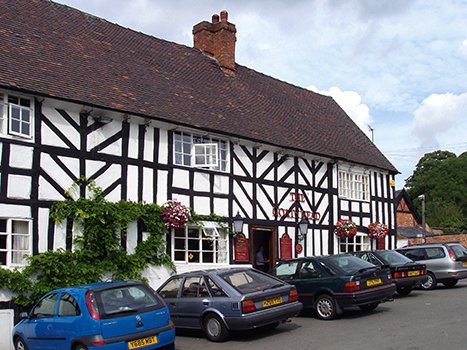



Historical names: Bromley Hurst (Manor) | Pagets Bromley (Manor)
Location: Abbots Bromley, Staffordshire
Places / associated places: Abbots Bromley, Staffordshire
Listed in Domesday Book: Yes
Location & Extent
GPS Location & Recorded Land Areas
Representative GPS point: 52.8171, -1.8816
Identity: confirmed — The record is the Burton Abbey ecclesiastical manor of Abbots Bromley, later known as Pagets Bromley, with Bromley Hurst as its associated historical liberty or manor component. The archive evidence distinguishes it from the separate Bagots Bromley manor.
Representative point: 52.8171, -1.8816
Basis: documented_manor_site — Manor Farmhouse on Hall Hill Lane, National Grid Reference SK 08076 24405, is identified by the Staffordshire Extensive Urban Survey as standing on, or incorporating remains of, the Abbot's medieval manor house. Local historical material likewise identifies Hall Hill, now Manor House Farm, as the traditional site of the monks' house associated with Burton Abbey.
Point confidence: medium
Boundary status: representative_point_only
Boundary period: Medieval to early modern, with later Paget-period continuation
Boundary confidence: medium
Boundary basis: The historical manor comprised the Abbots Bromley estate and the associated Bromley Hurst area in the southern part of the parish; Bagot's Bromley was a separate manor and must be excluded. The available evidence identifies constituent areas, field names and manorial records, including the 1306-1307 extent, 1416 Hurst rental, and later surveys and rentals, but does not provide a sufficiently recoverable perimeter polygon. The modern parish boundary and the wider nineteenth-century civil-parish area cannot be substituted for the historical manorial boundary.
Sources:
- Historic England: Manor Farmhouse, Hall Hill Lane, Abbots Bromley, List Entry 1038418: https://historicengland.org.uk/listing/the-list/list-entry/1038418 — Provides the documented site and National Grid Reference SK 08076 24405 for Manor Farmhouse, the building associated with the presumed medieval abbatial manor-house site.
- Staffordshire Extensive Urban Survey: Abbots Bromley: https://www.staffordshire.gov.uk/environment/Environment-and-countryside/HistoricEnvironment/Documents/AbbotsBromleyEUSReportFinal.pdf — States that the Hall Hill Farmhouse farmstead is believed to stand on, or incorporate remains of, the Abbot's medieval manor house; discusses the historical agricultural areas, Hurst, Bentilee and the southern portion of the manor.
- Staffordshire and Stoke-on-Trent Archive Service: Guide to Manorial Records of Staffordshire: https://staffordshirehistorycentre.blog/wp-content/uploads/2023/05/guide-to-sources-no.7-manorial-records-2021.pdf — Lists the records under 'Abbots Bromley (alias Pagets Bromley) & Bromley Hurst' and distinguishes them from Bagots Bromley, confirming the relevant historical naming and record grouping.
- Staffordshire History Centre: Records of the Paget family: https://www.staffordshirehistory.org.uk/collections/getrecord/GB169_K002 — Confirms that the Paget collection contains deeds and detailed surveys, valuations and rentals for Abbots Bromley from the medieval and post-Dissolution periods.
- The National Archives: Abbots Bromley Manor, F256001: https://discovery.nationalarchives.gov.uk/details/c/F256001 — Registry authority record for the exact manor identity and its historical association with Burton Abbey, William Paget and the name Pagets Bromley.
Warnings / uncertainty:
- No historically defensible closed polygon was located in the accessible evidence.
- The representative point marks the documented or presumed manorial site at Hall Hill; it should not be interpreted as the centre of the entire historical estate.
- The manor extent should not be replaced by the modern civil parish boundary or by the separate Bagot's Bromley manor.
About the Manor
Abbots Bromley was an ecclesiastical manor in the parish of Abbots Bromley, Staffordshire, historically associated with the estate of Burton Abbey. The settlement appears in pre-Conquest charters and in Domesday Book as Brunlege or Bromley, with the land forming part of the possessions of Burton Abbey. In the early thirteenth century the abbey developed the settlement as a market borough; a market was confirmed by royal charter in 1227. After the Dissolution of Burton Abbey, Abbots Bromley and Bromley Hurst passed to Sir William Paget and were subsequently known collectively as Pagets Bromley. The record identified here should not be merged with Bagots Bromley, the separate Bagot family manor in the same parish. The later Paget estate was gradually reduced by sales during the nineteenth and twentieth centuries, after which the place-name Abbots Bromley again became predominant.
Ownership / Holder Account
The estate is evidenced in pre-Conquest sources: King Edmund's charter of 942 granted lands including Abbots Bromley to Wulfsige the Black, and a charter of 966 describes the estate in the hands of Wulfric. Wulfric's will transferred Bromley to the Benedictine Abbey of Burton upon Trent in or about 1004. Burton Abbey retained the ecclesiastical lordship until the Dissolution. Following the suppression of the abbey, the Crown granted the estate to Sir William Paget in 1547, creating the post-Dissolution Paget manor known as Pagets Bromley. The estate descended within the Paget family until the attainder and confiscation of the Paget lands in 1583; the estate was subsequently restored to William Paget, later fourth Baron Paget, during the reign of James I. The Paget family retained the manor and associated estate for the following centuries, although the intervening individual descent is not fully reconstructed in the sources consulted. By the nineteenth century the manor was associated with the Marquess of Anglesey, the senior Paget title-holder, and the Paget Staffordshire estates were progressively sold. The exact legal date and instrument of the later sale or sales of the manor itself require further deed or title research.
Manorial Rights & Privileges
Historic manorial rights / privileges (1)
Market
Provisional
The settlement was developed as a market borough in the early thirteenth century, and a market was confirmed by royal charter in 1227.
Records & References
Sources and references mentioning this manor/title which are not necessarily conveyances or transfers.
53 records found.
1862-1862: rental, with Lichfield and Farewell
Held by: Staffordshire and Stoke-on-Trent Archive Service: Staffordshire County Record Office
Further information: NRA 10 Paget
1848-1848: receipts for amercements
Held by: Staffordshire and Stoke-on-Trent Archive Service: Staffordshire County Record Office
Further information: NRA 10 Paget
1848-1848: lists of amercements (2)
Held by: Staffordshire and Stoke-on-Trent Archive Service: Staffordshire County Record Office
Further information: NRA 10 Paget
1837-1837: rentals, of leases and chief rents
Held by: Staffordshire and Stoke-on-Trent Archive Service: Staffordshire County Record Office
Further information: NRA 41388 Paget
1835-1848: suit roll
Held by: Staffordshire and Stoke-on-Trent Archive Service: Staffordshire County Record Office
Further information: NRA 10 Paget
1835-1835: rental
Held by: Staffordshire and Stoke-on-Trent Archive Service: Staffordshire County Record Office
Further information: NRA 10 Paget
1823-1846: register of presentments of officers, with other manors (1 vol)
Held by: Staffordshire and Stoke-on-Trent Archive Service: Staffordshire County Record Office
Further information: NRA 10 Paget
1823-1823: list of amercements
Held by: Staffordshire and Stoke-on-Trent Archive Service: Staffordshire County Record Office
Further information: NRA 10 Paget
1822-1822: perambulations of manor (3, one is undated)
Held by: Staffordshire and Stoke-on-Trent Archive Service: Staffordshire County Record Office
Further information: NRA 10 Paget
1814-1814: suit roll
Held by: Staffordshire and Stoke-on-Trent Archive Service: Staffordshire County Record Office
Further information: NRA 10 Paget
1811-1818: court book
Held by: Staffordshire and Stoke-on-Trent Archive Service: Staffordshire County Record Office
Further information: NRA 10 Paget
1806-1806: memorandum re court
Held by: Staffordshire and Stoke-on-Trent Archive Service: Staffordshire County Record Office
Further information: NRA 10 Paget
1789-1837: vouchers, with Burton (manor and estate vouchers in annual mixed bundles)
Held by: Staffordshire and Stoke-on-Trent Archive Service: Staffordshire County Record Office
Further information: NRA 10 Paget
1774-1785: rent accounts, with other manors and estate rents (1 vol)
Held by: Staffordshire and Stoke-on-Trent Archive Service: Staffordshire County Record Office
Further information: NRA 10 Paget
1760-1760: rental and valuation, with Yoxall
Held by: Staffordshire and Stoke-on-Trent Archive Service: Staffordshire County Record Office
Further information: NRA 10 Paget
1746-1746: court roll
Held by: Staffordshire and Stoke-on-Trent Archive Service: Staffordshire County Record Office
Further information: NRA 10 Paget
1744-1776: bailiff's accounts
Held by: Staffordshire and Stoke-on-Trent Archive Service: Staffordshire County Record Office
Further information: NRA 10 Paget
1731-1731: court roll, with tack court
Held by: Staffordshire and Stoke-on-Trent Archive Service: Staffordshire County Record Office
Further information: NRA 5471 Bagot
1689-1703: bailiff's annual accounts, with other manors
Held by: Staffordshire and Stoke-on-Trent Archive Service: Staffordshire County Record Office
Further information: NRA 10 Paget
1654-1654: survey
Held by: Staffordshire and Stoke-on-Trent Archive Service: Staffordshire County Record Office
Further information: NRA 10 Paget
Conveyance & Descent
First holder to present holder: blood proximity & distance travelled
First recorded holder: Wulfsige the Black
Present holder:
Recorded title journey: 9 holder entries in this manor's saved Conveyance & Descent history.
No recorded holder currently has a usable saved direct-blood or collateral-blood relationship path from which to calculate proximity percentages.
First recorded holder → present holder
A usable saved blood relationship path between the first recorded holder and the present holder has not yet been recorded, so that first-to-present genealogical distance cannot be calculated.
Transfer: Granted or confirmed land including Abbots Bromley by King Edmund; the subsequent change to Wulfric is evidenced by a later charter, but the precise transfer date is unknown.
Previous holder: King Edmund, King of England
A Staffordshire heritage assessment states that King Edmund's charter of 942 granted lands including Abbots Bromley to Wulfsige the Black. This is the earliest securely identified secular holder in the researched sequence. The source does not provide a complete legal description of the manor's tenure or a precise termination date.
Source: High Speed Two Ltd, SES2 and AP2 ES Appendix CH-001-000, paragraphs 3.6.11-3.6.12, citing Staffordshire charter evidence. — source link
Wulfric Spot, Earl of Mercia
Transfer: Held the estate after the 966 charter and bequeathed Bromley to Burton Abbey in his will, probably executed shortly before or in 1004.
Previous holder: Wulfsige the Black, Anglo-Saxon landholder, the source does not assign him a formal title specific to Abbots Bromley.
The 966 charter of King Aethelred describes the boundaries of the estate in the possession of Wulfric. The same source states that Bromley became associated with Burton Abbey in circa 1004 when it passed under Wulfric's will. The precise date of death, probate, and completion of the transfer is not supplied.
Source: High Speed Two Ltd, SES2 and AP2 ES Appendix CH-001-000, paragraph 3.6.11, citing Staffordshire charter evidence; Staffordshire Past Track, Abbots Bromley historical description. — source link
Transfer: Received Bromley under the will of Wulfric Spot and retained it as part of the abbey's ecclesiastical estate until the Dissolution and subsequent Crown grant.
Shared holding: Burton Abbey ecclesiastical estate
Previous holder: Wulfric Spot, Earl of Mercia
Bromley was an ecclesiastical holding of Burton Abbey. Domesday Book recorded Brunlege among the lands of St Mary of Burton, and later heritage assessments state that villagers were villeins of Burton Abbey. Staffordshire archival descriptions confirm that the medieval deeds for the Burton Abbey estate at Abbots Bromley survive from the early thirteenth century onward. The end date is given as 1547 in a government heritage assessment; other local summaries describe the transfer as occurring during the 1540s or at the Dissolution, so the exact operative grant date should be treated cautiously.
Source: High Speed Two Ltd, SES2 and AP2 ES Appendix CH-001-000, paragraphs 3.6.11-3.6.13 and 3.7.4; Staffordshire History Centre, Guide to Sources No. 7, Manorial Records of Staffordshire; Staffordshire Record Office catalogue for the Paget estate. — source link
Transfer: Granted by the Crown after the Dissolution of Burton Abbey; the estate included Abbots Bromley and Bromley Hurst and became known as Pagets Bromley.
Shared holding: Paget estate
Co-holders: Thomas Paget, 3rd Baron Paget of Beaudesert, William Paget, 4th Baron Paget of Beaudesert, Paget family, Marquess of Anglesey
Previous holder: Abbey of Burton upon Trent, Benedictine monastic community of Burton Abbey
The government heritage assessment states that Abbots Bromley, as part of the former Burton Abbey estate, passed into the private ownership of Sir William Paget in 1547 and thereafter formed part of the newly created Manor of Pagets Bromley. Staffordshire archival material records the royal grant to Paget in 1549 and identifies Abbots Bromley and Bromley Hurst among the estates granted from the dissolved abbey. The slight discrepancy between 1547 and 1549 probably reflects the distinction between the effective transfer and the surviving grant documentation.
Source: High Speed Two Ltd, SES2 and AP2 ES Appendix CH-001-000, paragraph 3.7.4; Staffordshire History Centre, Records of the Paget family, Barons Paget of Beaudesert, Earls of Uxbridge and Marquesses of Anglesey; Staffordshire Record Office, D(W)1734/2/3/112b, Valor or rental of all the property of Lord Paget, circa 1550. — source link
Thomas Paget, 3rd Baron Paget of Beaudesert
Transfer: Inherited the Paget estate after the death of his father, William Paget; the estate was confiscated by the Crown in 1583 following Thomas Paget's exile and attainder-related difficulties.
Shared holding: Paget estate
Co-holders: Sir William Paget, later 1st Baron Paget of Beaudesert, William Paget, 4th Baron Paget of Beaudesert, Paget family, Marquess of Anglesey
A government heritage assessment states that, following the death of Sir Thomas Paget the younger in 1583, the estate was confiscated by the Crown. In context, the estate is the Paget estate that included Abbots Bromley and had become the Manor of Pagets Bromley. The source does not provide a separate instrument naming Abbots Bromley in the confiscation, so this entry records the manor connection at estate level rather than asserting a surviving individual conveyance deed.
Source: High Speed Two Ltd, SES2 and AP2 ES Appendix CH-001-000, paragraphs 3.7.4-3.7.6; Staffordshire History Centre, Records of the Paget family, including papers concerning confiscation and restitution of Paget lands following the attainder of Thomas Paget in 1587. — source link
The Crown, Crown custody following forfeiture
Transfer: Confiscated the Paget estate after Thomas Paget's exile; the subsequent restoration to his son William occurred during the reign of James I, but the exact date and instrument are not established here.
Holding arrangement: Other
Shared holding: Crown custody or forfeiture
Previous holder: Thomas Paget, 3rd Baron Paget of Beaudesert
The source explicitly states that the estate was confiscated by the Crown in 1583 and that Thomas Paget's son William was later restored to the estate after proving his loyalty. This entry records Crown custody or forfeiture rather than ordinary private ownership. The source does not establish whether the Crown directly administered the manor throughout the entire interval or whether parts of the estate were separately granted or leased during it.
Source: High Speed Two Ltd, SES2 and AP2 ES Appendix CH-001-000, paragraphs 3.7.5-3.7.6. — source link
William Paget, 4th Baron Paget of Beaudesert
Transfer: Restored by James I to the Paget family after the forfeiture of the estate of his father, Thomas Paget; the exact restoration date and instrument are not stated in the source consulted.
Shared holding: Paget estate
Co-holders: Sir William Paget, later 1st Baron Paget of Beaudesert, Thomas Paget, 3rd Baron Paget of Beaudesert, Paget family, Marquess of Anglesey
Previous holder: The Crown, Crown custody following forfeiture
The government heritage assessment states that William Paget, son of Thomas Paget, was restored to the estate during the reign of James I. Since the estate under discussion is the Paget estate that included Abbots Bromley and Pagets Bromley, this supports his holding at estate level. The source does not provide a manor-specific restoration date.
Source: High Speed Two Ltd, SES2 and AP2 ES Appendix CH-001-000, paragraphs 3.7.5-3.7.6; Staffordshire History Centre, Records of the Paget family. — source link
Paget family, Barons Paget of Beaudesert, later Earls of Uxbridge and Marquesses of Anglesey
Transfer: Continued descent and possession within the Paget family after the death of William Paget, 4th Baron. The consulted public sources establish continued Paget ownership but do not provide a complete individual-by-individual descent for Abbots Bromley.
Holding arrangement: Other
Shared holding: Paget estate
Co-holders: Sir William Paget, later 1st Baron Paget of Beaudesert, Thomas Paget, 3rd Baron Paget of Beaudesert, William Paget, 4th Baron Paget of Beaudesert, Marquess of Anglesey
Previous holder: William Paget, 4th Baron Paget of Beaudesert
Staffordshire archival sources describe Abbots Bromley records and estate documents under the Paget family from the sixteenth through nineteenth centuries, including manorial court rolls, surveys, rentals and accounts. A government heritage assessment states that the manor endured under the Pagets and that the family gradually sold its estates during the nineteenth and twentieth centuries. This grouped entry is used to avoid inventing individual conveyances not established by the sources.
Source: Staffordshire History Centre, Records of the Paget family, Barons Paget of Beaudesert, Earls of Uxbridge and Marquesses of Anglesey; Staffordshire History Centre, Guide to Sources No. 7, Manorial Records of Staffordshire; High Speed Two Ltd, SES2 and AP2 ES Appendix CH-001-000, paragraph 3.7.6. — source link
Marquess of Anglesey, 2nd Earl of Uxbridge, 1st Marquess of Anglesey from 1815
Transfer: Held the manor or principal manor estate as senior Paget title-holder; the later date and legal form of the sale or sales are not established in the sources consulted.
Shared holding: Paget estate
Co-holders: Sir William Paget, later 1st Baron Paget of Beaudesert, Thomas Paget, 3rd Baron Paget of Beaudesert, William Paget, 4th Baron Paget of Beaudesert, Paget family
Previous holder: Paget family, Barons Paget of Beaudesert, later Earls of Uxbridge and Marquesses of Anglesey
Nineteenth-century topographical evidence identifies the Marquess of Anglesey with the manor and its patronage, while local historical material states that the Marquess sold most of the Staffordshire estates during the nineteenth century. This entry records the documented later holder but does not claim that every component of the historic manor remained intact until the sale.
Source: Samuel Lewis, A Topographical Dictionary of England, 1831, entry for Bromley (Abbot's); Staffordshire Past Track, Abbots Bromley historical description; Staffordshire heritage assessment on the Paget estate. — source link
Corrections / Challenges
Sign in to challenge or submit evidence against a recorded assertion.
JSON API
Machine-readable published manor data, including public images, mapped land areas, notes, rights, conveyances, relationships, records, source/document-library entries and public file links.
https://manorialregistry.com/index.php?rest_route=/mhr/v1/manor/abbots-bromley-manorPublic API access is currently disabled. Authorised API clients must use a private X-MHR-API-Key; currently only administrator keys are enabled.
Private source files, pending edits, moderation/admin information, user API keys and non-public import identifiers are not returned.