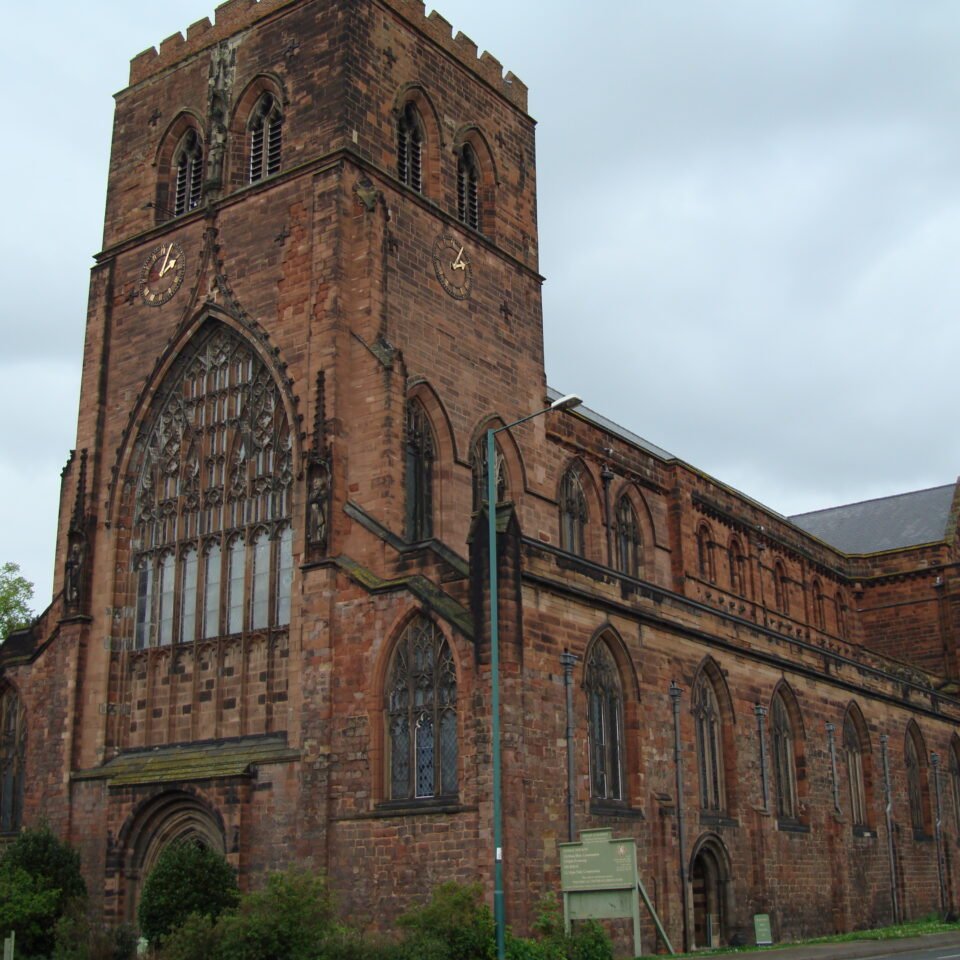



Historical names: Monks' Foregate (Manor)
Location: Shrewsbury, Holy Cross, Shropshire
Places / associated places: Shrewsbury, Holy Cross, Shropshire
Location & Extent
GPS Location & Recorded Land Areas
Representative GPS point: 52.7074, -2.744
Identity: confirmed — The record is securely identified with the medieval and post-Dissolution manor of the Abbey Foregate, also called Monks' Foregate, in Shrewsbury Holy Cross. The National Archives record and historical accounts associate this manor and its jurisdiction with Shrewsbury Abbey and distinguish it from individual houses, mills, tenements, and the former abbey mansion.
Representative point: 52.7074, -2.7440
Basis: documented_estate_centre — The representative point is the Abbey Church of the Holy Cross/Shrewsbury Abbey, the documented institutional centre of the Abbey Foregate estate and jurisdiction. Historic England gives the abbey church National Grid Reference SJ 49844 12474, approximately 52.7074, -2.7440 in WGS84.
Point confidence: high
Boundary status: representative_point_only
Boundary period: Medieval to early post-Dissolution period, especially before and around the 1540 Dissolution; later manorial extent remains insufficiently defined.
Boundary confidence: none
Boundary basis: The sources establish the manor's location in Abbey Foregate and its association with the abbey, Monks' Bridge, fairs, mills, adjoining lands, and local jurisdiction. They do not provide a reliable perimeter for the historical manorial land. The parish, modern Abbey Foregate locality, historic abbey precinct, and later individual estate properties cannot safely be substituted for the manor's territorial boundary.
Sources:
- The National Archives: Abbey Foregate Manor, record F244515: https://discovery.nationalarchives.gov.uk/details/c/F244515 — Identifies the registry record for Abbey Foregate Manor and its associated historical name and location in Shrewsbury Holy Cross.
- Historic England: Abbey Church of the Holy Cross, Shrewsbury, listing 1246392: https://historicengland.org.uk/listing/the-list/list-entry/1246392 — Documents the abbey church at Abbey Foregate, identifies it as the former Shrewsbury Abbey founded by Roger de Montgomery, and gives National Grid Reference SJ 49844 12474 used for the representative point.
- Victoria County History Shropshire: Markets and Fairs in Shrewsbury: https://www.vchshropshire.org/_Shrewsbury_2/3_2_Markets%20and%20Fairs.pdf — Confirms the historical fair area in Abbey Foregate, the Green near the abbey church, Monks' Bridge, and Philip Prynce as lord of the manor in 1681; useful for locating the jurisdictional centre but not for defining a complete manor boundary.
- Gazetteer of Markets and Fairs to 1516: Shropshire: https://archives.history.ac.uk/gazetteer/salop.html — Records the 1292 claim by the abbot to a fair at the manor of Abbey Foregate, also called Monks Foregate, by right of Shrewsbury Abbey.
- St Mary, Shrewsbury historical account: https://www.melocki.org.uk/salop/StMaryShrewsbury.html — Preserves the reported post-Dissolution descent of the manor from Elizabethan grantees through the Hatton and Prynce families, corroborating the distinct historical manorial lordship.
Warnings / uncertainty:
- No authoritative source located supplies a mapped or reconstructable perimeter for the historical manor.
- The abbey church point represents the documented manorial and estate centre, not the full extent of the manor.
- Do not use the modern parish, civil parish, Abbey Foregate locality, or abbey precinct boundary as the manor polygon.
About the Manor
Abbey Foregate Manor, also known historically as the Manor of Monks' Foregate, was the manorial and jurisdictional estate associated with the Benedictine Abbey of St Peter and St Paul at Shrewsbury, in the suburb now called Abbey Foregate and within the historic parish of Holy Cross. The abbey was founded by Roger de Montgomery, Earl of Shrewsbury, in 1083, on the site of an earlier church of St Peter, and the monastery controlled the bridge, precinct, adjoining lands, mills, fairs, and local jurisdiction in the Foregate area. Medieval records refer to the liberty or hundred of the Abbot of the Foregate, and later sources expressly call the estate the manor of the Abbey Foregate. The monastery was dissolved in January 1540. The abbey site and buildings subsequently passed through several hands, but the surviving evidence does not establish every intermediate transaction. A distinction must be made between the manorial lordship and individual houses, mills, tenements, and leases within Abbey Foregate. In particular, William Langley's acquisition of the former monastic buildings in 1546 is direct evidence of ownership of the abbey site and mansion, but is not by itself sufficient evidence that he held the entire manor.
Ownership / Holder Account
The earliest securely evidenced institutional lordship is that of Shrewsbury Abbey, founded in 1083 and holding the Foregate estate and associated jurisdiction until the Dissolution in 1540. The post-Dissolution descent is incompletely documented. A later historical account states that Queen Elizabeth I granted the manor of the Abbey Foregate to Robert Newdigate and Arthur Fountayne, who conveyed it on the following day to Richard Prynce, Thomas Hatton, and Thomas Rock, to them and the heirs of the survivor. The same account states that Thomas Hatton survived the other two grantees and that the manor remained in the Hatton family until 1654, when it was conveyed to Sir Richard Prynce, knight, son of the original Richard Prynce. By the early twentieth century, the manor was stated to be held by a descendant, the Earl of Tankerville. The precise dates of the Elizabethan grant, the deaths of the joint grantees, the 1654 conveyance instrument, and the subsequent descent to the Tankerville family have not been established from the public sources located. The former abbey mansion followed a partly separate descent: the monastic buildings were acquired by William Langley in 1546; the mansion property was later sold to Edward Baldwin about 1702, devised to Henry Powys of Berwick, and sold before 1821 to James Hiles. Those mansion transactions are not entered as manor conveyances because the sources describe the abbey buildings or mansion rather than expressly the manorial lordship.
Manorial Rights & Privileges
Historic manorial rights / privileges (3)
Liberty or hundred jurisdiction of the Abbot of the Foregate
Provisional
Medieval records refer to the liberty or hundred of the Abbot of the Foregate, indicating local jurisdiction associated with the monastic estate.
Control of the bridge and adjoining lands in the Foregate area
Provisional
The supplied historical account identifies control of the bridge and adjoining lands among the abbey's associated local interests.
Mills and fairs associated with the Foregate estate
Provisional
The supplied account identifies mills and fairs among the local resources or jurisdictional interests controlled by Shrewsbury Abbey in the Foregate area.
Records & References
Sources and references mentioning this manor/title which are not necessarily conveyances or transfers.
2 records found.
1575-1578: court book (1 vol)
Held by: Shropshire Archives
Further information: NRA 21445
1553-1554: court roll, with other manors
Held by: The National Archives
Conveyance & Descent
First holder to present holder: blood proximity & distance travelled
First recorded holder: Robert Newdigate and Arthur Fountayne
Present holder:
Recorded title journey: 5 holder entries in this manor's saved Conveyance & Descent history.
No recorded holder currently has a usable saved direct-blood or collateral-blood relationship path from which to calculate proximity percentages.
First recorded holder → present holder
A usable saved blood relationship path between the first recorded holder and the present holder has not yet been recorded, so that first-to-present genealogical distance cannot be calculated.
Robert Newdigate and Arthur Fountayne, Joint grantees of the manor of the Abbey Foregate under Elizabeth I
Transfer: Grant of the manor of the Abbey Foregate by Queen Elizabeth I, followed on the next day by conveyance to Richard Prynce, Thomas Hatton, and Thomas Rock.
Holding arrangement: Joint — Joint grantees; individual shares are not stated.
Shared holding: Newdigate and Fountayne
Previous holder: The Crown, following the Dissolution of Shrewsbury Abbey
A historical account cited in the St Mary's, Shrewsbury history states that the manor of the Abbey Foregate was granted by Elizabeth to Robert Newdigate and Arthur Fountayne. The exact date is not given and should not be converted to a particular year. The source describes the Crown grant as followed on the next day by a conveyance to Richard Prynce, Thomas Hatton, and Thomas Rock.
Source: St Mary's, Shrewsbury, in The History of the County of Salop, citing Anderson, Shropshire: its early history and antiquities. — source link
Richard Prynce, Thomas Hatton, and Thomas Rock, Joint grantees and subsequent holders of the manor of the Abbey Foregate
Transfer: Conveyance from Robert Newdigate and Arthur Fountayne to Richard Prynce, Thomas Hatton, and Thomas Rock, to them and the heirs of the survivor.
Holding arrangement: Joint — Joint holding subject to survivorship; the source does not specify separate fractional shares.
Shared holding: Prynce, Hatton, and Rock
Previous holder: Robert Newdigate and Arthur Fountayne, Joint grantees of the manor of the Abbey Foregate under Elizabeth I
The St Mary's historical account expressly links these three men to the manor of the Abbey Foregate and states that the conveyance was made on the day after the Elizabethan grant, to them and the heirs of the survivor. The source further states that Hatton survived the other two grantees. The exact date of the conveyance and the dates of the deaths of Prynce and Rock are not established.
Source: St Mary's, Shrewsbury, in The History of the County of Salop, citing Anderson, Shropshire: its early history and antiquities. — source link
Thomas Hatton and the Hatton family, Surviving joint grantee and holder of the manor of the Abbey Foregate
Transfer: Survivorship under the conveyance to the heirs of the survivor.
Shared holding: Hatton
Previous holder: Richard Prynce, Thomas Hatton, and Thomas Rock, Joint grantees and subsequent holders of the manor of the Abbey Foregate
The source states that Thomas Hatton was the survivor of the three original grantees and that the manor continued in his family until 1654. This is entered as a survivorship holding rather than as an inferred inheritance from a family relationship. The exact date on which Hatton became sole holder and the identity of the particular Hatton who conveyed in 1654 require confirmation from the underlying title deeds.
Source: St Mary's, Shrewsbury, in The History of the County of Salop, citing Anderson, Shropshire: its early history and antiquities. — source link
Sir Richard Prynce, knight, lord of the manor of the Abbey Foregate, son of Richard Prynce of Abbey Foregate
Transfer: Conveyance in 1654 from the Hatton family to Sir Richard Prynce, knight, identified by the source as the son of the original Richard Prynce.
Shared holding: Prynce
Previous holder: Thomas Hatton and the Hatton family, Surviving joint grantee and holder of the manor of the Abbey Foregate
The source expressly states that in 1654 the manor was conveyed to Sir Richard Prynce, knight, son of the original joint grantee Richard Prynce. The conveyance is therefore entered directly, although the underlying deed and the precise date in 1654 have not been located. The source does not establish the subsequent intermediate descent in detail.
Source: St Mary's, Shrewsbury, in The History of the County of Salop, citing Anderson, Shropshire: its early history and antiquities. — source link
Shrewsbury Abbey (Abbey of St Peter and St Paul, Shrewsbury)
Transfer: Foundation and endowment of the Benedictine abbey by Roger de Montgomery, Earl of Shrewsbury, followed by monastic possession of the Foregate estate and associated jurisdiction until the Dissolution.
Holding arrangement: Other — Institutional monastic holding; no fractional share applicable.
Previous holder: Earlier church of St Peter and pre-foundation ecclesiastical possession; precise predecessor holding is not established
Shrewsbury Abbey was founded in 1083 and is the earliest securely evidenced institutional lord of the estate associated with Monks' Foregate or Abbey Foregate. The abbey controlled the Foregate estate and associated local jurisdiction until its dissolution in January 1540.
Corrections / Challenges
Sign in to challenge or submit evidence against a recorded assertion.
JSON API
Machine-readable published manor data, including public images, mapped land areas, notes, rights, conveyances, relationships, records, source/document-library entries and public file links.
https://manorialregistry.com/index.php?rest_route=/mhr/v1/manor/abbey-foregate-manorPublic API access is currently disabled. Authorised API clients must use a private X-MHR-API-Key; currently only administrator keys are enabled.
Private source files, pending edits, moderation/admin information, user API keys and non-public import identifiers are not returned.